
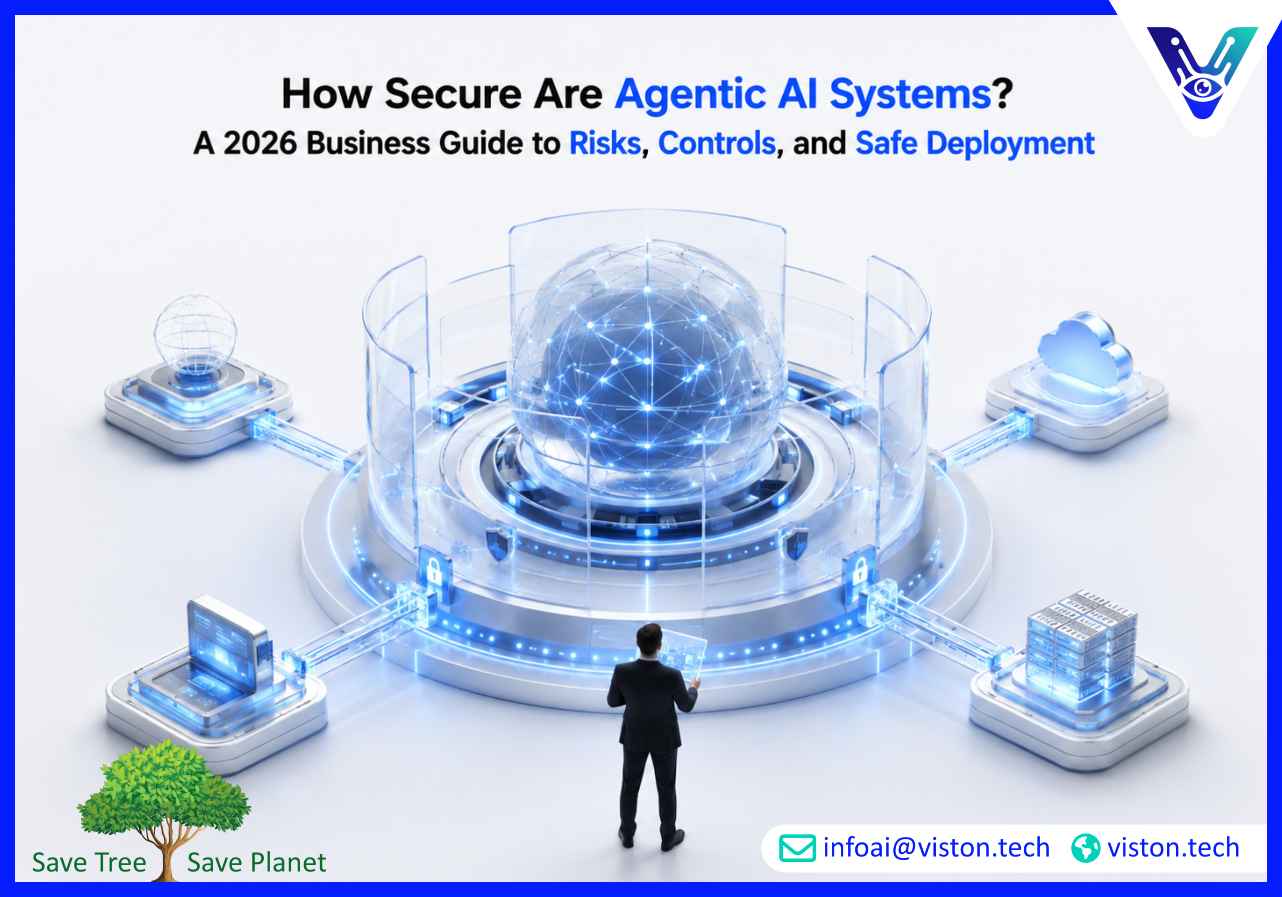
As organizations increasingly adopt autonomous AI technologies, security has become one of the most important considerations in AI implementation. Businesses exploring agentic AI systems want to understand whether these systems can operate safely while handling sensitive data, making decisions, interacting with software, and executing business processes. The answer is that agentic AI systems can be highly secure when designed, deployed, and governed correctly.
Agentic AI systems differ significantly from traditional AI applications. Rather than simply responding to prompts, agentic systems can plan actions, interact with multiple tools, access databases, communicate with APIs, execute workflows, and pursue predefined objectives with varying degrees of autonomy
Because these systems can take actions independently, their security requirements extend beyond standard AI model protection. Organizations must secure not only the underlying AI models but also the workflows, integrations, permissions, data access layers, and decision-making mechanisms that enable autonomous operation.
A modern agentic AI environment typically includes:
Each component introduces potential security considerations that must be addressed through a comprehensive deployment strategy.
In 2026, businesses are deploying AI agents for increasingly critical operations. These systems are helping organizations manage customer support, lead generation, procurement workflows, internal operations, compliance reviews, software development, financial reporting, and enterprise automation.
As the level of autonomy increases, so does the potential impact of security failures.
For example, an AI chatbot that only answers questions presents relatively limited risk. An autonomous AI agent with access to CRM systems, ERP platforms, customer databases, and payment workflows requires far stronger security controls.
Organizations now face challenges such as:
These concerns have pushed security from an optional consideration to a fundamental requirement in agentic AI deployment strategies.
Prompt injection remains one of the most discussed AI security challenges. Attackers may attempt to manipulate an AI agent’s instructions through malicious inputs designed to override its intended behavior.
If not properly protected, an AI agent could potentially reveal information, perform unauthorized actions, or bypass established safeguards.
Modern agentic systems now implement layered instruction hierarchies, input validation mechanisms, contextual filtering, and policy enforcement frameworks to mitigate these risks.
One of the most common implementation mistakes involves granting AI agents broad access across business systems.
When agents have unrestricted permissions, a security incident can affect a much larger portion of the organization’s infrastructure.
Leading organizations follow least-privilege principles, ensuring agents receive only the permissions necessary to complete specific tasks.
Agentic systems often process large amounts of operational, customer, financial, and internal business data.
Without appropriate safeguards, organizations may face risks such as:
Strong encryption, access controls, data masking, and audit logging help reduce these risks significantly.
Most agentic AI systems rely on external tools and APIs.
Every integration introduces a potential attack surface.
Security teams must evaluate:
A secure AI deployment is only as strong as its weakest integration.
Zero trust security models have become increasingly important for AI systems.
Instead of assuming trust, every request, user, application, and AI action is continuously verified before execution.
This approach significantly reduces lateral movement opportunities during potential security incidents.
Every AI agent should operate under clearly defined identities with controlled permissions.
Organizations should implement:
This creates accountability and limits unauthorized activities.
Agentic AI systems should never operate without visibility.
Comprehensive monitoring allows organizations to:
Real-time monitoring has become a standard enterprise requirement in 2026 AI deployments.
Fully autonomous operation is not always appropriate for sensitive business functions.
Many organizations use human-in-the-loop frameworks where critical decisions require approval before execution.
This approach balances automation efficiency with operational control and risk management.
Different industries face different security and compliance requirements when implementing agentic AI systems.
Security frameworks should be adapted to industry-specific requirements rather than applying a one-size-fits-all approach.
For organizations evaluating agentic AI initiatives, security should be embedded into every phase of development and deployment rather than added afterward.
Viston AI specializes in AI Agent Development & Deployment, helping businesses design, implement, and scale intelligent AI agents while maintaining strong governance and operational control.
Secure deployment involves much more than selecting an AI model. It requires careful architecture planning, workflow design, access control management, integration security, monitoring systems, auditability, and risk management processes.
Through structured AI agent development practices, organizations can establish safeguards that align autonomous capabilities with business objectives. This includes defining operational boundaries, implementing approval workflows, managing permissions, monitoring agent actions, and ensuring visibility across AI-driven processes.
Businesses adopting AI agents often need support integrating security requirements into existing enterprise environments. This may include CRM systems, ERP platforms, internal databases, customer service operations, analytics platforms, cloud infrastructure, and third-party software ecosystems.
By focusing on practical deployment strategies, scalable architectures, and responsible automation practices, Viston AI helps organizations build agentic AI systems that are designed to operate securely while supporting business growth, efficiency, and innovation initiatives.
The future of agentic AI depends heavily on trust. Organizations must demonstrate that autonomous systems can operate reliably, securely, transparently, and responsibly.
Key priorities for future-ready AI security include:
Businesses that prioritize these principles are more likely to realize the benefits of AI automation while minimizing operational and security risks.
No. Agentic AI systems are not automatically secure. Their security depends on architecture design, access controls, monitoring, governance, integration security, and deployment practices.
Excessive permissions and poorly governed integrations are among the most significant risks because they can allow unauthorized access to business systems and sensitive data.
Yes. With proper implementation, agentic AI systems can align with enterprise security policies, governance frameworks, audit requirements, and regulatory obligations.
No. Organizations should follow least-privilege principles and grant only the permissions necessary for specific agent tasks.
Human oversight remains critical, especially for sensitive operations involving financial transactions, compliance decisions, customer communications, and strategic business processes.
Viston AI supports organizations through AI Agent Development & Deployment services that focus on structured implementation, workflow governance, integration planning, operational controls, and scalable AI adoption strategies.
How secure agentic AI systems are ultimately depends on how they are designed, governed, and deployed. While these systems introduce new security considerations, they can operate safely when supported by strong access controls, monitoring, governance frameworks, secure integrations, and human oversight. As organizations continue expanding AI adoption in 2026, security must remain a foundational element of every deployment strategy. Businesses investing in AI Agent Development & Deployment should prioritize security from the beginning to maximize the benefits of automation while minimizing operational and compliance risks. Organizations working with experienced specialists such as Viston AI can establish practical, scalable approaches for secure and responsible AI agent implementation.
