
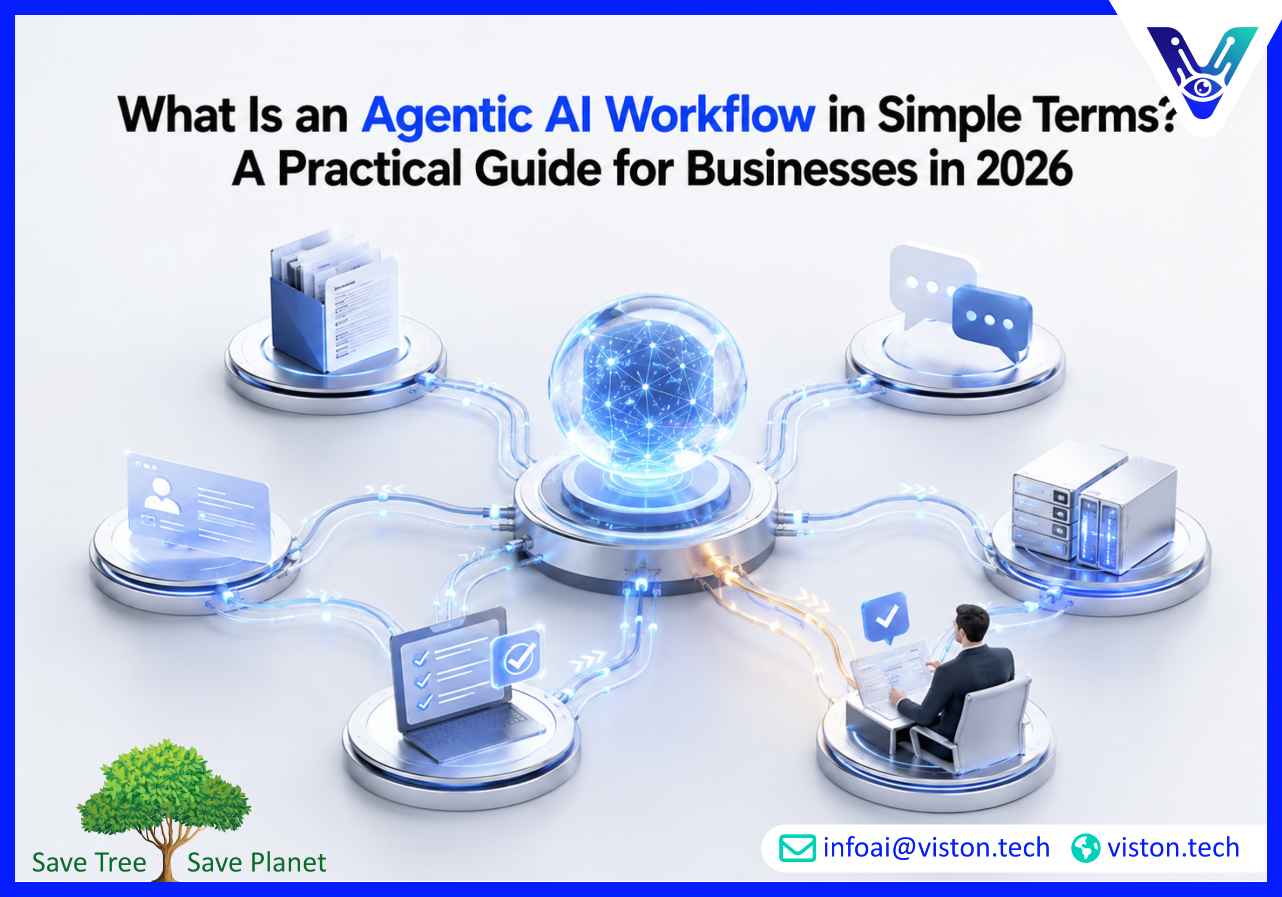
Businesses are increasingly exploring AI beyond simple chatbots and automation tools. One concept gaining attention in 2026 is the agentic AI workflow. In simple terms, an agentic AI workflow allows AI systems to perform tasks, make decisions, use tools, and complete business processes with a higher level of autonomy while still operating within defined rules and objectives.
An agentic AI workflow is a business process where AI agents work toward a goal by taking actions, gathering information, making decisions, and interacting with systems without requiring constant human instructions.
Unlike traditional automation, which follows predefined rules step by step, agentic workflows can adapt to changing situations and determine the best way to complete a task.
A simple example is lead management. Instead of a person manually reviewing leads, an AI agent can:
The workflow operates around a business objective rather than a fixed sequence of commands.
Modern businesses manage increasing amounts of data, customer interactions, operational processes, and digital systems. Manual coordination often slows down productivity and creates bottlenecks.
Agentic AI workflows help organizations automate more complex work by allowing AI agents to handle tasks that involve reasoning, planning, and decision-making.
As organizations move beyond basic automation, agentic workflows provide a more intelligent way to manage complex business operations.
Most agentic workflows follow a structured process, even though the AI has flexibility in how it completes tasks.
The AI agent receives an objective such as qualifying leads, processing invoices, onboarding customers, or answering support requests.
The agent accesses relevant systems, databases, documents, APIs, or business applications to collect the information needed.
The AI evaluates available information and determines the next action based on predefined business rules and workflow objectives.
The agent performs actions such as updating records, sending communications, generating reports, assigning tasks, or retrieving additional information.
Validation mechanisms or additional agents may review outputs to ensure quality and accuracy.
If a situation requires human judgment, compliance approval, or exception handling, the workflow can transfer control to the appropriate person.
This combination of autonomy and oversight is what makes agentic AI workflows particularly useful for business environments.
Agentic AI workflows can support a wide range of business functions across industries.
The most effective use cases involve workflows that require coordination between multiple systems, data sources, and business decisions.
While agentic AI workflows offer significant benefits, successful implementation requires planning and governance.
AI agents can only make good decisions when they have access to accurate and current information.
Businesses must ensure agents operate within appropriate permissions and security policies.
Organizations need clear rules regarding what agents can do independently and when human approval is required.
Most workflows depend on connections with CRMs, ERP systems, databases, communication platforms, and business applications.
A successful deployment balances automation, transparency, accountability, and operational control.
For organizations exploring Agentic AI Workflows, Viston AI focuses on helping businesses design, develop, integrate, and deploy AI-driven workflow solutions that align with operational goals.
Building effective agentic workflows involves more than connecting an AI model to a business process. It requires workflow analysis, agent design, orchestration logic, system integrations, governance controls, testing, and continuous optimization.
Viston AI supports businesses seeking practical implementations that automate complex processes while maintaining visibility, security, and scalability. This approach helps organizations move from isolated AI experiments toward structured workflow automation that delivers measurable operational value.
As businesses increasingly adopt AI across sales, customer service, operations, marketing, and back-office functions, agentic workflows provide a framework for creating intelligent systems that can work alongside teams and business applications effectively.
Traditional automation follows fixed rules, while agentic AI workflows can analyze situations, make decisions, adapt to changing conditions, and determine how best to achieve a goal.
No. Most organizations use agentic workflows to handle repetitive and time-consuming tasks, allowing employees to focus on higher-value work that requires human judgment and creativity.
Yes. Modern agentic workflows are often integrated with CRM platforms, ERP systems, databases, communication tools, analytics platforms, and custom applications.
Yes. Small businesses can use agentic workflows to automate sales, customer support, marketing, operations, and administrative tasks without requiring large teams.
Yes. Viston AI provides services related to Agentic AI Workflows, helping businesses design and deploy workflow automation solutions that connect AI capabilities with practical business operations.
Understanding what an agentic AI workflow is in simple terms starts with recognizing that it is more than automation. It is a system where AI agents can plan, decide, act, and collaborate to achieve business goals with limited human intervention. As organizations seek greater efficiency and scalability in 2026, Agentic AI Workflows are becoming an important part of modern business operations. With the right strategy, governance, and implementation approach, businesses can use these workflows to streamline processes, improve productivity, and create more intelligent operational systems. Viston AI helps organizations explore and implement these capabilities in ways that align with real business needs.
