
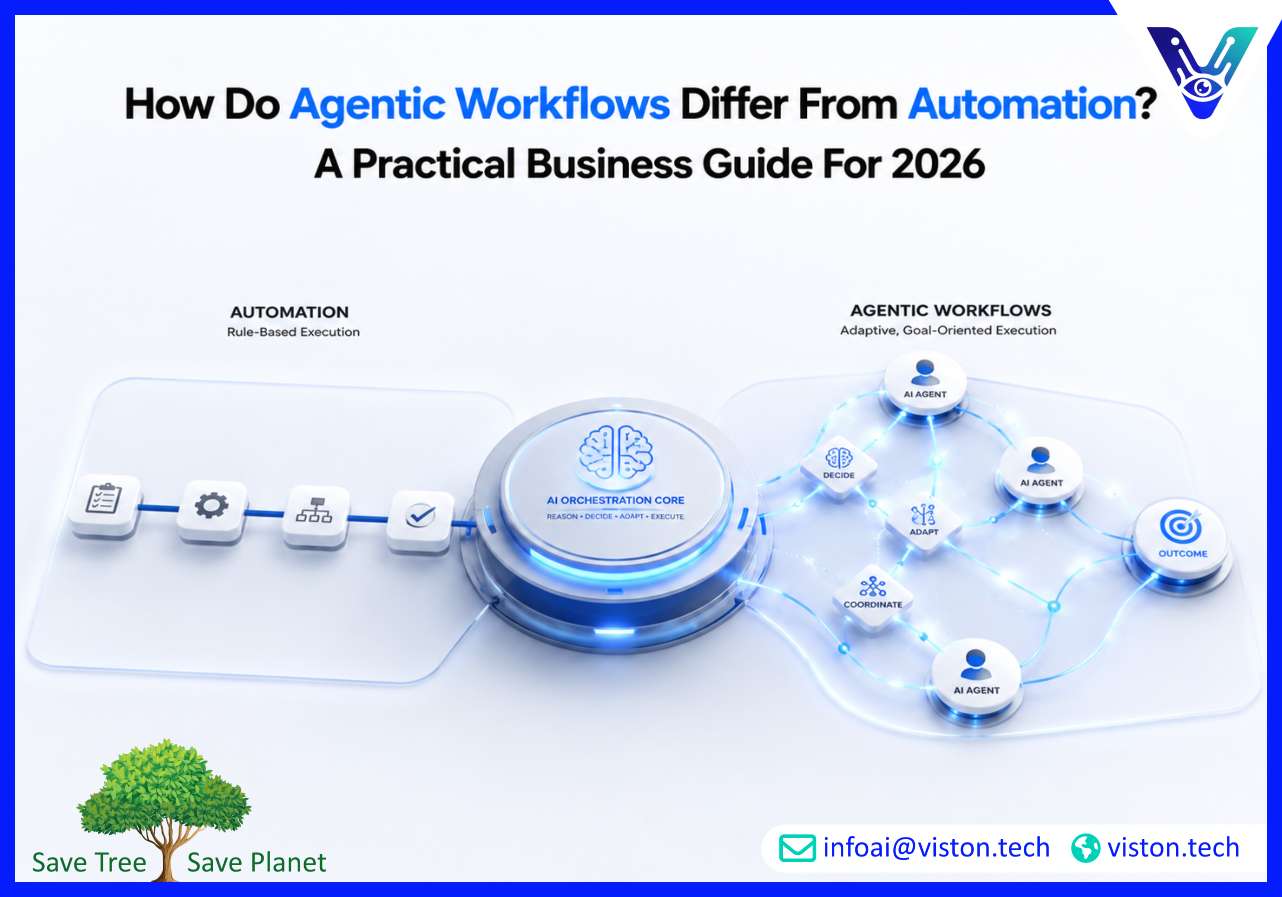
Businesses have used automation for years to streamline repetitive tasks and improve efficiency. However, as AI capabilities evolve, agentic workflows are emerging as a more adaptive and intelligent approach to process execution. Understanding how agentic workflows differ from automation is becoming increasingly important for organizations seeking greater operational flexibility, scalability, and decision-making support in 2026.
Traditional automation is designed to execute predefined tasks based on specific rules and conditions. It follows structured workflows where every action, decision path, and outcome is programmed in advance.
Examples of traditional automation include:
Automation excels when processes are predictable, repetitive, and follow clear decision trees. The system performs exactly what it has been instructed to do and generally cannot adapt when unexpected situations occur.
This approach remains valuable for many operational tasks, but business environments are increasingly complex and often require context-aware decision-making.
Agentic workflows use AI agents that can reason, plan, execute tasks, interact with tools, retrieve information, and adapt their actions based on changing circumstances.
Unlike traditional automation, agentic workflows are not limited to rigid rule-based sequences. AI agents can evaluate objectives, determine the best course of action, collaborate with other agents, and dynamically respond to new information.
An agentic workflow may involve multiple specialized agents working together to achieve a business goal. Each agent can have a specific responsibility such as research, validation, customer communication, data analysis, decision support, reporting, or workflow orchestration.
The focus shifts from automating individual tasks to enabling coordinated digital work that can handle more complex business processes.
Traditional automation follows predefined rules. If a situation falls outside those rules, the process typically stops or requires human intervention.
Agentic workflows can evaluate context, analyze available information, and make task-level decisions within defined boundaries. This allows them to handle more variability and complexity.
For example, an automated support workflow may route tickets based on keywords. An agentic workflow can understand the customer’s issue, retrieve relevant information, determine urgency, and recommend the next action.
Automation performs best when workflows remain stable and predictable.
Agentic systems are designed to adapt. They can respond to changing inputs, incomplete data, evolving requirements, and unexpected scenarios without requiring every possible path to be hardcoded.
This adaptability is particularly valuable in environments where business processes frequently change.
Traditional automation focuses on completing predefined steps.
Agentic workflows focus on achieving an outcome.
Instead of following a fixed sequence, AI agents can determine how to reach a desired objective while respecting business rules, governance requirements, and operational constraints.
Both approaches can integrate with software systems, but agentic workflows often coordinate actions across multiple platforms simultaneously.
AI agents may access:
They can combine information from these sources to support decision-making and workflow execution.
Exception handling is one of the biggest distinctions.
Traditional automation often struggles when inputs fall outside expected parameters.
Agentic workflows can analyze unusual situations, request additional information, escalate when necessary, and continue operating within defined limits.
This reduces the number of manual interventions required for complex processes.
Not every process requires agentic AI. Organizations should evaluate workflow complexity, business impact, and decision-making requirements before choosing an approach.
These activities benefit from speed, consistency, and low implementation complexity.
These workflows involve context, judgment, multiple data sources, and dynamic decision-making.
As organizations seek greater efficiency and scalability, agentic workflows offer advantages that extend beyond traditional automation.
Businesses can automate processes that previously required constant human oversight due to complexity or variability.
AI agents can gather information, evaluate options, and provide recommendations more quickly than manual workflows.
Teams spend less time managing routine coordination and more time focusing on strategic work.
Agentic workflows can deliver faster responses, more personalized interactions, and improved service quality.
Organizations can support growing workloads without proportionally increasing headcount.
However, successful implementation still requires governance, monitoring, security controls, and human oversight where appropriate.
For businesses exploring Agentic AI Workflows, implementation requires more than deploying AI models. Organizations need workflow analysis, process design, orchestration logic, system integrations, governance frameworks, and ongoing optimization.
Viston AI specializes in Agentic AI Workflows that help organizations move beyond basic automation and build intelligent, goal-driven business processes. Its approach focuses on designing workflows where AI agents can collaborate, access business systems, execute tasks, and support operational outcomes while maintaining visibility and control.
Businesses evaluating agentic workflows often face challenges around workflow design, integration complexity, security, scalability, and performance measurement. Viston AI helps address these challenges by aligning agentic systems with practical business objectives rather than treating AI as a standalone technology initiative.
Whether supporting sales operations, customer service, internal processes, knowledge management, or workflow transformation initiatives, agentic AI workflows can create more adaptive and efficient operating models for modern organizations.
Traditional automation follows predefined rules and steps, while agentic workflows use AI agents that can reason, adapt, make decisions, and pursue goals within defined business constraints.
No. Traditional automation remains highly effective for predictable, rule-based tasks. Agentic workflows are most valuable for processes that involve complexity, context, and dynamic decision-making.
They can require greater initial investment due to workflow design, integrations, governance, and AI infrastructure. However, they may generate greater value for complex business processes.
In many cases, yes. Human-in-the-loop controls are often necessary for high-risk decisions, compliance-sensitive processes, financial approvals, and customer-facing actions.
Industries with complex workflows, large data volumes, customer interactions, and cross-functional processes often benefit significantly, including finance, healthcare, technology, logistics, retail, and professional services.
Yes. Viston AI provides Agentic AI Workflow services that support workflow design, AI agent development, orchestration, integrations, deployment, and optimization for business operations.
Understanding how agentic workflows differ from automation is essential for organizations evaluating the future of business process transformation. While traditional automation remains highly effective for structured and repetitive tasks, agentic AI workflows introduce adaptability, contextual decision-making, and goal-oriented execution. As businesses increasingly seek scalable and intelligent operational models in 2026, agentic workflows provide new opportunities to automate complex processes that were previously difficult to manage through rule-based systems alone. For organizations exploring Agentic AI Workflows, Viston AI offers specialized expertise in designing and implementing practical, business-focused agentic solutions.
