
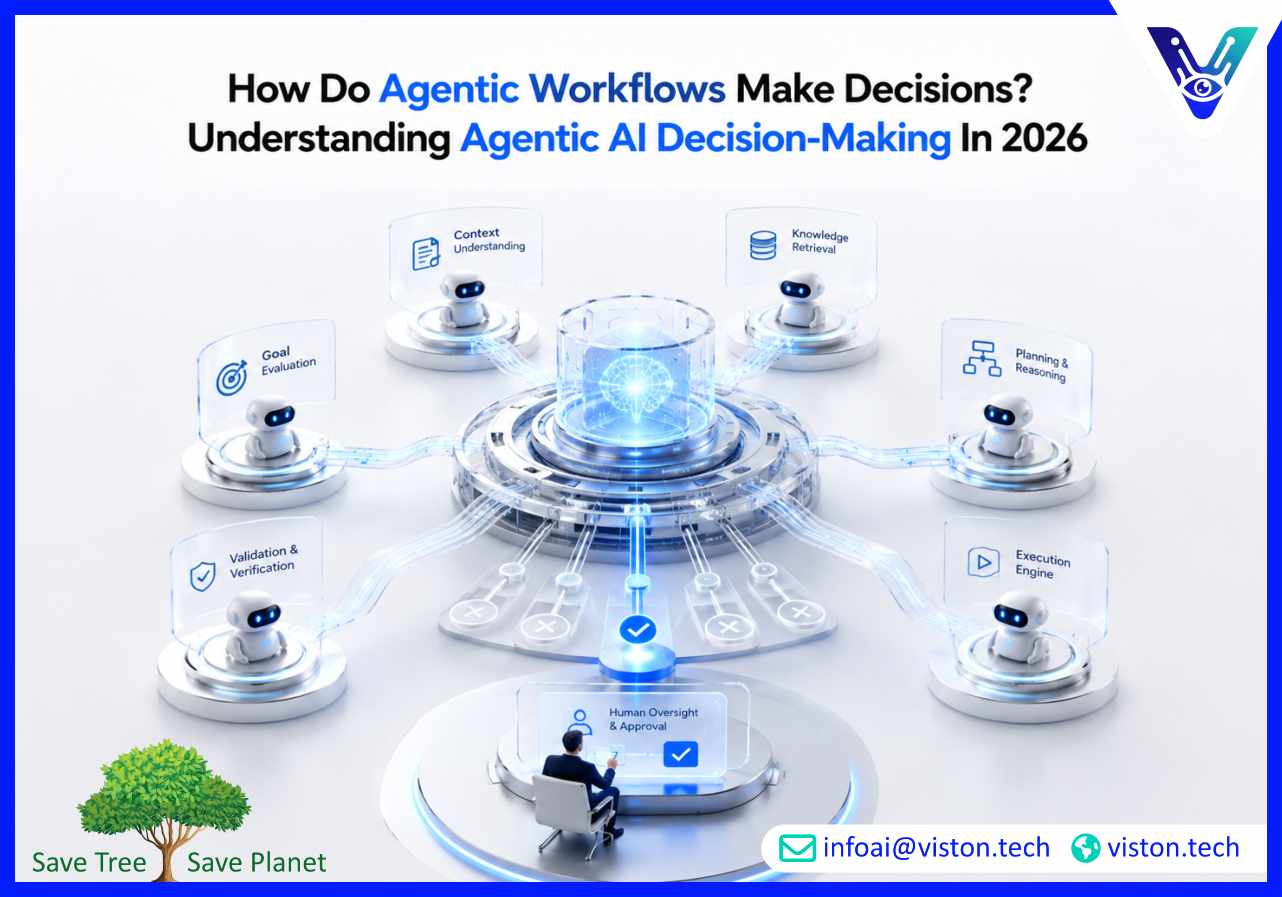
Businesses are rapidly moving beyond traditional automation and exploring systems that can reason, plan, execute tasks, and adapt to changing situations. This shift has brought significant attention to agentic AI workflows. As organizations evaluate the potential of AI-powered operations, one of the most important questions is: how do agentic workflows make decisions?
Unlike conventional automation tools that follow predefined rules, agentic workflows are designed to analyze information, evaluate options, select actions, and continuously adjust their behavior based on goals, context, and outcomes. This ability allows organizations to automate more complex processes while maintaining operational control.
In 2026, agentic workflows are becoming a strategic capability for businesses seeking greater efficiency, scalability, and intelligent process automation. Understanding how these workflows make decisions helps organizations implement them effectively while managing risks and maintaining governance.
An agentic workflow is a business process powered by AI agents that can independently perform tasks, make decisions within defined boundaries, interact with systems, retrieve information, and collaborate with other agents or humans to achieve specific objectives.
Unlike standard workflow automation, where every step is explicitly programmed, agentic workflows introduce a level of controlled autonomy. The AI agent is given goals, instructions, tools, access permissions, and decision-making frameworks that allow it to determine the best course of action during execution.
These workflows often combine:
The result is a workflow that can adapt to situations rather than simply following static instructions.
Agentic workflows make decisions by combining information gathering, reasoning, objective evaluation, business rules, contextual understanding, and action selection. Instead of relying solely on fixed decision trees, they use a structured decision-making process designed to achieve predefined goals.
Every agentic workflow begins with a goal.
The goal acts as the primary decision-making framework that guides the agent’s behavior. Rather than receiving detailed instructions for every possible scenario, the agent receives a desired outcome.
Examples include:
The objective provides direction while allowing flexibility in execution.
When a workflow starts, the agent first determines:
This foundational understanding drives every subsequent decision.
Before making decisions, agentic workflows gather information from available sources.
Modern agents can access:
The quality of decisions depends heavily on the quality of information available to the workflow.
For example, if a customer support agent receives a complaint, it may retrieve:
This retrieval process gives the agent the context required to make informed decisions.
Traditional automation treats every situation similarly. Agentic workflows evaluate context before choosing actions.
Context evaluation includes:
For instance, two support tickets may contain similar questions, but the workflow may respond differently depending on customer tier, contract level, urgency, compliance requirements, or previous interactions.
Context enables more intelligent and personalized decisions.
One of the defining characteristics of agentic workflows is their ability to reason through multiple potential actions.
Rather than immediately executing the first available option, the agent evaluates alternatives.
This reasoning process often includes:
For example, if an invoice contains missing information, an agent may consider:
The workflow selects the option that best aligns with business objectives and operational rules.
Although agentic workflows have autonomy, they do not operate without controls.
Business rules remain critical to decision-making.
Organizations define:
These rules create guardrails that guide agent behavior.
For example:
The workflow can make decisions independently while remaining aligned with organizational policies.
Many modern agentic workflows use multiple specialized agents rather than a single AI system.
This approach improves decision quality by distributing responsibilities.
Common agent roles include:
Each agent contributes expertise to the overall workflow.
For example, a sales workflow may involve:
This collaborative model often produces better decisions than relying on a single general-purpose agent.
Decision-making improves significantly when workflows can remember relevant information.
Memory allows agents to:
In practical business environments, memory is often connected to enterprise systems rather than relying solely on model memory.
Customer records, workflow histories, transaction logs, and knowledge repositories provide persistent context that supports better decisions.
As workflows accumulate operational data, organizations can also refine decision strategies and improve performance over time.
Despite increasing autonomy, most businesses do not want AI making every decision independently.
Human oversight remains an essential component of responsible agentic workflows.
Organizations typically define situations where human approval is required.
Examples include:
This approach is often called human-in-the-loop decision-making.
Rather than replacing human judgment, agentic workflows support decision-makers by gathering information, presenting recommendations, and automating routine actions.
The final authority remains with qualified personnel when appropriate.
Agentic workflows are increasingly being deployed across multiple business functions.
In each scenario, decision-making is driven by a combination of objectives, context, rules, data, and oversight.
As businesses explore Agentic AI Workflows, successful implementation requires more than selecting an AI model. Organizations need workflow design, orchestration architecture, system integration, governance frameworks, security controls, monitoring capabilities, and operational alignment.
Viston AI focuses on Agentic AI Workflows that help businesses move from isolated automation toward coordinated AI-driven operations. This includes designing agent roles, building workflow orchestration systems, integrating business applications, implementing approval mechanisms, and ensuring workflows operate within defined business constraints.
For organizations seeking scalable AI adoption, the ability to create reliable decision-making systems is often the difference between experimental AI projects and production-ready business automation. By combining workflow strategy, automation expertise, and agent orchestration capabilities, Viston AI supports businesses looking to implement agentic systems that deliver measurable operational value.
Yes, agentic workflows can make decisions independently within predefined rules, permissions, and operational boundaries established by the organization.
They use data from business systems, documents, databases, knowledge repositories, customer records, workflow histories, policies, and external tools connected to the workflow.
Yes. Traditional automation follows fixed instructions, while agentic workflows can evaluate context, reason through options, adapt to changing situations, and determine appropriate actions.
Absolutely. Organizations define permissions, policies, approval requirements, escalation rules, and governance frameworks that control how agents make decisions.
Multiple specialized agents can focus on different responsibilities, improving accuracy, validation, collaboration, and overall workflow performance.
Yes. Viston AI provides Agentic AI Workflow expertise focused on workflow design, AI agent development, orchestration, integration, governance, and scalable business automation.
Understanding how agentic workflows make decisions is essential for businesses evaluating next-generation automation strategies in 2026. These workflows combine objectives, contextual understanding, reasoning, business rules, system integrations, memory, and human oversight to execute tasks intelligently and efficiently. Unlike traditional automation, agentic workflows can adapt to changing conditions while remaining aligned with organizational goals and governance requirements. As businesses seek greater operational efficiency and scalable automation, Agentic AI Workflows provide a practical framework for intelligent decision-making across sales, operations, support, finance, and enterprise processes. Organizations working with specialists such as Viston AI can build structured, reliable, and business-focused agentic systems capable of delivering meaningful operational outcomes.
