
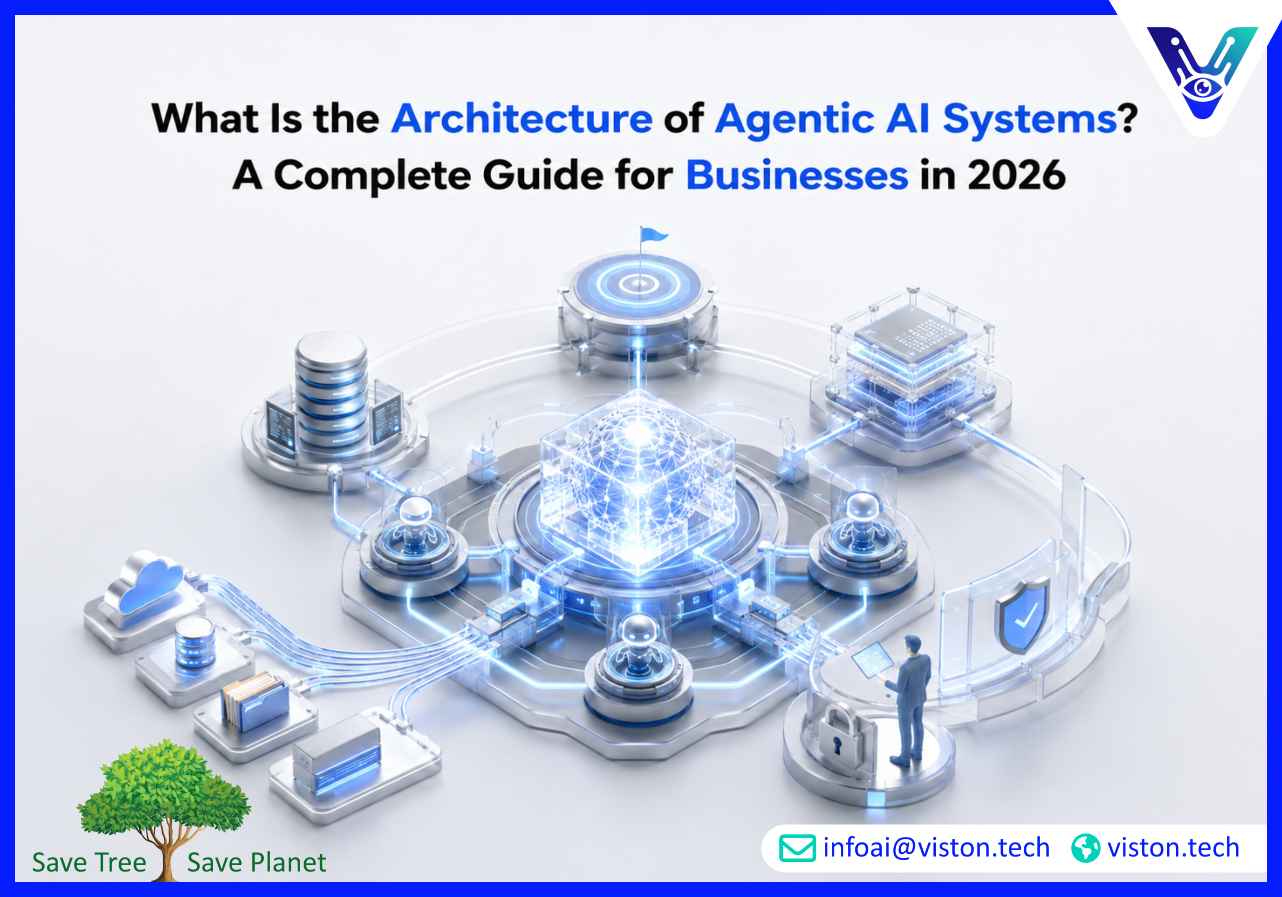
As organizations move beyond simple AI assistants and automation tools, agentic AI systems are becoming a major focus of digital transformation initiatives. These systems are designed to operate with greater autonomy, make decisions, coordinate actions, and pursue defined objectives with minimal human intervention. Understanding the architecture of agentic AI systems is essential for businesses evaluating advanced AI workflow automation, intelligent operations, and scalable AI-driven decision-making.
The architecture of an agentic AI system refers to the collection of components, frameworks, workflows, and decision-making mechanisms that allow an AI agent to perceive information, reason about tasks, make decisions, execute actions, and continuously improve outcomes.
Unlike traditional AI applications that respond to individual prompts, agentic AI systems are designed to operate as goal-oriented entities. They can analyze objectives, create plans, interact with external systems, evaluate results, and adapt their behavior based on changing conditions.
A modern agentic architecture typically combines large language models, reasoning engines, memory layers, orchestration frameworks, data integrations, and monitoring systems into a coordinated ecosystem.
The objective is not simply to generate responses but to achieve business outcomes through intelligent action.
Every agentic AI system begins with a goal or objective. This layer defines what the agent is attempting to accomplish.
Examples include:
The goal management layer translates business objectives into actionable tasks that agents can understand and execute.
The reasoning engine is often considered the brain of an agentic system.
Its responsibilities include:
Advanced planning systems can create multi-step execution strategies that adapt as new information becomes available.
This capability distinguishes agentic systems from traditional workflow automation platforms.
Memory enables agents to maintain context across interactions and workflows.
Without memory, an AI agent would effectively start from scratch every time a task is initiated.
Modern agentic architectures commonly use multiple memory types:
Memory allows agents to learn from previous experiences and make more informed decisions over time.
Large language models (LLMs) often serve as the cognitive foundation of agentic systems.
These models provide capabilities such as:
However, modern agentic systems rarely rely solely on LLMs. Instead, they combine language models with structured business logic, planning frameworks, and external tools.
An agentic AI system continuously receives information from multiple sources.
These may include:
The architecture must support secure and reliable access to these information sources.
After data is collected, the system creates contextual understanding.
This stage often involves:
Context building ensures the agent operates with accurate and relevant information.
Once context is established, the reasoning engine evaluates available options.
The decision-making process may include:
Advanced systems continuously reassess decisions as new information becomes available.
Many organizations are moving toward multi-agent architectures rather than relying on a single AI agent.
In this approach, specialized agents collaborate to accomplish complex objectives.
The coordinator agent manages workflow orchestration and task delegation.
Responsibilities often include:
Specialized agents focus on particular business functions.
Examples include:
Each agent can be optimized for specific responsibilities while contributing to broader organizational goals.
A communication framework enables agents to exchange information efficiently.
This layer supports:
Effective communication is essential for scalable multi-agent environments.
As agentic systems become more autonomous, governance becomes increasingly important.
Modern architectures include dedicated control mechanisms to ensure safe and compliant operation.
Agent permissions determine which systems and resources can be accessed.
Controls may include:
Organizations must ensure AI activities comply with regulatory and internal policies.
Compliance components often monitor:
Many enterprise deployments maintain human supervision over critical decisions.
This architectural layer enables:
This balance between automation and oversight helps organizations reduce operational risk.
Agentic AI workflows are only as effective as the architecture supporting them.
Without proper planning, memory management, integrations, monitoring, and governance, even powerful AI models struggle to deliver consistent business outcomes.
A well-designed architecture enables:
Businesses increasingly recognize that successful AI initiatives require robust architectural foundations rather than simply deploying large language models.
As organizations explore advanced AI automation, architectural design becomes one of the most important factors influencing long-term success. Viston AI specializes in Agentic AI Workflows that help businesses move beyond isolated AI implementations toward structured, scalable, and business-focused automation systems.
Rather than focusing solely on model deployment, Viston AI helps organizations design end-to-end agentic architectures that integrate data sources, business applications, workflow orchestration frameworks, decision engines, and governance controls. This enables companies to automate complex operational processes while maintaining visibility, security, and accountability.
For businesses implementing intelligent automation initiatives, agentic workflow development often requires expertise across system integration, AI orchestration, process optimization, and enterprise infrastructure. Viston AI supports organizations in building architectures that align with operational objectives while ensuring scalability and reliability.
Whether the goal involves customer operations, internal workflows, knowledge management, analytics, or multi-agent coordination, a structured architectural approach helps transform AI experimentation into measurable business outcomes.
The purpose is to provide a structured framework that enables AI agents to understand goals, make decisions, execute actions, access data, and continuously optimize outcomes.
Traditional AI typically responds to individual prompts or predefined rules. Agentic AI systems can plan, reason, take actions, coordinate workflows, and pursue objectives with greater autonomy.
Memory allows agents to retain context, learn from previous interactions, access historical information, and improve decision-making across extended workflows.
A multi-agent architecture uses multiple specialized AI agents that collaborate to complete tasks. Each agent handles specific responsibilities while coordinating with others through an orchestration framework.
They can be when built with proper governance, access controls, monitoring, compliance frameworks, audit trails, and human oversight mechanisms.
Viston AI helps organizations design, integrate, orchestrate, and optimize agentic AI workflows that align with business objectives while supporting scalability, governance, and operational efficiency.
The architecture of agentic AI systems forms the foundation for autonomous, goal-driven AI operations. By combining reasoning engines, memory layers, orchestration frameworks, data integrations, governance controls, and intelligent agents, organizations can create systems capable of managing increasingly complex business processes. As Agentic AI Workflows continue to evolve throughout 2026, businesses that invest in strong architectural design will be better positioned to achieve scalable automation, improved decision-making, and sustainable operational efficiency. For organizations evaluating advanced AI initiatives, understanding architecture is the first step toward successful implementation.
