
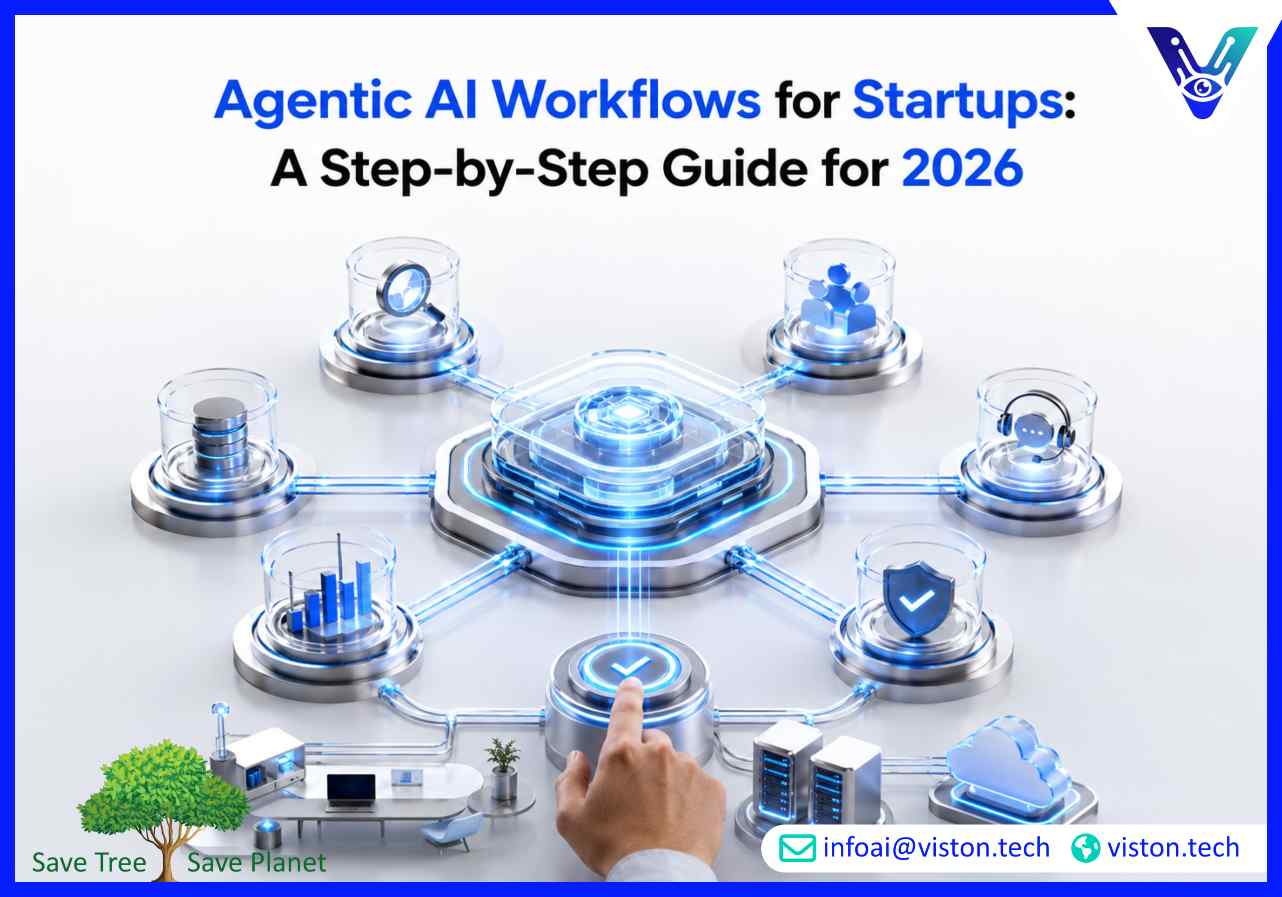
Startups are under constant pressure to scale quickly while operating with limited resources. In 2026, agentic AI workflows are helping startups automate complex business processes, improve operational efficiency, and accelerate growth without significantly increasing headcount. Understanding how to design and implement these workflows can provide a competitive advantage from the earliest stages of business development.
Agentic AI workflows are structured business processes powered by AI agents that can perform tasks, make decisions, access tools, retrieve information, and coordinate actions across systems with varying levels of autonomy.
Unlike traditional automation, which follows predefined rules, agentic workflows can adapt to context, analyze information, and execute multi-step processes while maintaining business objectives.
For startups, this creates opportunities to automate operational activities that would normally require multiple team members. Areas such as lead qualification, customer support, onboarding, reporting, content operations, sales administration, and internal knowledge management can benefit significantly from agentic systems.
As startup teams remain lean, agentic AI workflows help maximize productivity by reducing repetitive work and allowing employees to focus on strategic initiatives.
AI agents can handle repetitive and time-consuming activities, allowing startup teams to focus on product development, customer acquisition, and growth initiatives.
As startups grow, workflows often become more complex. Agentic AI systems can scale alongside business operations without requiring proportional increases in staffing.
Agents can gather information, analyze data, generate recommendations, and trigger actions much faster than manual workflows.
AI-powered workflows can improve response times, onboarding experiences, customer support interactions, and communication consistency.
Tasks such as CRM updates, reporting, scheduling, data entry, document processing, and internal coordination can be partially or fully automated.
For startups aiming to achieve more with fewer resources, agentic workflows can become a practical extension of the existing team.
The first step is selecting workflows that offer meaningful business value. Startups should focus on processes that are repetitive, time-consuming, and operationally important.
Examples include:
Starting with one workflow helps reduce implementation complexity and allows teams to measure results more effectively.
Before introducing AI agents, startups should document how the process currently operates.
This includes:
Understanding the existing workflow makes it easier to identify automation opportunities and define agent responsibilities.
Successful agentic workflows rely on specialization.
Instead of assigning every task to a single AI agent, startups should create focused agents with specific responsibilities.
Examples include:
Specialized agents are easier to manage, test, monitor, and optimize over time.
Orchestration determines how agents interact and collaborate.
A workflow should clearly define:
This orchestration layer ensures agents work together as a coordinated system rather than acting independently.
Agentic workflows become valuable when connected to business systems.
Common startup integrations include:
These integrations allow agents to access information, update records, and execute business actions automatically.
Even highly capable AI agents should operate within clear boundaries.
Startups should define situations that require human review, including:
Human-in-the-loop controls improve trust, accuracy, and operational reliability.
Before deploying workflows across the business, startups should conduct extensive testing.
Important evaluation areas include:
Continuous optimization ensures workflows remain aligned with business objectives as the company grows.
AI agents can research prospects, enrich lead data, score opportunities, schedule meetings, and update CRM records automatically.
Support workflows can classify tickets, retrieve relevant knowledge, generate responses, and escalate complex issues to human agents.
Marketing teams can automate content research, campaign reporting, audience segmentation, competitor monitoring, and performance analysis.
AI agents can collect, categorize, summarize, and prioritize customer feedback from multiple channels.
Administrative workflows such as onboarding, documentation management, reporting, and information retrieval can be streamlined through agentic automation.
The most successful startup implementations focus on practical workflows that deliver measurable business outcomes rather than experimental AI deployments.
While agentic AI workflows offer significant benefits, startups should approach implementation strategically.
Starting small and expanding gradually often produces better results than attempting large-scale automation initiatives from the outset.
For startups exploring agentic AI workflows, implementation success depends on more than selecting AI models. Effective deployment requires workflow analysis, agent design, orchestration planning, system integration, governance, testing, and ongoing optimization.
Viston AI specializes in Agentic AI Workflows that help businesses move beyond isolated automation toward coordinated AI-driven operations. By focusing on practical workflow execution, Viston AI supports startups in identifying high-value automation opportunities, designing specialized AI agents, integrating business systems, and building scalable workflow architectures.
Startups often face resource constraints, making efficiency and scalability critical priorities. Agentic AI workflows can help reduce operational overhead, accelerate decision-making, improve customer experiences, and support growth without adding unnecessary complexity.
Through a structured approach to workflow automation, orchestration, and AI integration, Viston AI helps organizations create systems that align with real business objectives while maintaining flexibility for future expansion.
Agentic AI workflows are business processes powered by AI agents that can perform tasks, access systems, make decisions, coordinate actions, and complete multi-step workflows with varying levels of autonomy.
They help startups automate repetitive processes, improve efficiency, scale operations, reduce manual workload, and maximize productivity without significantly increasing headcount.
Traditional automation follows predefined rules, while agentic AI workflows can adapt to context, collaborate across systems, make decisions, and manage more complex business processes.
Sales, customer support, marketing, operations, product management, and administrative functions often achieve significant benefits through workflow automation and AI agent coordination.
Implementation timelines depend on workflow complexity, integrations, governance requirements, and business objectives. Many startups begin with a pilot workflow before expanding adoption.
Yes. Viston AI provides Agentic AI Workflow services that help startups design, integrate, orchestrate, and optimize AI-powered workflows aligned with operational and growth objectives.
Agentic AI workflows are becoming an important growth enabler for startups in 2026. By combining specialized AI agents, workflow orchestration, business system integrations, and human oversight, startups can automate complex processes while maintaining control and operational quality. Organizations that approach implementation strategically can improve efficiency, scalability, and customer experiences without significantly increasing operational costs. For startups seeking practical AI adoption, Agentic AI Workflows provide a structured path toward sustainable automation, and Viston AI offers specialized expertise to support successful implementation and long-term business value.
