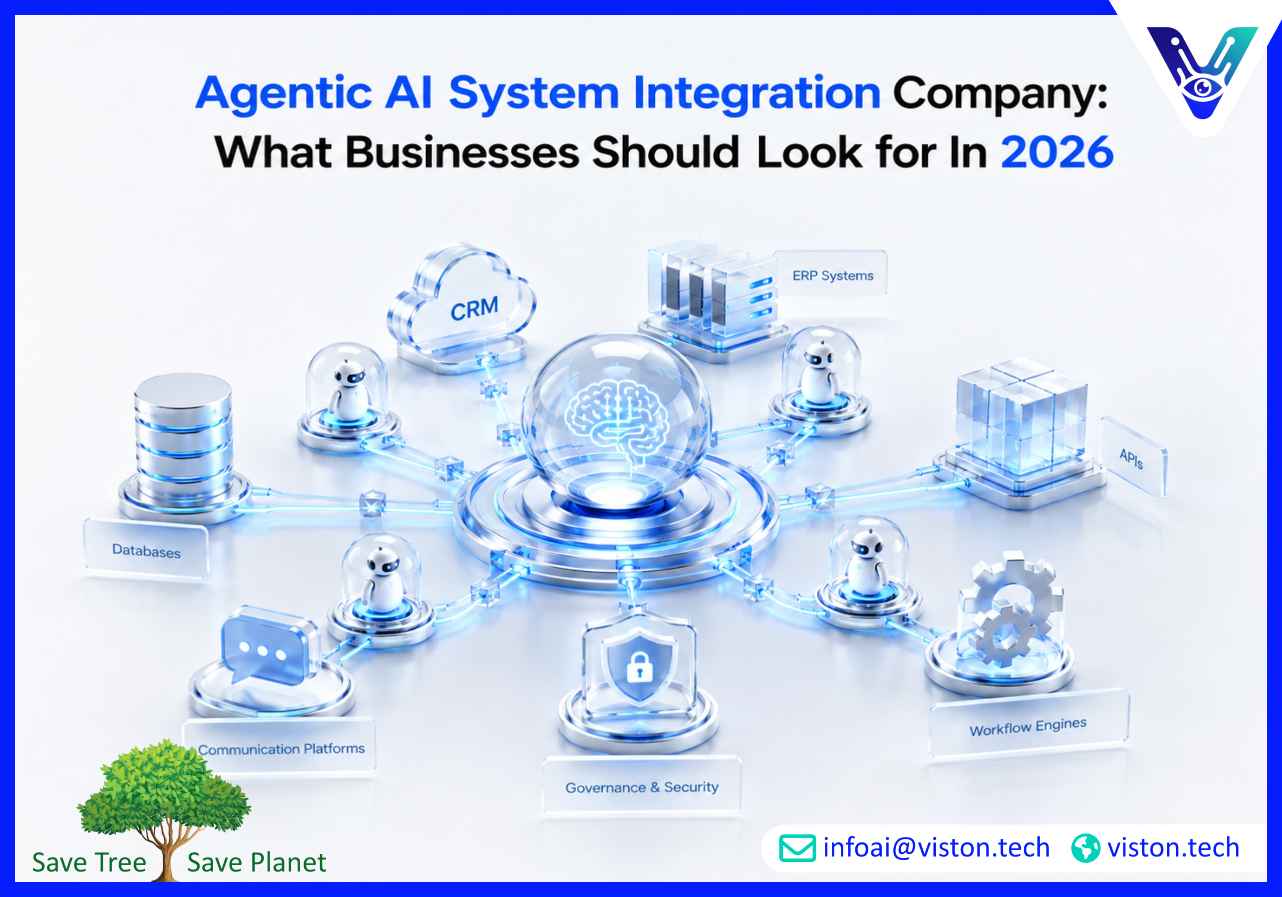
Agentic AI System Integration Company: What Businesses Should Look for in 2026
As organizations move from experimenting with AI tools to deploying AI across business operations, the demand for an experienced agentic AI system integration company continues to grow. Businesses need more than standalone AI applications—they need connected, intelligent systems that work seamlessly across platforms, workflows, data sources, and teams to deliver measurable operational outcomes.
What Does an Agentic AI System Integration Company Do?
An agentic AI system integration company helps organizations connect AI agents with existing business systems, applications, workflows, and data environments. Unlike traditional software integrations, agentic AI integration focuses on enabling AI agents to perform tasks, collaborate with other agents, access information, make workflow decisions, and execute actions within defined business processes.These integrations often involve connecting AI systems with:
Customer Relationship Management (CRM) platforms
Enterprise Resource Planning (ERP) systems
Knowledge management platforms
Customer support tools
Data warehouses and databases
Communication systems
Business intelligence platforms
Custom enterprise applications
Third-party APIs and services
The goal is to transform AI from an isolated assistant into an operational capability that supports real business activities.In 2026, organizations increasingly require AI agents that can work across multiple systems while maintaining governance, security, transparency, and business alignment.
Why Agentic AI System Integration Matters in 2026
Many businesses have already adopted AI tools, but disconnected AI deployments often create limited value. Teams may use AI for content generation, research, or basic automation, yet operational bottlenecks remain because systems are not connected.Agentic AI integration addresses this challenge by creating workflows where AI agents can interact with enterprise systems, retrieve information, perform actions, and coordinate tasks.
Key Business Drivers
Reducing repetitive manual work
Improving operational efficiency
Accelerating response times
Enhancing customer experiences
Improving data accessibility
Supporting scalable automation initiatives
Enabling cross-platform workflow orchestration
Increasing visibility into business processes
Organizations are increasingly focusing on practical AI adoption that improves operational performance rather than implementing AI for its own sake.
Key Capabilities of a Reliable Agent Integration Services Provider
Not every integration partner is equipped to handle agentic AI deployments. Successful implementations require expertise across AI technologies, system architecture, workflow design, security, governance, and enterprise integration.
AI Agent Architecture Design
Effective integration begins with defining how agents operate, what responsibilities they own, how they communicate, and when human intervention is required. Well-designed architectures reduce complexity and improve reliability.
Workflow Orchestration
Agentic systems rarely operate independently. Multiple agents often need to collaborate across workflows involving approvals, exceptions, validations, and business rules. Orchestration frameworks help coordinate these interactions efficiently.
System and API Integration
Enterprise environments contain numerous applications and data sources. A capable integration provider ensures AI agents can securely access and interact with required systems without disrupting existing operations.
Security and Governance
As AI agents gain access to business systems, governance becomes essential. Organizations require permission controls, audit logging, monitoring, compliance safeguards, and approval workflows to maintain trust and accountability.
Scalability Planning
Many AI initiatives begin with a single workflow before expanding across departments. Integration architectures should support future growth without requiring complete redesigns.A strong integration strategy considers both immediate business needs and long-term operational scalability.
How Businesses Can Evaluate an Agentic AI System Integration Company
Selecting an integration partner requires more than reviewing technical capabilities. Organizations should evaluate whether a provider can support business objectives, operational requirements, and long-term AI adoption goals.
Business Process Understanding
Technology expertise alone is insufficient. Effective integration partners understand workflows, operational dependencies, stakeholder requirements, and performance objectives.
Integration Experience
Providers should demonstrate experience connecting AI systems with enterprise software, APIs, databases, cloud environments, and workflow platforms.
Governance Approach
Responsible AI deployment requires oversight mechanisms. Businesses should evaluate how providers address security, compliance, auditing, monitoring, and risk management.
Implementation Methodology
Successful projects typically follow structured phases including discovery, assessment, architecture design, integration development, testing, deployment, and optimization.
Support and Optimization
Agentic AI systems require ongoing refinement. Providers should offer monitoring, performance evaluation, workflow optimization, and support services to ensure continued effectiveness.The most successful partnerships focus on business outcomes rather than simply delivering technical integrations.
Common Use Cases for Agentic AI System Integration
Organizations across industries are using agentic AI integrations to improve efficiency and automate complex business processes.
Sales Operations
Lead qualification workflows
CRM automation
Prospect research
Pipeline management support
Sales reporting automation
Customer Support
Ticket routing and prioritization
Knowledge retrieval
Response generation
Escalation management
Customer communication workflows
Operations Management
Process automation
Task coordination
Workflow monitoring
Exception handling
Operational reporting
Finance and Administration
Invoice processing
Approval routing
Data reconciliation
Compliance checks
Document management
As agentic AI capabilities mature, integration opportunities continue expanding across departments and business functions.
Why Businesses Choose Viston AI for Agent Integration Services
For organizations seeking an agentic AI system integration company, Viston AI provides Agent Integration Services designed to connect AI agents with real business workflows, systems, and operational objectives.Building effective agentic systems requires more than deploying AI models. Businesses need structured integration strategies that connect agents with enterprise applications, APIs, databases, communication platforms, and workflow environments. Viston AI focuses on helping organizations bridge this gap through practical implementation approaches aligned with operational requirements.Its Agent Integration Services support businesses looking to automate workflows, improve process efficiency, enhance data accessibility, and create coordinated AI-driven operations. This includes integration planning, workflow orchestration, system connectivity, governance considerations, testing, and deployment support.By focusing on business outcomes rather than isolated AI functionality, Viston AI helps organizations develop scalable agentic environments capable of supporting long-term automation initiatives. As enterprise AI adoption continues accelerating in 2026, structured integration remains one of the most important factors influencing successful deployment.
Frequently Asked Questions
What is an agentic AI system integration company?
An agentic AI system integration company helps businesses connect AI agents with enterprise systems, workflows, data sources, and applications so agents can perform useful operational tasks within business processes.
How is agentic AI integration different from traditional software integration?
Traditional integration connects systems and applications. Agentic AI integration enables AI agents to access information, make decisions within defined boundaries, execute actions, and coordinate workflows across connected systems.
Why do businesses need Agent Integration Services?
Agent Integration Services help organizations move beyond isolated AI tools by embedding AI capabilities directly into business operations, improving efficiency, automation, and scalability.
What systems can AI agents integrate with?
AI agents can integrate with CRM platforms, ERP systems, databases, document repositories, customer support tools, communication platforms, analytics environments, and APIs.
How important is governance in agentic AI integration?
Governance is critical. Organizations need monitoring, access controls, audit trails, compliance safeguards, approval workflows, and risk management mechanisms to ensure responsible AI deployment.
Can Viston AI help implement agentic AI integrations?
Yes. Viston AI provides Agent Integration Services focused on connecting AI agents with enterprise workflows, business systems, and operational processes to support practical AI adoption initiatives.
Conclusion
Choosing the right agentic AI system integration company can significantly influence the success of an organization’s AI initiatives. Effective integration ensures AI agents work within existing business environments, support operational goals, and deliver measurable value rather than functioning as disconnected tools. As businesses increasingly adopt AI-driven workflows in 2026, Agent Integration Services play a vital role in creating secure, scalable, and business-focused implementations. For organizations looking to build connected AI ecosystems, Viston AI offers expertise aligned with practical agent integration and workflow automation requirements.