
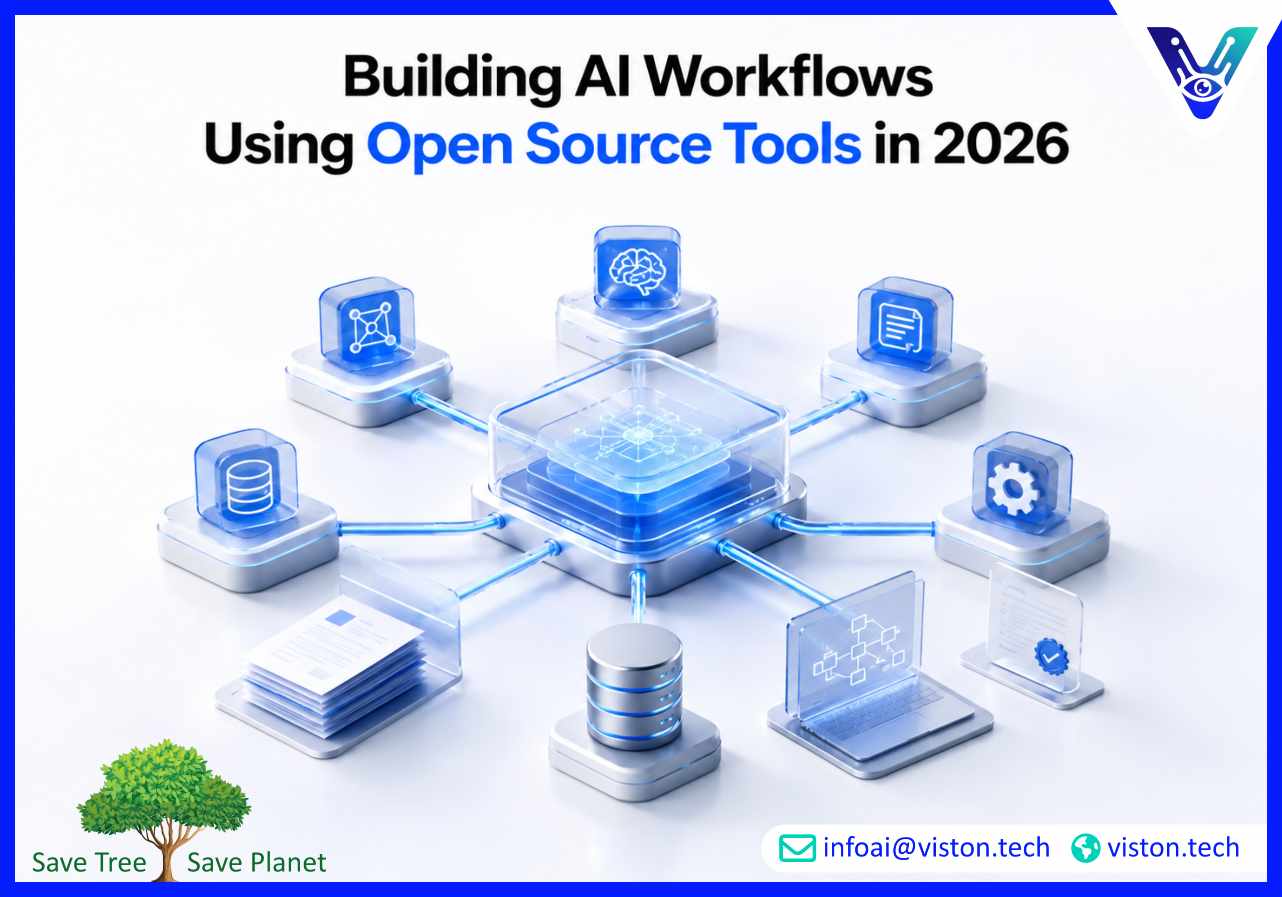
Businesses are increasingly turning to open source technologies to build AI workflows that are flexible, scalable, and aligned with their operational requirements. As AI adoption matures in 2026, organizations are moving beyond isolated AI tools and focusing on orchestrated workflows that automate processes, connect systems, and enable intelligent decision-making across business functions.
Open source AI technologies have evolved significantly over the past few years. What was once limited to experimentation is now supporting production-grade AI workflows across enterprises, startups, and growing businesses.
Organizations are choosing open source tools because they offer greater control over architecture, deployment, customization, and integration. Unlike closed ecosystems, open source solutions allow businesses to design workflows around their own processes rather than adapting operations to fit vendor limitations.
Building AI workflows using open source tools can support a wide range of business objectives, including:
The growing ecosystem of open source AI frameworks has made advanced workflow automation more accessible while reducing dependency on proprietary platforms.
Successful AI workflows are not built around a single model or application. They involve multiple components working together to deliver reliable business outcomes.
Orchestration coordinates tasks, decision points, system interactions, approvals, and agent communication. It acts as the control layer that manages how information moves through the workflow.
Popular open source orchestration technologies often help businesses define workflow logic, automate processes, and monitor execution across systems.
Agent-based workflows are becoming increasingly common in 2026. Instead of relying on one large AI system, organizations deploy specialized agents responsible for specific tasks.
Examples include:
These agents collaborate through orchestration frameworks to complete business workflows efficiently.
AI workflows require access to business information. Open source solutions can connect with databases, document repositories, CRM systems, APIs, enterprise applications, and knowledge bases.
Accurate context is critical because workflow quality depends heavily on the data available to the AI system.
Most business workflows involve multiple platforms. Open source integration frameworks help connect AI capabilities with existing business systems, allowing workflows to trigger actions, update records, generate reports, and automate repetitive tasks.
The open source ecosystem offers a growing range of technologies that support workflow development.
Agent frameworks help businesses create autonomous or semi-autonomous agents that can reason, execute tasks, use tools, retrieve information, and collaborate with other agents.
These frameworks are often used for:
Open source workflow platforms enable organizations to automate processes without building every component from scratch.
Common workflow capabilities include:
Modern AI workflows often require retrieval-augmented generation (RAG) capabilities. Open source vector databases help AI systems search, retrieve, and utilize relevant information from large knowledge repositories.
This improves response quality and supports enterprise knowledge management initiatives.
As AI workflows become more complex, monitoring becomes essential. Open source observability tools help organizations track workflow performance, identify failures, monitor agent behavior, and improve reliability over time.
Monitoring is particularly important when AI workflows support customer-facing or operationally critical processes.
While open source technologies provide flexibility, successful implementation requires careful planning and governance.
The most successful AI workflows begin with a clearly defined business objective. Organizations should identify measurable goals such as reducing processing time, improving customer response speed, increasing accuracy, or lowering operational costs.
Technology selection should follow business requirements, not the other way around.
AI workflows should be built using modular components. This makes it easier to update individual agents, replace technologies, add integrations, and scale workflows as requirements evolve.
Modularity also reduces long-term maintenance challenges.
Not every decision should be fully automated. High-risk workflows involving compliance, finance, legal matters, or customer communications often benefit from human review stages.
Human-in-the-loop controls help maintain quality and reduce operational risks.
Open source tools provide flexibility, but organizations remain responsible for security, access controls, monitoring, auditability, and compliance.
AI workflows should include appropriate governance measures to protect sensitive information and ensure responsible operation.
AI workflows are not static systems. Organizations should regularly evaluate performance, identify bottlenecks, refine prompts, improve integrations, and optimize agent behavior.
Continuous improvement helps maximize long-term business value.
Organizations across industries are implementing open source AI workflows to address operational challenges and improve efficiency.
As agentic systems mature, these workflows are becoming more capable of handling complex, multi-step business processes that previously required significant manual effort.
Organizations exploring open source AI workflow development often face challenges related to architecture design, orchestration strategy, integrations, governance, and long-term scalability. This is where specialized expertise in Agentic AI Workflows becomes valuable.
Viston AI focuses on helping businesses design and implement agentic workflow solutions that connect AI capabilities with real operational processes. Rather than deploying isolated AI tools, the emphasis is placed on building coordinated systems where AI agents can collaborate, access relevant data, interact with business applications, and automate meaningful workflows.
Its expertise in Agentic AI Workflows supports organizations looking to leverage open source technologies while maintaining reliability, security, and business alignment. This includes workflow design, agent orchestration, system integration, automation planning, and performance optimization.
As businesses continue adopting open source AI ecosystems in 2026, structured implementation becomes increasingly important. Viston AI helps organizations move from experimentation to production-ready workflows that support measurable operational outcomes and sustainable AI adoption strategies.
AI workflows are structured processes where artificial intelligence systems perform tasks, make decisions, retrieve information, and automate business activities through coordinated workflow logic.
Open source tools offer flexibility, customization, transparency, integration capabilities, and greater control over deployment and infrastructure decisions.
An agentic AI workflow uses specialized AI agents that can perform tasks, access tools, communicate with other agents, and complete multi-step business processes with varying levels of autonomy.
Yes. Many enterprises use open source technologies for AI workflows because they provide scalability, customization, integration flexibility, and support for complex operational requirements.
Organizations should evaluate data quality, system integrations, workflow complexity, governance requirements, security controls, monitoring needs, and long-term maintenance considerations.
Viston AI helps businesses design, orchestrate, integrate, and optimize Agentic AI Workflows that align AI technologies with operational goals and business processes.
Building AI workflows using open source tools has become a practical strategy for organizations seeking flexibility, scalability, and greater control over AI adoption in 2026. By combining orchestration frameworks, AI agents, integrations, retrieval systems, and governance controls, businesses can create workflows that automate complex processes and deliver measurable operational value. Success depends on thoughtful workflow design, strong implementation practices, and continuous optimization. For organizations exploring Agentic AI Workflows, Viston AI provides specialized expertise that helps transform open source AI technologies into reliable, business-focused workflow solutions.
