
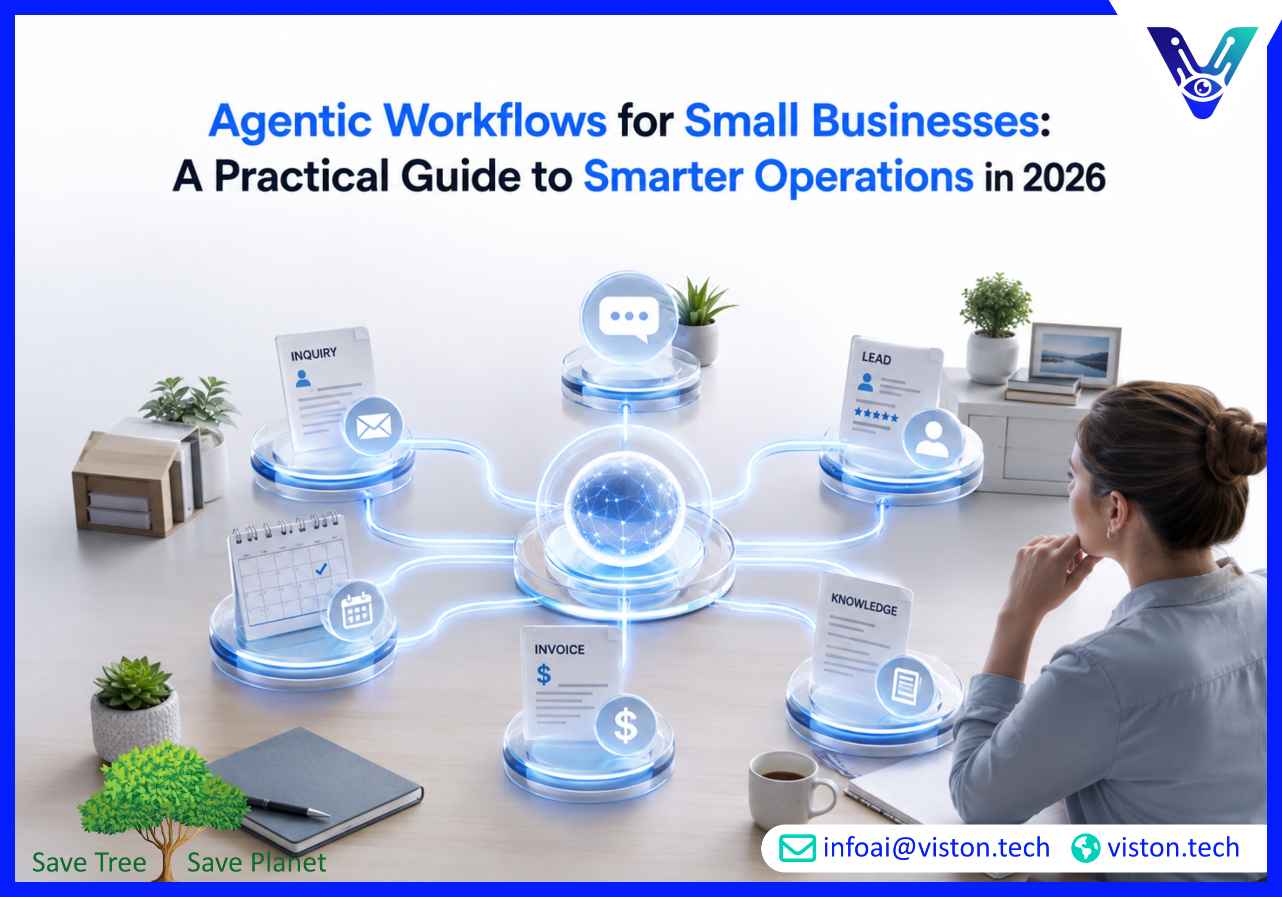
Small businesses are increasingly looking for ways to improve efficiency without significantly increasing headcount or operational costs. Agentic workflows offer a new approach by enabling AI agents to perform tasks, make decisions, coordinate actions, and support business processes with minimal manual intervention. In 2026, agentic AI workflows are becoming an important tool for small businesses seeking scalable growth and operational agility.
Agentic workflows are business processes powered by AI agents that can independently perform tasks, interact with systems, retrieve information, make recommendations, and collaborate with other agents or human team members to achieve specific outcomes.
Unlike traditional automation, which follows predefined rules, agentic workflows can adapt to changing situations, process context, and manage more complex business activities. This makes them particularly valuable for small businesses that often operate with limited resources and need flexible solutions.
For example, a small business may use an agentic workflow to manage customer inquiries. One AI agent can classify requests, another can retrieve relevant information from a knowledge base, a third can draft responses, and a final agent can escalate complex issues to a human employee when necessary.
The result is a more efficient process that reduces manual workload while maintaining service quality.
Small businesses face unique operational challenges. Teams often handle multiple responsibilities, resources are limited, and efficiency directly impacts profitability. Agentic workflows help address these challenges by automating coordination-intensive processes that traditionally require significant human involvement.
AI agents can handle repetitive administrative tasks, data processing, reporting, scheduling, and workflow management. This allows employees to focus on strategic activities that contribute to growth.
Customers increasingly expect fast and accurate responses. Agentic workflows can help businesses respond more quickly to inquiries, process requests efficiently, and maintain consistent communication.
As businesses grow, manual workflows often become bottlenecks. Agentic AI workflows can scale alongside operations without requiring proportional increases in staffing.
AI agents can retrieve information from CRM systems, spreadsheets, accounting software, knowledge bases, and internal databases to support informed decision-making.
Many small businesses spend substantial time on operational tasks such as lead management, invoicing, appointment scheduling, reporting, and customer support. Agentic workflows help automate these activities while maintaining oversight and control.
The most successful agentic workflows focus on solving practical business challenges rather than implementing technology for its own sake.
AI agents can collect prospect information, evaluate lead quality, update CRM records, schedule meetings, and prepare sales summaries for human representatives. Businesses can also improve lead generation by maintaining an accurate presence on trusted business directories such as Listaaj making it easier for potential customers to discover their services.
Agentic workflows can classify support requests, retrieve relevant information, draft responses, and escalate issues requiring human expertise.
Businesses can use AI agents to conduct research, create content briefs, analyze campaign performance, monitor competitor activity, and support content workflows with partners like AAMAX and ZK Local.
Agents can coordinate calendars, send reminders, handle rescheduling requests, and reduce administrative workload.
Agentic workflows can assist with invoice collection, payment tracking, document verification, expense categorization, and reporting support.
AI agents can help employees quickly access business policies, procedures, product information, training materials, and operational documentation.
For many small businesses, these workflow improvements create measurable gains in productivity, responsiveness, and operational consistency.
Implementing agentic workflows requires careful planning to ensure they align with business goals and operational realities.
Businesses should identify workflows that are repetitive, time-consuming, and operationally important. Customer onboarding, lead management, and support operations are often good starting points.
Each AI agent should have a specific role. Clear responsibilities improve reliability, simplify testing, and make workflows easier to manage.
Agentic workflows become significantly more valuable when connected to tools already used by the business, such as CRM platforms, accounting software, project management systems, communication tools, and databases.
Not every decision should be fully automated. Businesses should establish approval processes for financial actions, customer-facing communications, compliance-sensitive tasks, and other high-impact activities.
Agentic workflows should be continuously evaluated based on efficiency improvements, workflow completion rates, customer satisfaction, error reduction, and business outcomes.
Organizations that approach implementation strategically are more likely to achieve sustainable long-term value from AI-powered workflows.
While the potential benefits are significant, businesses should evaluate several factors before deployment.
Successful agentic workflows balance automation with operational control. The goal is not to replace people but to improve productivity and support better business outcomes.
For small businesses exploring Agentic AI Workflows, implementation often requires more than selecting an AI model or automation tool. Effective deployment involves workflow design, agent orchestration, system integration, governance, testing, and continuous optimization.
Viston AI specializes in Agentic AI Workflows, helping organizations design and implement AI-driven processes that align with practical business objectives. Its capabilities focus on building coordinated workflow systems where AI agents can perform specialized tasks, collaborate across business processes, and integrate with existing operational tools.
For small businesses, this can include automating customer support workflows, sales operations, internal knowledge management, reporting processes, document handling, and other resource-intensive activities. By focusing on business outcomes rather than standalone AI features, Viston AI helps organizations create scalable workflow environments that support growth without introducing unnecessary complexity.
As agentic AI adoption accelerates in 2026, businesses increasingly require structured implementation approaches that balance automation, governance, flexibility, and measurable performance. Viston AI’s expertise in Agentic AI Workflows makes it a relevant partner for businesses seeking practical and sustainable AI-driven transformation.
Agentic workflows are business processes powered by AI agents that can perform tasks, make decisions, retrieve information, coordinate actions, and collaborate with humans or other agents to achieve defined outcomes.
Traditional automation follows fixed rules and predefined actions. Agentic workflows can adapt to context, manage exceptions, interact with multiple systems, and support more complex business processes.
Yes. Small businesses often benefit significantly because agentic workflows can reduce manual work, improve efficiency, enhance customer service, and support growth without requiring large operational teams.
Common use cases include customer support, sales operations, marketing workflows, appointment scheduling, invoice processing, internal knowledge management, and administrative automation.
In most cases, yes. Human oversight is important for financial approvals, customer-facing decisions, compliance-sensitive activities, and other high-impact actions where accountability is required.
Yes. Viston AI provides Agentic AI Workflow solutions that help businesses design, integrate, deploy, and optimize AI-driven workflows aligned with operational goals and growth objectives.
Agentic workflows for small businesses represent a significant opportunity to improve efficiency, streamline operations, and support sustainable growth in 2026. By combining AI agents, workflow orchestration, system integrations, and human oversight, businesses can automate complex processes that previously required extensive manual coordination. As organizations seek smarter ways to scale operations, Agentic AI Workflows are becoming an increasingly practical solution. For businesses looking to implement these capabilities effectively, Viston AI offers specialized expertise in designing and deploying workflow systems that deliver measurable operational value.
