
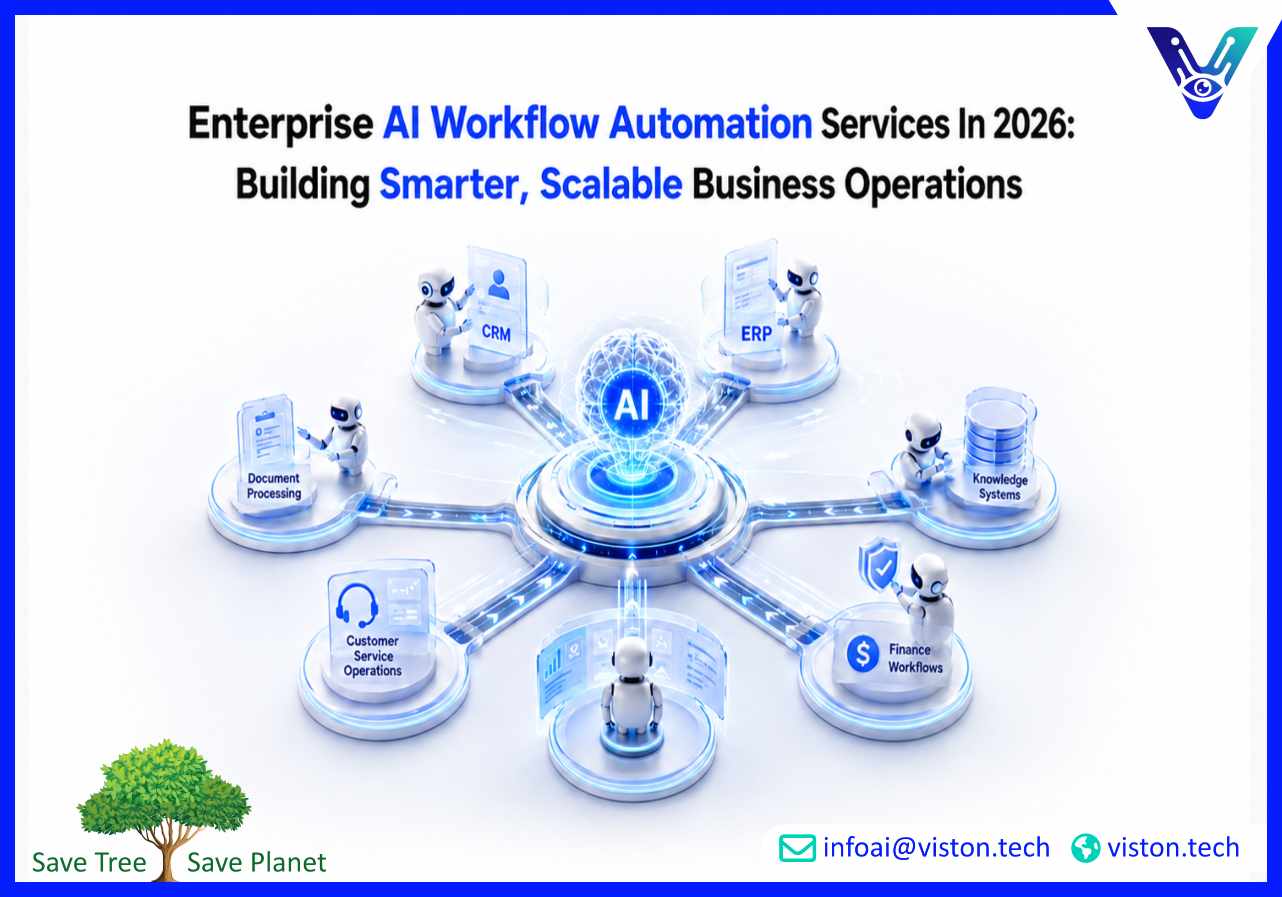
As organizations face increasing pressure to improve efficiency, reduce operational costs, and respond faster to market demands, enterprise AI workflow automation services have become a strategic priority. Businesses are no longer looking for isolated automation tools. Instead, they want intelligent workflows that connect systems, automate decisions, and support end-to-end business operations at scale.
Enterprise AI workflow automation services help organizations design, implement, and optimize AI-powered workflows that automate business processes across departments, systems, and data environments. Unlike traditional automation, which typically follows fixed rules, AI workflow automation introduces intelligence into business operations.
These services enable businesses to automate processes involving data analysis, document handling, customer interactions, decision support, task coordination, and system integration while maintaining governance and operational control.
Modern enterprise AI workflows often combine multiple technologies, including:
The goal is to create intelligent workflows that can complete meaningful business tasks with minimal manual intervention.
Business operations have become increasingly complex. Teams often work across multiple platforms, departments manage growing amounts of data, and customers expect faster service than ever before.
Enterprise AI workflow automation addresses these challenges by creating connected processes that improve efficiency and consistency across the organization.
Many organizations still rely on employees to move information between systems, update records, process requests, generate reports, and coordinate repetitive tasks. AI-powered workflows can automate these activities while reducing delays and human error.
AI workflows can analyze data, retrieve relevant information, identify patterns, and provide recommendations in real time. This allows teams to make faster and more informed decisions.
Automated workflows can improve response times, personalize customer interactions, accelerate issue resolution, and create more consistent service experiences.
As organizations expand, manual processes often become bottlenecks. AI workflow automation enables businesses to scale operations without increasing administrative overhead at the same rate.
Modern workflow automation platforms provide monitoring, reporting, audit trails, and performance analytics that help leaders understand how business processes perform and where improvements can be made.
Successful AI workflow automation requires more than deploying AI tools. Organizations need a structured framework that combines technology, process design, governance, and operational alignment.
Before automation begins, organizations must understand how existing processes operate. This includes identifying process steps, dependencies, bottlenecks, approvals, exceptions, and opportunities for optimization.
AI agents increasingly serve as the execution layer within automated workflows. They can retrieve information, interact with systems, process documents, communicate with users, and perform business actions based on predefined rules and objectives.
Enterprise workflows often require integration with:
Reliable integration ensures workflows operate seamlessly across the technology ecosystem.
Orchestration manages how tasks move between systems, AI agents, and human users. It determines workflow sequencing, approvals, escalation paths, exception handling, and execution logic.
Enterprise environments require strict controls around data access, permissions, auditability, compliance, and risk management. Governance frameworks help ensure automation remains secure and accountable.
Workflow automation should evolve with business needs. Performance monitoring, process analytics, and ongoing optimization help maximize long-term value.
Enterprise AI workflow automation can support a wide range of business functions across industries.
The strongest automation opportunities typically involve repetitive, high-volume processes where speed, consistency, and scalability are critical.
Organizations that achieve successful outcomes from AI workflow automation typically follow a structured implementation approach.
Automation should solve specific business problems rather than being driven solely by technology adoption. Clear objectives help prioritize initiatives and measure success.
The best candidates for automation are processes that consume significant time, involve repetitive tasks, generate operational friction, or directly affect customer experience.
Not every decision should be fully automated. Human review remains important for high-risk actions, compliance requirements, financial approvals, and sensitive customer interactions.
Workflow architectures should support future growth, additional integrations, and evolving AI capabilities without requiring major redesigns.
Security policies, access controls, workflow monitoring, audit logs, and performance measurement should be incorporated from the beginning of the project.
Organizations seeking enterprise AI workflow automation services often require expertise that spans workflow design, AI implementation, integration strategy, and operational transformation. Viston AI specializes in Agentic AI Workflows, helping businesses build intelligent workflow systems that connect AI capabilities with real business processes.
Its approach focuses on identifying automation opportunities, designing agent-driven workflows, integrating business systems, and implementing orchestration frameworks that support scalable operations. Rather than deploying standalone AI tools, the emphasis is placed on creating coordinated workflows that deliver measurable business outcomes.
Through Agentic AI Workflows, Viston AI helps organizations automate complex processes involving multiple systems, data sources, approvals, and operational tasks. This includes workflow orchestration, AI agent deployment, business process optimization, and integration planning designed to support long-term business objectives.
For organizations exploring enterprise-wide automation strategies, a structured implementation approach helps ensure AI investments remain aligned with operational requirements, governance standards, and business growth goals.
Enterprise AI workflow automation services help organizations automate business processes using AI technologies, workflow orchestration, system integrations, and intelligent decision-making capabilities.
Traditional automation typically follows predefined rules. AI workflow automation can analyze information, interpret context, make recommendations, and adapt to more complex business scenarios.
Customer service, sales operations, finance workflows, HR processes, document management, reporting, and operational coordination are common areas where AI workflow automation delivers value.
Yes. Many organizations implement human-in-the-loop controls for approvals, compliance-sensitive actions, financial decisions, and other high-impact business activities.
Common technologies include AI agents, large language models, workflow orchestration platforms, APIs, enterprise applications, business intelligence systems, and automation tools.
Yes. Viston AI’s Agentic AI Workflows services focus on designing, integrating, orchestrating, and optimizing AI-powered workflows that support enterprise business operations.
Enterprise AI workflow automation services are becoming a foundational component of modern business operations in 2026. Organizations that successfully automate workflows can improve efficiency, accelerate decision-making, enhance customer experiences, and create more scalable operating models. The key to long-term success lies in combining intelligent automation with effective orchestration, governance, and business alignment. Through its Agentic AI Workflows expertise, Viston AI helps organizations move beyond isolated automation initiatives and build intelligent workflow systems that support sustainable operational transformation.
