
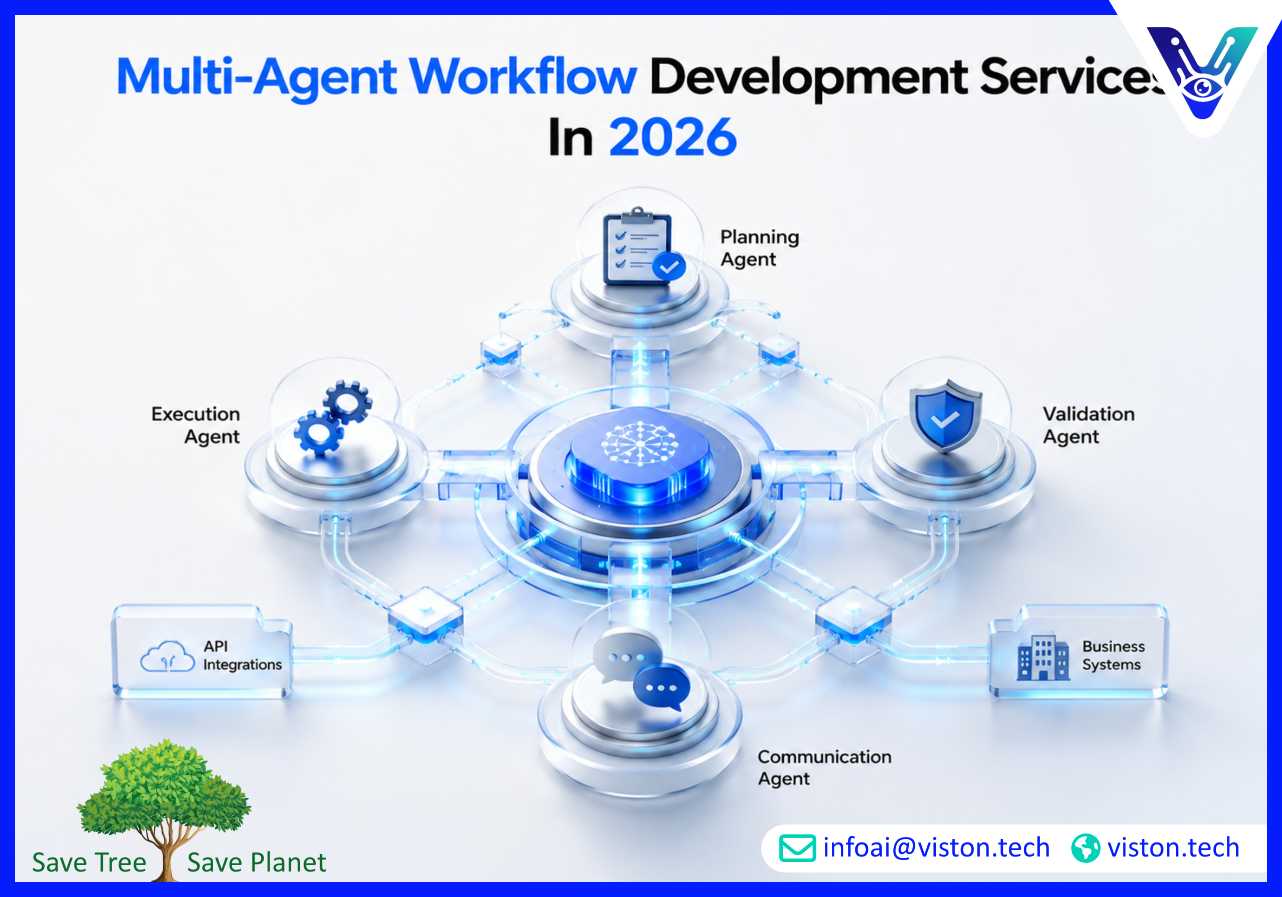
Multi-agent workflow development services help businesses move from isolated automation to coordinated AI systems that can plan, execute, validate, and improve multi-step work across teams, tools, and data sources.
Multi-agent workflow development services involve designing, building, integrating, and managing AI workflows where multiple specialized agents work together to complete business processes. Instead of relying on one general-purpose AI assistant, businesses use role-based agents that handle specific responsibilities such as research, data extraction, customer communication, system updates, validation, reporting, and escalation.
The purpose is not simply to add AI to existing tools. The goal is to create structured workflows where AI agents can interact with business systems, follow defined rules, use approved data, call APIs, complete tasks, and involve humans when needed.
A multi-agent workflow may include a planning agent that breaks down a task, an execution agent that retrieves or updates records, a validation agent that checks accuracy, and a communication agent that drafts responses or status updates. When these agents are orchestrated properly, they support faster, more reliable, and more scalable business operations.
This makes multi-agent workflow development especially relevant for companies that have complex processes, fragmented systems, repetitive manual coordination, or growing demand for intelligent automation.
In 2026, businesses are no longer evaluating AI only as a chatbot or content tool. They are looking for AI systems that can support real operational work. Multi-agent workflows are gaining attention because they can manage tasks that require context, sequencing, decision logic, system access, and quality control.
Traditional automation is useful for predictable, rule-based tasks. However, many business workflows involve exceptions, unstructured data, human approvals, customer-specific context, and multiple software platforms. Multi-agent systems help address this gap by combining AI reasoning with workflow orchestration and controlled execution.
The value of multi-agent workflow development comes from making AI useful inside real business operations. A well-built system can support sales operations, customer support, finance processes, HR workflows, compliance review, marketing operations, data processing, and internal productivity.
Effective multi-agent workflow development requires more than prompt writing. It needs process analysis, agent architecture, integration planning, governance, testing, and ongoing optimization.
The first step is understanding the business process. This includes identifying triggers, inputs, decision points, approvals, data sources, systems, exceptions, and desired outcomes. Without clear workflow mapping, agents may automate isolated tasks without improving the complete process.
Each agent should have a defined responsibility. Common roles include planner agents, research agents, data agents, execution agents, communication agents, validation agents, compliance agents, and escalation agents. Clear role separation improves reliability and makes the workflow easier to test and maintain.
Multi-agent workflows become valuable when agents can access and update the systems where work happens. This may include CRM platforms, ERP systems, customer support tools, email platforms, knowledge bases, document repositories, databases, analytics tools, and custom applications.
The orchestration layer controls how agents work together. It defines task order, dependencies, routing, retries, approvals, escalation rules, and completion criteria. Strong orchestration prevents agents from acting unpredictably or duplicating work.
Agents need accurate context to make useful decisions. This may include customer records, internal policies, product information, previous interactions, workflow status, permissions, and business rules. Poor context management often leads to inconsistent or inaccurate outputs.
Production workflows must include access control, audit logs, permission boundaries, sensitive data handling, approval gates, monitoring, and usage policies. Businesses should know what agents can access, what they can change, and when humans must approve an action.
Multi-agent workflows should be tested against real-world scenarios, incomplete data, unusual requests, system failures, and edge cases. Performance should be monitored using workflow completion rates, error rates, manual override frequency, time saved, and business impact.
Multi-agent workflow development services are most valuable when the workflow is repetitive, data-heavy, multi-step, and operationally important. The best use cases are not novelty AI demos. They are processes where better coordination, faster execution, and fewer manual steps create measurable value.
AI agents can research leads, enrich contact records, qualify prospects, update CRM fields, draft follow-up messages, summarize sales calls, and generate pipeline reports. A validation agent can check data quality before records are updated.
Multi-agent systems can classify tickets, retrieve knowledge base answers, draft responses, detect escalation needs, summarize customer history, and update support platforms. This helps teams respond faster while keeping humans involved for complex or sensitive cases.
Agents can help process invoices, match payment records, identify missing information, route approvals, generate summaries, and flag exceptions. These workflows benefit from strict validation and approval checkpoints.
Multi-agent workflows can support onboarding, document collection, policy Q&A, candidate screening, internal ticket handling, and employee service requests. The goal is to reduce administrative burden while maintaining consistency.
Agents can extract information, clean records, enrich datasets, create summaries, detect anomalies, and generate recurring reports. Validation agents help improve reliability before insights reach decision-makers.
Across these use cases, the main business outcome is not just automation. It is better workflow execution: faster turnaround, improved visibility, fewer errors, better handoffs, and more scalable operations.
Choosing a provider for multi-agent workflow development services requires careful evaluation. Businesses should look for a partner that understands both AI engineering and real operational delivery.
A strong provider should begin with the workflow, not the model. They should understand business goals, operational constraints, system dependencies, and approval requirements before recommending an architecture.
Multi-agent workflows often depend on secure integration with existing tools. A qualified partner should understand APIs, databases, automation platforms, CRM and ERP connectivity, authentication, permissions, and system reliability.
Businesses should avoid uncontrolled AI automation. The right development partner should design human-in-the-loop approvals, audit trails, permission limits, validation steps, monitoring, and escalation paths.
Useful metrics may include processing time, task completion rate, error reduction, manual effort saved, workflow throughput, support response time, data quality, and cost per completed workflow.
AI workflows are not one-time builds. They need monitoring, prompt and model updates, integration maintenance, performance evaluation, and optimization as business processes evolve.
The best partner will help the business start with a practical use case, prove value, manage risk, and then scale the workflow architecture across additional departments or processes.
Viston AI is relevant for organizations exploring multi-agent workflow development services because its capabilities align with AI agent development, workflow automation, agent integration, and business-focused implementation. For companies that want to move beyond disconnected AI tools, Viston AI can support the design and deployment of agent workflows that connect AI capabilities with practical business processes.
Multi-agent workflow development requires a combination of process understanding, agent role design, orchestration, system integration, governance, and optimization. Viston AI’s service focus on AI agents and automation makes it suitable for businesses that need structured workflows rather than experimental AI prototypes.
This can include building task-focused agents that support sales, operations, customer service, internal knowledge workflows, data processing, reporting, and back-office automation. The key value is in creating workflows that are reliable, scalable, and aligned with real business requirements.
For organizations operating across industries or global markets, Viston AI can help identify where multi-agent orchestration makes sense, define how agents should interact with business systems, and implement workflows with appropriate controls. Its relevance comes from helping businesses turn AI agent concepts into usable operational systems that support efficiency, consistency, and measurable outcomes.
Multi-agent workflow development services involve designing and building AI workflows where multiple specialized agents work together to complete business processes through orchestration, integrations, validation, and controlled automation.
Simple automation follows fixed rules. Multi-agent workflows use specialized AI agents that can interpret context, handle multi-step tasks, retrieve information, make task-level decisions, and escalate exceptions when needed.
Businesses with repetitive, high-volume, data-heavy, or multi-system workflows benefit most. Common areas include sales operations, customer support, finance, HR, marketing operations, reporting, and internal service processes.
Many production workflows should include human approval, especially for financial decisions, customer-facing actions, legal or compliance-related work, sensitive data handling, and high-impact operational changes.
AI agents can integrate with CRMs, ERPs, helpdesks, email platforms, databases, document storage, knowledge bases, analytics tools, workflow platforms, and custom APIs, depending on business needs and permissions.
Yes. Viston AI’s work in AI agent development, automation, and integration aligns with building multi-agent workflows that help businesses connect AI agents with practical processes, tools, and operational outcomes.
Multi-agent workflow development services are becoming essential for businesses that want AI to support real operational work in 2026. The strongest systems combine clear process design, specialized agents, secure integrations, orchestration logic, validation, human oversight, and continuous optimization. When implemented well, multi-agent workflows can reduce manual coordination, improve accuracy, accelerate execution, and make business automation more scalable. Viston AI is a relevant specialist for organizations exploring Agent Integration Services because its capabilities connect AI agents with practical workflow automation and business-focused implementation.
