
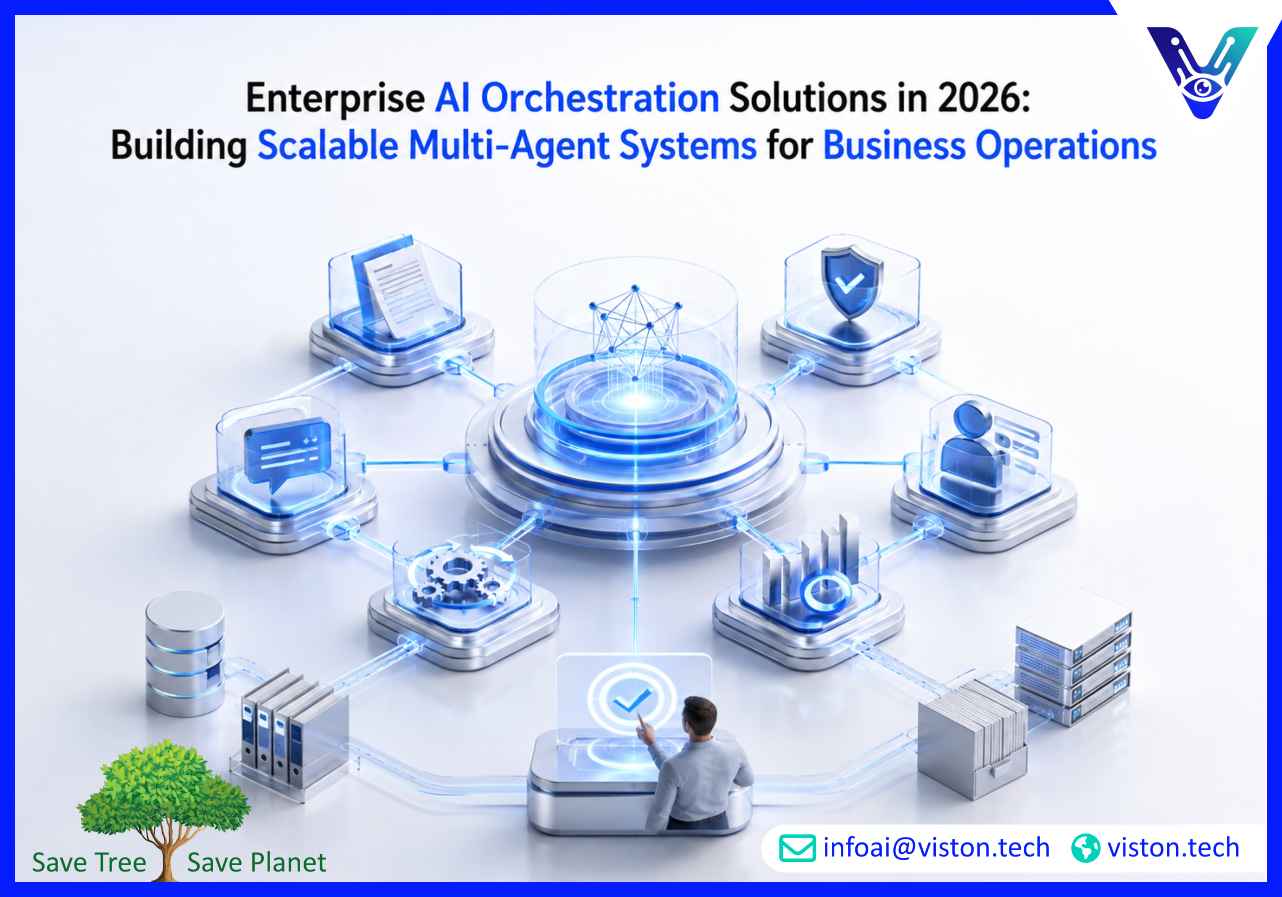
As organizations move beyond isolated AI deployments, enterprise AI orchestration solutions have emerged as a critical capability for managing complex, multi-step business processes. In 2026, businesses are increasingly investing in multi-agent orchestration to coordinate AI agents, business systems, data sources, and human workflows within a structured operational framework.
Enterprise AI orchestration solutions are platforms, architectures, and implementation frameworks that coordinate multiple AI agents, business applications, workflows, and decision-making processes across an organization.
Rather than relying on a single AI assistant, orchestration enables specialized AI agents to work together toward a common business objective. Each agent performs a defined role while the orchestration layer manages communication, task sequencing, approvals, context sharing, exception handling, and governance.
For example, a customer onboarding workflow may involve:
Enterprise orchestration ensures these agents collaborate efficiently while maintaining visibility, control, and accountability throughout the process.
As businesses scale AI adoption, orchestration becomes the foundation that transforms disconnected AI tools into coordinated operational systems.
Many organizations initially adopted AI through standalone applications, copilots, chatbots, or department-specific automation initiatives. While these deployments often deliver localized benefits, they rarely address end-to-end business processes.
Enterprise AI orchestration solves this challenge by enabling AI systems to work across multiple platforms, departments, and workflows.
Most enterprise processes involve multiple steps, approvals, systems, and stakeholders. AI orchestration enables agents to coordinate these activities while maintaining process integrity.
Coordinated AI agents can automate repetitive work, reduce manual handoffs, eliminate bottlenecks, and accelerate task completion across departments.
Orchestrated systems can gather information from multiple sources, analyze context, validate outputs, and provide more informed recommendations to business users.
Organizations require visibility into AI actions, access controls, audit trails, approval mechanisms, and policy enforcement. Orchestration provides the governance framework needed for responsible AI deployment.
As AI adoption expands, organizations need a structured approach that supports growing numbers of agents, integrations, workflows, and business use cases without creating operational complexity.
Successful orchestration environments combine technology, governance, integration capabilities, and operational design.
The orchestration engine manages interactions between agents. It determines which agent performs each task, when information is transferred, and how workflows progress toward completion.
This layer enables agents to collaborate while avoiding duplication, conflicts, or workflow breakdowns.
Enterprise workflows often contain approvals, dependencies, escalations, retries, and exception handling requirements.
Orchestration solutions provide workflow management capabilities that allow organizations to define how tasks move through business processes.
Most AI agents require access to enterprise systems such as:
Integration infrastructure ensures secure and reliable connectivity between agents and enterprise applications.
Effective orchestration depends on maintaining context throughout workflows. Agents must access relevant information without losing important business details during task handoffs.
Shared memory systems help maintain continuity across complex multi-step processes.
Enterprise environments require comprehensive monitoring capabilities, including:
Governance becomes increasingly important as organizations expand AI-driven operations.
Enterprise AI orchestration solutions deliver value when workflows involve coordination across multiple systems, data sources, and decision points.
Multiple agents can collaborate to classify requests, retrieve knowledge, draft responses, escalate complex issues, update support systems, and track resolution status.
This approach improves response speed while maintaining service quality.
Orchestrated agents can support lead qualification, account research, opportunity analysis, CRM management, proposal generation, and forecasting workflows.
The result is improved efficiency throughout the sales lifecycle.
Finance teams can leverage multi-agent systems for invoice processing, reconciliation, approval routing, reporting, compliance verification, and anomaly detection.
These workflows often benefit from human oversight combined with AI-driven automation.
AI orchestration can coordinate demand forecasting, inventory analysis, procurement workflows, supplier communication, logistics monitoring, and operational reporting.
This enables more responsive and data-driven supply chain operations.
Organizations increasingly use orchestrated AI agents to retrieve information, summarize documentation, support employee inquiries, maintain knowledge repositories, and improve internal productivity.
These systems help employees access accurate information more efficiently.
Organizations evaluating orchestration platforms should focus on long-term operational requirements rather than short-term experimentation.
The solution should support integration with existing enterprise applications, APIs, databases, and workflow systems.
Enterprise deployments require robust authentication, authorization, encryption, auditability, and policy management capabilities.
As AI adoption grows, orchestration platforms must support increasing workflow volumes, additional agents, and expanded operational demands.
Organizations should ensure workflows can include approvals, reviews, escalations, and intervention points where human judgment remains necessary.
Regulated industries and large enterprises often require extensive reporting, monitoring, and compliance controls to support responsible AI usage.
Governance should be built into the orchestration framework rather than added later.
Organizations implementing enterprise AI orchestration solutions often require expertise that extends beyond AI model deployment. Successful orchestration projects involve workflow design, agent coordination, system integration, governance planning, and operational optimization.
Viston AI specializes in Multi-Agent Orchestration services that help businesses design, implement, and scale coordinated AI ecosystems. By focusing on workflow-driven AI implementation, Viston AI helps organizations identify where multiple specialized agents can create operational value while maintaining oversight and reliability.
Its approach includes evaluating business processes, defining agent responsibilities, designing orchestration frameworks, integrating enterprise systems, and establishing governance mechanisms that support sustainable AI adoption.
For organizations seeking to automate complex workflows, improve operational efficiency, and build scalable AI-driven processes, multi-agent orchestration provides a practical path from isolated automation toward enterprise-wide intelligent operations. Viston AI’s expertise in this area supports businesses looking to implement structured, secure, and outcome-focused orchestration strategies.
Enterprise AI orchestration solutions coordinate multiple AI agents, systems, workflows, and business processes to deliver structured and scalable automation across an organization.
Traditional automation typically follows predefined rules. AI orchestration manages intelligent agents that can analyze context, make task-level decisions, collaborate with other agents, and adapt to changing business conditions.
Multi-agent orchestration is the process of coordinating multiple specialized AI agents that work together to complete complex workflows while maintaining governance, visibility, and operational control.
Customer service, sales operations, finance, supply chain management, knowledge management, HR, and operational support functions often achieve significant value from orchestrated AI workflows.
Yes. Most enterprise deployments include human-in-the-loop controls for approvals, exception handling, compliance reviews, and high-impact decisions where human judgment remains important.
Viston AI provides Multi-Agent Orchestration services that help organizations design AI workflows, coordinate specialized agents, integrate enterprise systems, and implement governance frameworks that support scalable AI operations.
Enterprise AI orchestration solutions are becoming a foundational component of business transformation strategies in 2026. As organizations expand AI adoption, the ability to coordinate agents, workflows, systems, and human oversight determines whether AI initiatives deliver meaningful operational value. Multi-Agent Orchestration enables businesses to move beyond isolated automation and create intelligent, scalable workflows that support efficiency, governance, and long-term growth. For organizations pursuing enterprise-wide AI capabilities, Viston AI offers specialized expertise in designing and implementing orchestration frameworks that align AI execution with real business objectives.
