
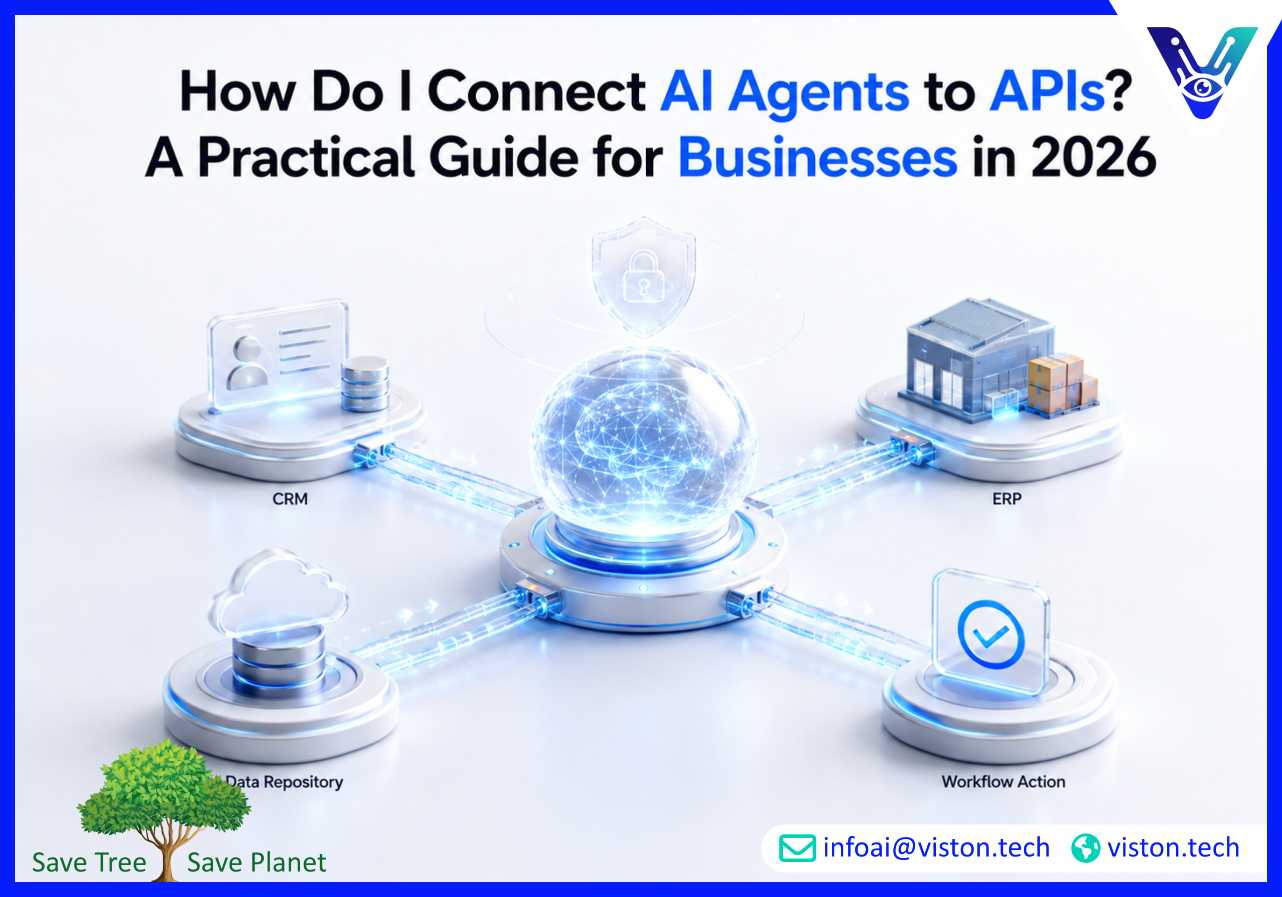
AI agents become significantly more valuable when they can interact with real business systems. While large language models can generate insights and recommendations, APIs allow AI agents to retrieve data, trigger actions, update records, and automate workflows across business applications. Understanding how to connect AI agents to APIs is now a critical capability for organizations adopting agentic AI workflows in 2026.
An AI agent without API access is limited to processing information provided directly to it. By connecting AI agents to APIs, businesses enable agents to interact with external systems, applications, databases, and services in real time.
APIs act as communication bridges between AI agents and business platforms. They allow agents to access current information, perform tasks, and participate in operational workflows rather than simply generating responses.
Common API-connected AI agent capabilities include:
For organizations implementing Agentic AI Workflows, APIs provide the foundation that allows agents to operate across multiple systems while supporting business objectives.
At a technical level, an API connection allows an AI agent to send requests to another system and receive responses. The agent can then use that information to make decisions, complete tasks, or continue a workflow.
Most modern APIs use HTTP requests and return data in structured formats such as JSON. An AI agent can submit requests to retrieve information or perform actions.
For example:
The API response provides the data needed for the agent to continue processing.
Business APIs typically require authentication before allowing access. AI agents must be configured with appropriate credentials and permissions.
Common authentication methods include:
Security should always be considered during implementation. Agents should receive only the permissions necessary to perform their assigned tasks.
Modern AI frameworks often use tool-calling mechanisms that allow agents to invoke APIs dynamically. Instead of manually coding every workflow step, the agent can identify when an API is needed and execute the appropriate function.
This enables more flexible and scalable automation while maintaining governance controls.
Organizations use several integration approaches depending on their systems, objectives, and workflow complexity.
In the simplest model, an AI agent connects to one business application.
Examples include:
This approach is often used for initial AI adoption projects.
Many business processes span multiple platforms. An AI agent may need to gather information from several systems before taking action.
Examples include:
This model supports more sophisticated workflows and business automation.
In advanced Agentic AI Workflows, multiple agents collaborate while interacting with different APIs.
For example:
Orchestration ensures each agent performs its role while maintaining workflow consistency and visibility.
Successful AI agent integration requires more than technical connectivity. Organizations should focus on reliability, security, governance, and operational performance.
Rather than connecting agents to every system immediately, identify workflows that offer measurable business value. Common starting points include customer support, lead qualification, onboarding, reporting, and internal operations.
Each agent should have a defined purpose. Avoid giving agents unrestricted access across multiple systems without clear operational boundaries.
API access should follow least-privilege principles. Restrict permissions based on business requirements and regularly review access rights.
Agents should verify API responses before acting on them. Validation helps reduce workflow errors and improves reliability.
For financial transactions, legal decisions, customer communications, or compliance-sensitive actions, include human review stages before execution.
Organizations should maintain logs of API calls, workflow decisions, escalations, and outcomes. Monitoring improves transparency and supports governance requirements.
For organizations adopting Agentic AI Workflows, connecting AI agents to APIs is often one of the most important implementation challenges. Viston AI helps businesses design and deploy agentic systems that integrate with existing applications, business processes, and operational environments.
Effective API integration requires more than simply establishing connections between systems. It involves workflow design, orchestration logic, security planning, governance controls, agent specialization, monitoring, and ongoing optimization. These elements are essential for creating AI workflows that operate reliably in production environments.
Viston AI’s expertise in Agentic AI Workflows enables organizations to build structured automation systems where AI agents can interact with CRMs, ERP platforms, databases, internal applications, customer support tools, analytics systems, and external services through secure API integrations.
By focusing on practical business outcomes, organizations can move beyond isolated AI experiments and develop scalable workflows that improve operational efficiency, reduce manual effort, and support long-term automation initiatives.
An API is a communication interface that allows AI agents to interact with external systems, applications, databases, and services. APIs enable agents to retrieve information and perform actions within business workflows.
Yes. Many agentic systems connect to multiple APIs simultaneously, allowing agents to gather information from various sources and coordinate complex workflows across business applications.
They can be secure when implemented correctly. Security measures typically include authentication, authorization controls, encryption, monitoring, audit logs, and role-based permissions.
AI agents commonly integrate with CRM systems, ERP platforms, databases, customer support tools, analytics platforms, cloud applications, document management systems, and custom business software.
Not always. Many modern business applications provide existing APIs that AI agents can use directly. Custom API development may be necessary when working with proprietary or legacy systems.
Yes. Viston AI supports Agentic AI Workflows by helping organizations design, integrate, orchestrate, and deploy AI agents that securely connect to business systems through APIs and workflow automation architectures.
Understanding how to connect AI agents to APIs is essential for organizations looking to unlock the full value of Agentic AI Workflows in 2026. APIs enable agents to interact with business systems, access real-time information, automate actions, and participate in end-to-end operational processes. When implemented with proper security, governance, and orchestration, API-connected AI agents can significantly improve efficiency, scalability, and workflow automation. For businesses exploring agentic automation, Viston AI provides expertise in building practical AI workflows that connect intelligent agents with the systems that power modern operations.
