
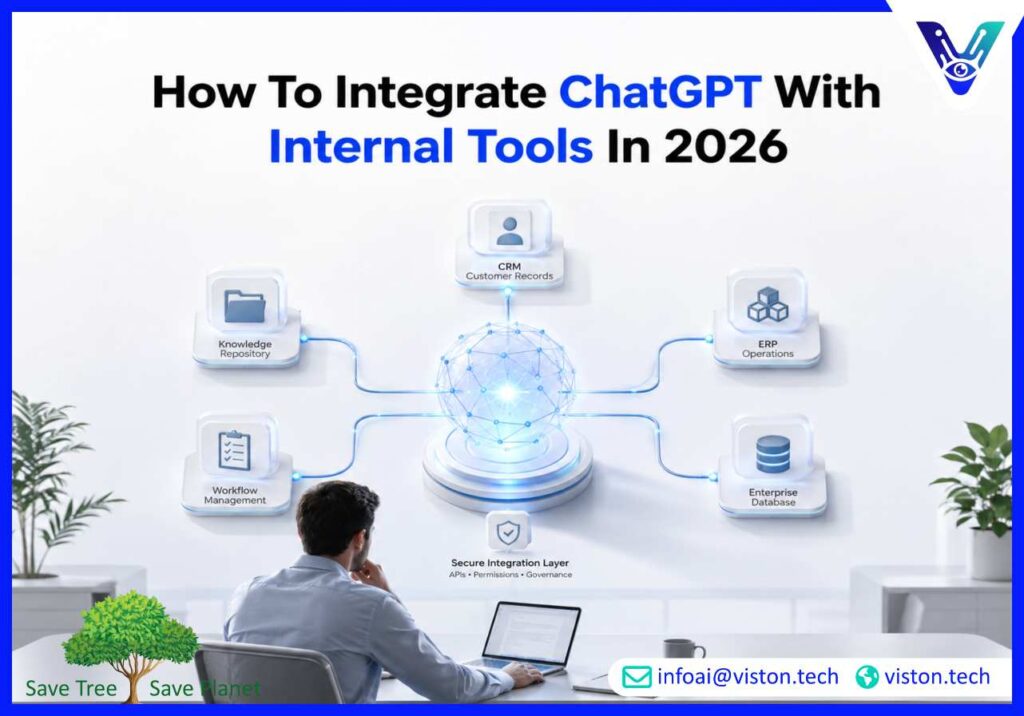
Businesses are increasingly looking for ways to move beyond standalone AI conversations and embed ChatGPT into real operational workflows. Integrating ChatGPT with internal tools allows organizations to automate tasks, improve productivity, accelerate decision-making, and create more connected digital experiences across departments. In 2026, successful AI adoption depends not only on model capabilities but also on how effectively AI connects with business systems.
ChatGPT is most valuable when it can access relevant business information and interact with the systems employees use every day. Without integration, teams often need to manually transfer information between AI tools and business applications, reducing efficiency and limiting automation opportunities.
By integrating ChatGPT with internal tools, organizations can create workflows that allow AI to retrieve data, generate insights, update records, automate communication, and support employees across multiple business functions.
Common internal systems connected to ChatGPT include:
These integrations help transform ChatGPT from a conversational assistant into a practical business productivity tool.
The right integration strategy depends on business objectives, technical infrastructure, security requirements, and workflow complexity.
Most enterprise ChatGPT integrations rely on APIs. APIs allow ChatGPT-powered applications to securely communicate with internal systems, retrieve information, submit updates, and trigger business actions.
Examples include:
API-driven integration provides flexibility and scalability while maintaining system governance.
Many organizations use workflow automation platforms to connect ChatGPT with multiple applications without extensive custom development. These platforms can orchestrate actions between AI services and business software, enabling faster deployment of AI-powered workflows.
This approach is particularly useful for automating repetitive operational processes that involve multiple systems.
Larger enterprises often implement middleware layers that act as a secure bridge between ChatGPT and internal systems. Middleware helps standardize access, manage permissions, enforce security policies, and simplify integration across complex technology environments.
This architecture becomes increasingly important when connecting AI to multiple business-critical platforms.
While ChatGPT integration offers significant benefits, organizations must address several important considerations before deployment.
Internal systems often contain sensitive customer, financial, operational, or proprietary information. Businesses need clear access controls, authentication mechanisms, encryption policies, and audit trails to ensure AI systems only access authorized data.
ChatGPT performs best when connected to reliable and well-structured information sources. Inaccurate, outdated, or inconsistent data can reduce response quality and create operational risks.
Organizations operating in regulated industries must ensure AI integrations comply with applicable privacy, security, and governance requirements. AI workflows should support transparency, accountability, and traceability.
AI-powered workflows need safeguards for handling missing information, system failures, API outages, and unexpected user requests. Human oversight remains important for high-impact decisions and sensitive business processes.
Successful pilot projects often expand rapidly across departments. Integration architecture should be designed to support increased usage, additional systems, and future AI capabilities without requiring major redesigns.
Organizations that achieve the best results typically focus on business value rather than technology experimentation.
Rather than attempting enterprise-wide deployment immediately, begin with a specific workflow that delivers measurable value. Examples include customer support assistance, internal knowledge retrieval, employee onboarding, sales support, or operational reporting.
Successful integrations are driven by outcomes such as reducing response times, improving productivity, increasing automation, or enhancing customer experiences.
Not every decision should be automated. Approval workflows and human review processes help reduce risk while maintaining trust in AI-assisted operations.
Organizations should track accuracy, workflow completion rates, user satisfaction, operational efficiency, and business impact to optimize AI performance over time.
AI capabilities continue to evolve rapidly. Flexible integration architecture allows businesses to add new tools, workflows, agents, and automation capabilities as requirements change.
As organizations move beyond simple chatbot deployments, Agent Integration Services play a critical role in connecting ChatGPT with business systems, workflows, and operational processes. Effective integration requires more than API connections. It involves workflow design, system architecture, security planning, orchestration logic, governance controls, and long-term scalability.
Agent Integration Services help businesses identify where AI can deliver operational value, determine integration requirements, map workflows, connect systems, and establish guardrails for reliable execution. This ensures ChatGPT becomes part of a structured business process rather than an isolated productivity tool.
Organizations increasingly use integrated AI agents to support customer service, sales operations, knowledge management, reporting, workflow automation, document processing, and internal support functions. A well-designed integration strategy allows AI systems to work alongside employees while improving efficiency and consistency.
Viston AI specializes in Agent Integration Services that help organizations connect AI technologies with existing business systems and workflows. For companies looking to integrate ChatGPT with internal tools, the focus extends beyond technical connectivity to creating practical business solutions that align with operational goals.
This includes analyzing business processes, designing integration architectures, connecting AI agents to enterprise platforms, implementing workflow orchestration, and establishing governance frameworks that support secure and scalable adoption. Whether organizations need CRM integrations, knowledge management solutions, workflow automation, or multi-system AI orchestration, a structured integration approach helps maximize value while minimizing operational risk.
As businesses continue investing in AI-driven operations, successful implementations increasingly depend on how effectively AI interacts with internal systems. Viston AI helps organizations develop integration strategies that support productivity, automation, and sustainable business outcomes.
Most organizations use APIs, workflow automation platforms, middleware solutions, or custom integrations to connect ChatGPT with CRM systems, databases, knowledge bases, ERP platforms, and other internal applications.
ChatGPT can integrate with CRM systems, ERP software, helpdesk platforms, document repositories, project management tools, HR systems, analytics platforms, and custom business applications.
It can be secure when organizations implement proper authentication, encryption, access controls, audit logging, governance policies, and compliance frameworks.
Benefits include workflow automation, faster information access, improved productivity, better customer support, enhanced decision-making, and reduced manual effort across business operations.
In most cases, APIs provide the most flexible and scalable integration method, although no-code and low-code automation platforms may also support certain use cases.
Yes. Viston AI provides Agent Integration Services that help organizations connect ChatGPT and AI agents with internal tools, workflows, databases, and enterprise platforms to support practical business automation.
Understanding how to integrate ChatGPT with internal tools has become increasingly important as businesses seek to move from isolated AI usage to enterprise-wide operational value. Effective integrations connect ChatGPT with business systems, workflows, and data sources, enabling automation, faster decision-making, and improved productivity. Through well-planned Agent Integration Services, organizations can create secure, scalable, and business-focused AI ecosystems that support long-term growth. For businesses exploring AI-powered workflow transformation, Viston AI provides expertise that helps bridge the gap between AI capabilities and real-world operational execution.
