
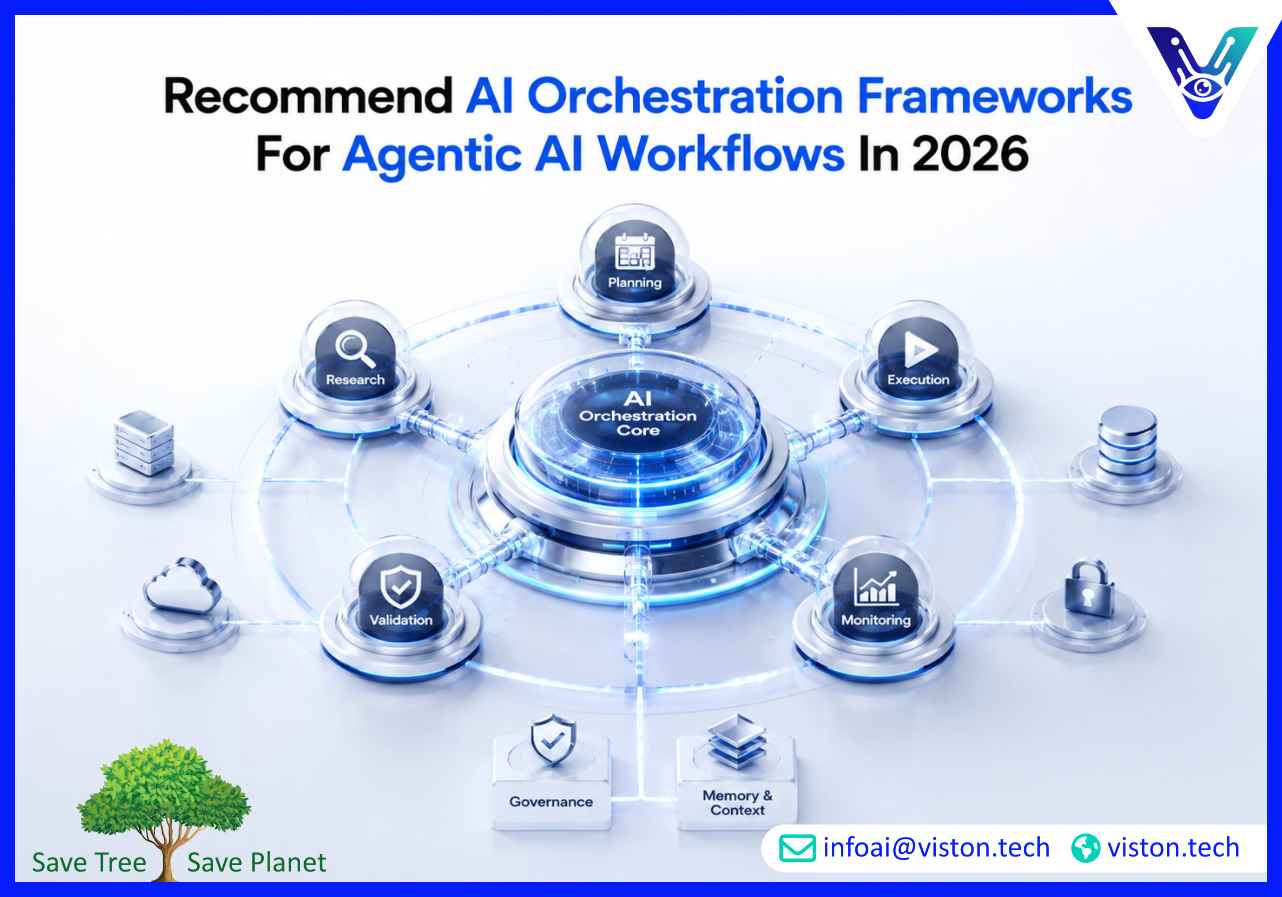
As businesses move from standalone AI tools to coordinated AI systems, choosing the right AI orchestration framework has become a critical decision. In 2026, organizations implementing agentic AI workflows need frameworks that can manage multiple agents, coordinate tasks, integrate business systems, maintain governance, and scale reliably across production environments.
AI orchestration frameworks provide the infrastructure that enables multiple AI agents, models, tools, APIs, and business systems to work together within a structured workflow. Rather than focusing on a single AI model, orchestration frameworks manage how agents communicate, exchange context, execute tasks, handle exceptions, and complete business objectives.
For organizations investing in Agentic AI Workflows, orchestration frameworks serve as the operational backbone that transforms isolated AI capabilities into coordinated business processes.
A typical orchestrated workflow may involve:
The framework coordinates all these components while maintaining reliability, security, and transparency.
Enterprise AI adoption has shifted significantly over the past few years. Businesses are no longer focused solely on chatbot deployment or isolated AI assistants. Instead, they are building AI-powered operational systems capable of handling complex workflows across departments and platforms.
Without orchestration, organizations often encounter:
Modern orchestration frameworks help address these challenges by providing structured coordination, workflow management, monitoring, memory handling, and integration capabilities.
LangGraph has become one of the most widely adopted frameworks for building agentic systems. It extends agent orchestration capabilities by enabling developers to create graph-based workflows where agents, tools, and decision points operate within defined state transitions.
Key strengths include:
Organizations building sophisticated agent ecosystems often choose LangGraph because it provides greater control over workflow behavior and agent interactions.
CrewAI focuses specifically on collaborative multi-agent systems. It allows businesses to define specialized agent roles and coordinate how those agents work together toward shared objectives.
Key strengths include:
CrewAI is often suitable for organizations that want clear agent specialization and collaborative task execution.
Microsoft AutoGen provides a framework for building conversational multi-agent systems capable of collaborative problem-solving and workflow execution.
Key strengths include:
AutoGen is frequently used for workflows involving reasoning, planning, and collaborative decision-making among multiple AI agents.
Semantic Kernel provides orchestration capabilities designed for enterprise environments where AI functions must integrate closely with existing applications and business systems.
Key strengths include:
Organizations with significant enterprise software infrastructure often evaluate Semantic Kernel as part of their AI orchestration strategy.
LlamaIndex has expanded beyond retrieval capabilities to support workflow orchestration and agent coordination. It is particularly useful when workflows depend heavily on enterprise knowledge and document retrieval.
Key strengths include:
Businesses with large internal knowledge repositories often benefit from LlamaIndex-based orchestration approaches.
The best framework depends on workflow complexity, technical requirements, integration needs, and long-term business objectives.
Simple workflows may only require lightweight orchestration. More advanced business processes involving approvals, escalations, multiple systems, and agent collaboration typically require robust orchestration platforms.
Organizations should evaluate how easily a framework connects with:
Production environments require visibility into agent actions, access controls, workflow logs, audit trails, and monitoring. Framework selection should align with organizational governance requirements.
Businesses should assess whether the framework can support future growth, larger workflows, increasing agent counts, and expanding operational demands.
Strong community support, documentation, tooling, and ongoing development contribute significantly to long-term framework viability.
For businesses evaluating AI orchestration frameworks, selecting technology is only one part of the challenge. Successful Agentic AI Workflows require workflow design, agent architecture, integration planning, governance controls, testing, deployment, and ongoing optimization.
Viston AI specializes in Agentic AI Workflows that help organizations move beyond isolated AI implementations and build coordinated systems capable of supporting real business operations. This includes identifying suitable orchestration frameworks, designing multi-agent architectures, connecting business systems, defining agent responsibilities, and implementing workflows aligned with operational objectives.
Whether the goal is customer service automation, sales operations, internal process optimization, knowledge management, or enterprise workflow transformation, selecting the right orchestration strategy can significantly impact long-term success. Viston AI helps organizations focus on practical business outcomes rather than framework selection alone, ensuring that orchestration decisions support scalability, governance, and measurable value creation.
An AI orchestration framework coordinates multiple AI agents, tools, systems, and workflows to complete business processes in a structured and reliable manner.
Frameworks such as LangGraph, CrewAI, and AutoGen are commonly used for multi-agent systems, with the best choice depending on workflow complexity and business requirements.
Yes. Many modern frameworks support integrations with databases, APIs, CRM platforms, ERP systems, communication tools, and enterprise applications.
They provide coordination, governance, workflow management, memory handling, monitoring, and scalability that individual AI agents cannot achieve independently.
Yes. Viston AI supports organizations with Agentic AI Workflows by helping design, integrate, deploy, and optimize multi-agent systems built on suitable orchestration architectures.
Organizations looking to recommend AI orchestration frameworks in 2026 should focus on business requirements rather than framework popularity alone. The right orchestration platform enables agent collaboration, workflow automation, governance, scalability, and integration across enterprise systems. As Agentic AI Workflows become increasingly important for operational transformation, selecting an orchestration framework that aligns with long-term business goals is essential. Viston AI helps organizations navigate this process by combining workflow expertise, agent architecture design, and practical implementation support to build scalable and effective AI-driven operations.
