
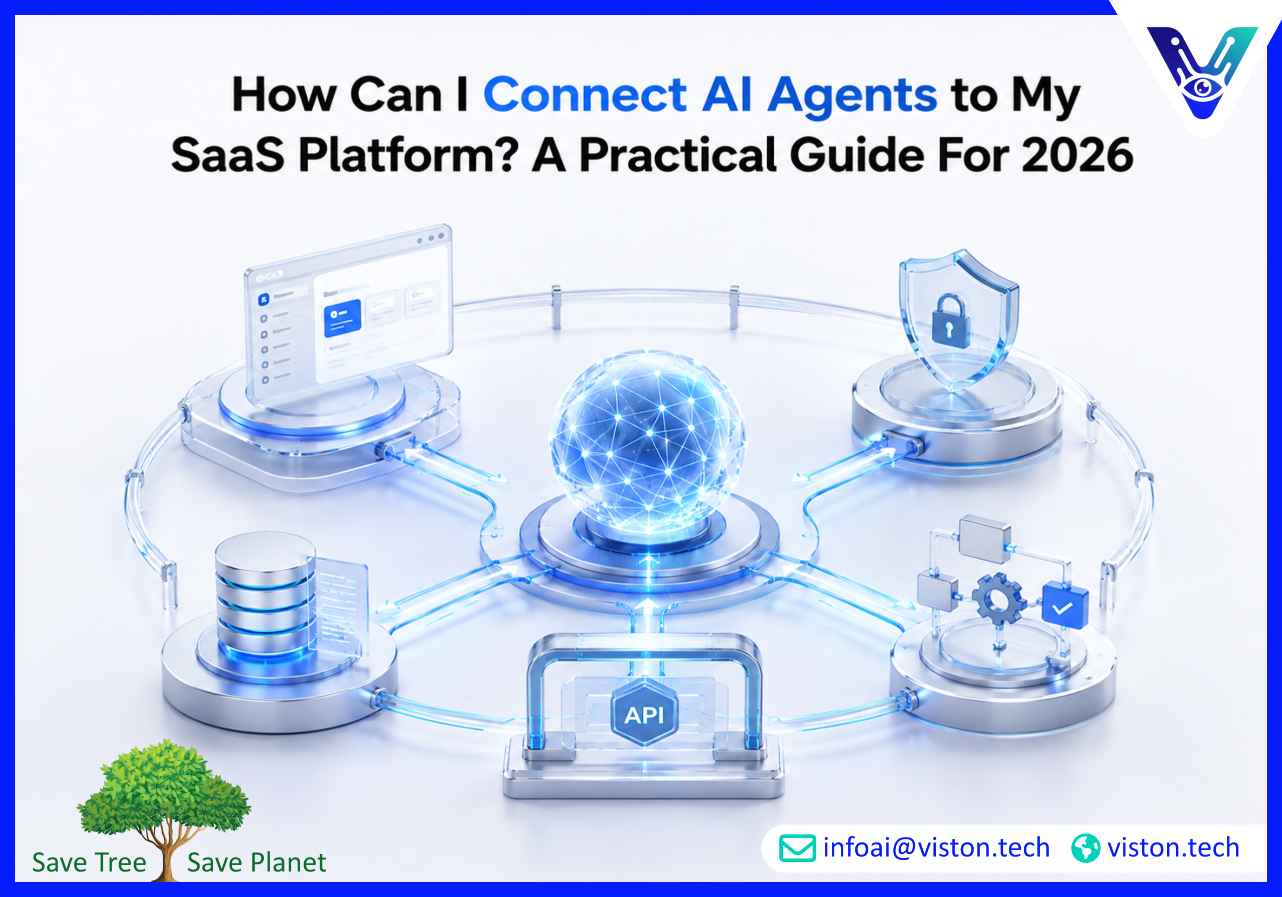
As SaaS companies look for new ways to improve customer experiences, automate operations, and scale efficiently, AI agents are becoming a strategic capability rather than an experimental technology. Connecting AI agents to a SaaS platform allows businesses to automate workflows, interact with users intelligently, access business data securely, and execute tasks across multiple systems with minimal manual intervention.
Modern SaaS products are expected to do more than simply store data and manage workflows. Customers increasingly expect intelligent assistance, proactive recommendations, automated support, and faster outcomes.
AI agents help SaaS providers deliver these capabilities by acting as autonomous or semi-autonomous digital workers that can retrieve information, analyze data, communicate with users, trigger actions, and coordinate processes across integrated systems.
Unlike traditional chatbots, AI agents can understand context, use tools, interact with APIs, and complete multi-step tasks that support both customers and internal teams.
Common business objectives for AI agent integration include:
Connecting AI agents to a SaaS platform involves enabling the agents to securely access data, interact with business logic, and perform actions within the application environment.
The integration typically combines several components:
Rather than operating independently, AI agents become connected participants within the SaaS ecosystem, capable of supporting users and business processes in real time.
Successful AI agent integration requires more than connecting a language model to an application. Businesses must design a reliable architecture that supports performance, security, scalability, and governance.
Most SaaS platforms expose APIs that allow AI agents to access information and perform actions. APIs serve as the primary communication layer between agents and business systems.
Well-structured APIs allow agents to:
AI agents should only access information that users are authorized to view. Secure integration requires identity management, role-based permissions, token management, and access controls.
This ensures agents operate within defined boundaries while protecting sensitive business and customer data.
AI agents need relevant context to provide useful responses and actions. This often includes customer records, transaction history, documentation, account settings, product information, and workflow status.
Effective context management significantly improves response quality and decision-making accuracy.
Many SaaS use cases involve multiple systems and tasks. Workflow orchestration coordinates how AI agents interact with different tools, databases, APIs, and users.
Orchestration helps manage:
Businesses need visibility into agent behavior and outcomes. Monitoring systems track performance, usage, accuracy, workflow completion rates, security events, and operational health.
Governance controls help ensure compliance, reliability, and accountability as AI usage scales.
Organizations that achieve successful AI integrations typically follow a structured implementation approach rather than deploying AI directly into production environments.
Start with a business problem rather than a technology decision. Focus on workflows where AI agents can create measurable value.
Examples include:
Review APIs, data sources, authentication systems, integrations, and workflow dependencies. Understanding the existing architecture helps identify integration opportunities and technical constraints.
Each AI agent should have a clearly defined role. Specialized agents often perform better than a single agent attempting to manage every task.
Examples include:
Connect agents to required APIs, databases, third-party applications, and internal services while maintaining security and access controls.
Not every action should be automated. Human approval workflows help manage risk for sensitive tasks involving customer communications, financial actions, compliance decisions, or account modifications.
Testing should include realistic scenarios, incomplete data situations, edge cases, permission boundaries, workflow failures, and user interactions.
Once deployed, continuously evaluate agent performance, user satisfaction, operational impact, and workflow outcomes to improve effectiveness over time.
While AI integration offers significant benefits, businesses should prepare for several common challenges.
Agents often require access to information spread across multiple systems. Integration planning should address fragmented data environments.
Improper permissions, unsecured APIs, and inadequate governance can create security concerns. Strong controls are essential.
Many SaaS processes involve exceptions, approvals, and dependencies that require careful orchestration design.
As usage grows, AI infrastructure, integrations, and monitoring systems must support increasing workloads without degrading performance.
Customers and employees need confidence that AI agents provide reliable information and operate within appropriate boundaries.
For SaaS companies exploring AI-powered automation and intelligent workflows, Viston AI provides Agent Integration Services designed to connect AI agents with business systems, applications, and operational processes.
Successful AI agent integration requires expertise in APIs, workflow design, orchestration, security, data management, and system architecture. Viston AI helps organizations evaluate integration opportunities, define agent responsibilities, build secure connections between platforms, and deploy scalable agent-driven workflows aligned with business objectives.
Whether the goal is customer support automation, operational efficiency, intelligent product experiences, workflow orchestration, or multi-agent collaboration, Agent Integration Services help ensure AI capabilities become a functional part of the SaaS platform rather than a disconnected feature.
By focusing on practical implementation and business outcomes, Viston AI supports organizations seeking reliable AI adoption strategies that scale alongside product growth and customer demands.
Yes. AI agents typically connect through APIs, databases, workflow systems, and integration layers that allow them to access information and perform approved actions.
In most cases, APIs are the preferred method for secure and scalable integration. They provide controlled access to platform functionality and data.
AI agents can support customer service, onboarding, reporting, lead management, knowledge retrieval, workflow automation, analytics, and operational processes.
When implemented correctly, AI agent integrations can be highly secure through authentication controls, role-based permissions, encryption, monitoring, and governance policies.
Implementation timelines vary depending on platform complexity, integration requirements, workflow scope, and security considerations. Simple integrations may take weeks, while larger projects can require several months.
Yes. Viston AI’s Agent Integration Services support businesses seeking to connect AI agents with SaaS applications, business systems, workflows, and operational processes.
Connecting AI agents to a SaaS platform is becoming a strategic priority for businesses seeking greater automation, efficiency, and customer value in 2026. Successful implementations require more than AI models alone—they depend on secure integrations, workflow orchestration, governance controls, and a clear understanding of business objectives. By combining AI capabilities with existing systems and processes, organizations can create intelligent, scalable experiences that support both operational performance and long-term growth. For companies exploring this transition, Agent Integration Services from Viston AI provide the expertise needed to build practical and sustainable AI-powered SaaS solutions.
