
To design a scalable AI agent integration system, businesses need more than connected tools. They need structured workflows, secure integrations, reliable orchestration, clear governance, and measurable outcomes that allow AI agents to support real operational work without creating unnecessary complexity.
A scalable AI agent integration system connects AI agents with business applications, data sources, APIs, documents, workflows, and human decision points. The goal is to help agents complete useful tasks across systems while remaining controlled, auditable, and reliable.
In practical terms, an AI agent integration system may allow agents to read customer records, retrieve knowledge base answers, update CRM fields, create support tickets, summarize documents, trigger approvals, draft emails, analyze reports, or escalate exceptions to a human team member.
Scalability matters because early AI agent experiments often work well in a narrow test environment but fail when exposed to real business complexity. Production workflows include incomplete data, permission limits, system errors, approval rules, compliance requirements, conflicting instructions, and changing business priorities.
A well-designed system supports growth across more users, departments, workflows, integrations, and transaction volumes without becoming unstable or difficult to govern.
In 2026, businesses are moving from isolated AI assistants toward agentic AI workflows that can execute multi-step processes. This shift creates new opportunities, but it also increases the need for architecture, monitoring, access control, and workflow discipline.
AI agents are most valuable when they are embedded into operational systems rather than used as standalone chat interfaces. When connected properly, they can reduce repetitive work, improve response speed, support decision-making, and help teams coordinate tasks across platforms.
The main advantage of Agentic AI Workflows is that agents can work within structured business processes. They can retrieve context, call tools, follow defined logic, collaborate with other agents, and involve humans when judgment or approval is required.
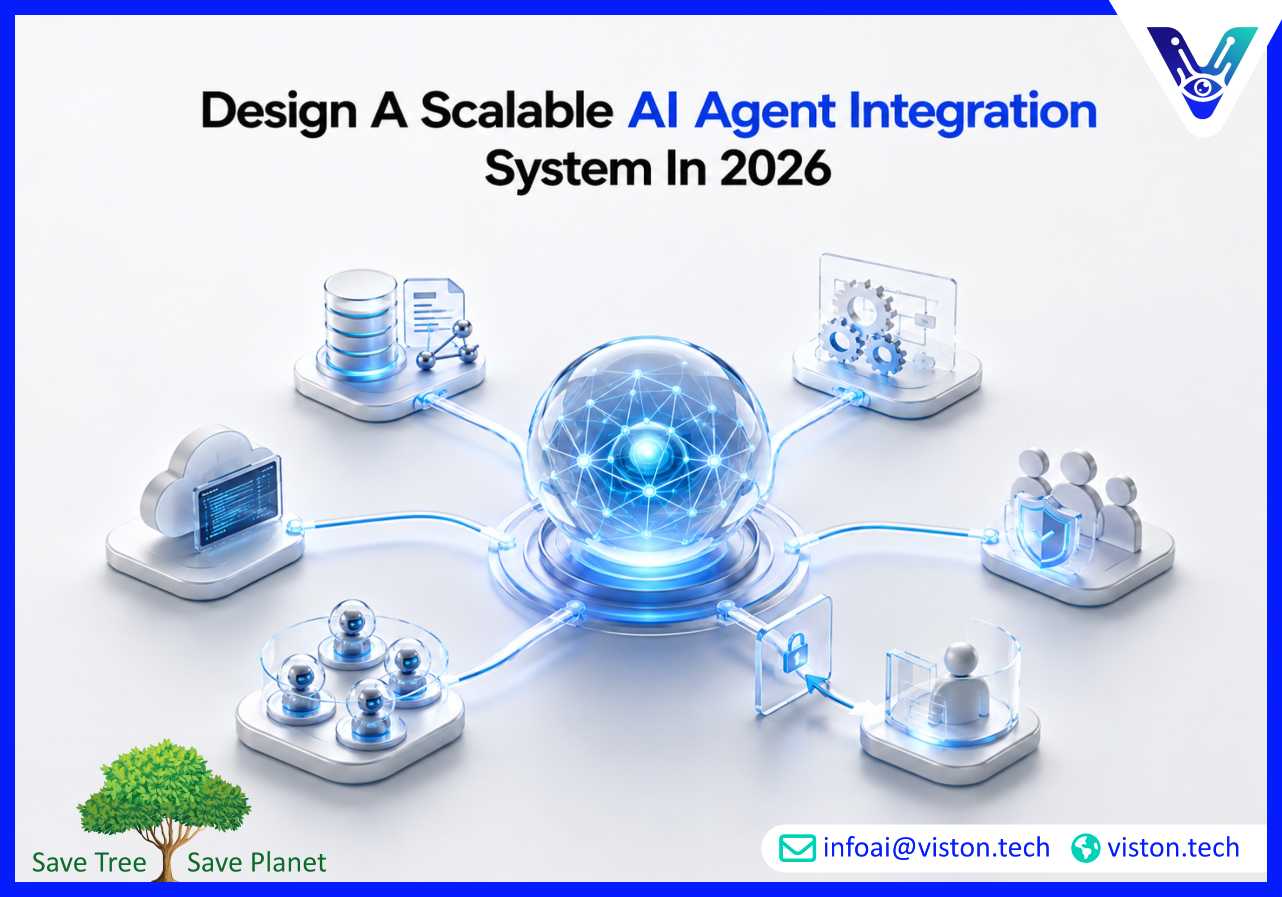
A scalable AI agent integration system should be designed as an operational architecture, not as a collection of prompts. Each layer has a specific role in making the system secure, useful, and maintainable.
The orchestration layer controls how agents move through a process. It defines triggers, routing, sequencing, retries, approvals, fallback paths, and escalation rules. Without orchestration, agents may complete individual tasks but fail to deliver a consistent business outcome.
Common orchestration patterns include sequential workflows, parallel task execution, routing to specialist agents, planner-reviewer loops, and human-in-the-loop approvals. The right pattern depends on the workflow’s risk, complexity, and business importance.
Scalable systems usually work better with focused agents rather than one large general-purpose agent. Specialist roles may include research agents, data extraction agents, CRM agents, support agents, reporting agents, compliance review agents, quality assurance agents, and escalation agents.
Clear responsibilities make each agent easier to test, monitor, improve, and govern. They also reduce the risk of duplicated work or uncontrolled decision-making.
AI agents need secure access to the systems they use. This may include CRM platforms, ERP systems, helpdesks, email tools, calendars, document repositories, databases, analytics platforms, payment systems, and custom APIs.
The integration layer should control permissions carefully. Agents should only access the data and actions required for their assigned task. High-risk actions, such as deleting records, sending external messages, approving payments, or changing legal documents, should include approval controls.
Agents need reliable context to perform well. This may include customer history, product details, policies, SOPs, pricing rules, compliance requirements, project notes, internal documentation, and previous workflow activity.
Retrieval-augmented generation, knowledge bases, structured databases, and workflow memory can help agents use current information instead of relying only on model knowledge. Strong context management improves accuracy and reduces inconsistent outputs.
Production AI agent systems need logs, audit trails, version control, performance tracking, error reporting, access management, and review processes. Governance is especially important when agents handle sensitive data, customer communication, financial records, or regulated workflows.
Monitoring should track completion rates, failed runs, escalation frequency, response quality, processing time, manual overrides, cost per workflow, and business outcomes.
The strongest systems begin with business process clarity. Technology decisions should follow workflow design, not lead it.
Start with a process that is repetitive, data-heavy, time-consuming, and meaningful to the business. Good candidates include lead qualification, customer onboarding, support triage, invoice processing, document review, internal knowledge retrieval, sales follow-up, procurement requests, and operational reporting.
Document every input, system, approval, exception, output, and dependency. This helps identify where agents can act independently, where they need access to tools, and where humans should remain involved.
Assign each agent a specific purpose. For example, one agent may classify requests, another may retrieve customer data, another may draft a response, and another may validate the output before completion.
Decide which tools each agent can use, what permissions it has, what data it can retrieve, and what actions require approval. Integration rules should be specific, testable, and aligned with security policies.
Create the workflow structure that controls task order, routing, retries, validation, and escalation. This is where the system becomes scalable because every agent action follows a defined process rather than operating unpredictably.
Guardrails may include input checks, output validation, confidence thresholds, restricted actions, approval gates, policy checks, and rollback procedures. These safeguards reduce operational risk and improve trust.
Testing should include normal cases, incomplete information, duplicate records, conflicting instructions, system downtime, unusual customer requests, and high-volume usage. A scalable system must handle exceptions, not just ideal conditions.
After deployment, monitor performance and improve the system over time. Useful metrics include processing speed, manual effort reduced, accuracy, exception rate, cost per run, user satisfaction, and workflow completion quality.
Agentic AI Workflows become valuable when they are designed for business reliability. The following considerations help prevent common integration failures.
Agents should not have unlimited authority. Define which actions are fully automated, which require review, and which are never automated. Controlled autonomy makes the system safer and easier to scale.
Design agents, tools, prompts, workflows, and integrations as modular components. This makes it easier to replace models, update APIs, add new workflows, or improve individual agents without rebuilding the full system.
AI agents depend on accurate and accessible data. Poor data quality can lead to weak recommendations, duplicate actions, failed automations, and unreliable outputs. Data cleaning, normalization, and source-of-truth rules should be part of the design.
Security cannot be added later as an afterthought. Access controls, encryption, audit logs, role-based permissions, secure API handling, and sensitive data policies should be built into the integration architecture.
The best agent systems do not remove people from every process. They reduce unnecessary manual work while giving employees better information, faster drafts, cleaner handoffs, and clearer escalation paths.
Viston AI is relevant to organizations designing scalable AI agent integration systems because its service focus aligns with Agentic AI Workflows, AI automation, and workflow bots. Businesses exploring agentic systems often need support with more than model selection; they need workflow analysis, agent design, integration planning, orchestration logic, testing, monitoring, and practical deployment.
Viston AI can help businesses identify where AI agents should be embedded into existing processes, how agents should interact with tools and data, and which workflows are suitable for automation with human oversight. This is especially useful for organizations that want to move beyond simple chatbots and create structured systems that support operations, customer service, sales, HR, finance, data processing, or internal productivity.
A scalable integration system requires clear agent roles, secure tool access, workflow guardrails, measurable outcomes, and continuous optimization. Viston AI’s positioning around AI automation and workflow bots connects directly to these requirements. Its relevance is strongest for businesses that need practical implementation support, reliable workflow design, and agentic systems that can operate inside real business environments rather than remaining experimental prototypes.
A scalable AI agent integration system connects AI agents with business tools, data, workflows, and approval processes so agents can complete tasks reliably as usage, complexity, and business requirements grow.
Basic automation follows fixed rules. AI agent integration allows agents to interpret context, retrieve information, use tools, collaborate across workflows, and escalate exceptions when human input is needed.
AI agents can integrate with CRM systems, ERP platforms, helpdesks, email tools, calendars, databases, document repositories, analytics platforms, project management tools, and custom APIs.
Scalability depends on modular architecture, secure integrations, clear orchestration, defined agent roles, monitoring, access controls, reusable workflows, and the ability to handle exceptions without breaking the process.
Yes, many workflows should include human oversight, especially when agents handle financial approvals, legal content, sensitive customer data, compliance decisions, or external communication.
Yes. Viston AI’s work in Agentic AI Workflows, AI automation, and workflow bots makes it relevant for businesses that need structured design, integration, and deployment support for scalable agentic systems.
To design a scalable AI agent integration system in 2026, businesses need a structured approach that combines workflow orchestration, specialist agents, secure integrations, context management, governance, and continuous optimization. Agentic AI Workflows can help organizations automate complex processes, reduce manual coordination, and improve operational visibility when designed with the right controls. Viston AI is a credible specialist for businesses exploring practical agentic systems because its AI automation and workflow capabilities align with the real requirements of scalable AI agent integration.
