
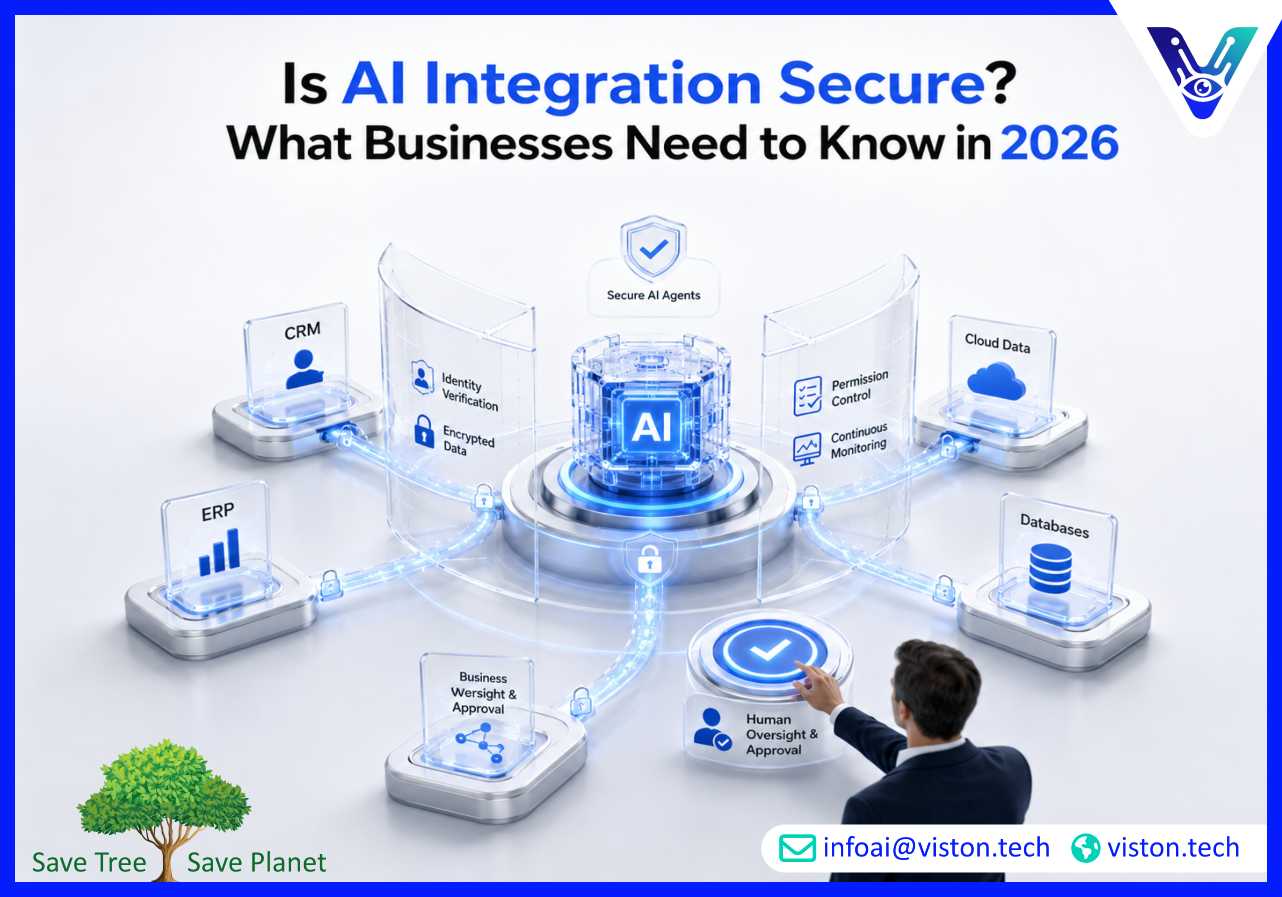
As businesses increasingly adopt AI-powered workflows, automation, and intelligent agents, security has become one of the most important considerations during implementation. The answer to whether AI integration is secure is not a simple yes or no. AI integration can be highly secure when designed, deployed, and managed correctly. However, poor implementation practices can introduce operational, data, compliance, and cybersecurity risks.
AI integration involves connecting artificial intelligence systems with existing business applications, databases, workflows, communication tools, and operational platforms. These integrations often give AI agents access to valuable business information and the ability to perform actions within connected systems.
Because AI integrations frequently interact with customer records, financial information, internal documentation, CRM platforms, ERP systems, and cloud applications, security must be built into every stage of deployment.
A secure AI integration strategy focuses on protecting data, controlling access, maintaining compliance, monitoring activity, and ensuring that AI systems operate within clearly defined boundaries.
Modern AI systems are far more capable than traditional automation tools. AI agents can retrieve information, interact with software platforms, trigger workflows, generate content, update records, and support decision-making processes.
While these capabilities create significant business value, they also increase the importance of governance and security controls.
Organizations implementing AI integrations today must consider:
Businesses that address these factors proactively can significantly reduce risks while benefiting from AI-driven automation.
If AI systems are granted excessive permissions, they may gain access to information that is not required for their intended function. Proper role-based access controls help prevent unnecessary exposure of sensitive data.
AI systems often process large volumes of information. Without appropriate safeguards, confidential business information, customer records, or proprietary data could be exposed through prompts, outputs, or integrations.
Most AI integrations rely on APIs to communicate with business systems. Poorly secured APIs can create vulnerabilities that attackers may exploit to access data or manipulate workflows.
Organizations operating in regulated industries must ensure AI integrations comply with applicable laws, industry standards, and internal governance requirements. Failure to do so can create legal and operational challenges.
Without logging and monitoring mechanisms, businesses may struggle to identify unusual behavior, unauthorized actions, or system misuse.
These risks do not make AI integration inherently insecure. Instead, they highlight why professional implementation and governance are essential.
Organizations can significantly improve AI security by following established implementation practices.
AI agents should only access the systems, data, and functions necessary to perform their assigned tasks. Limiting permissions reduces the impact of potential security issues.
Strong authentication mechanisms such as multi-factor authentication, secure API keys, token-based access, and identity management systems help protect connected environments.
Encryption protects sensitive information as it moves between systems and while stored within business environments.
Detailed activity logs help organizations track AI actions, investigate incidents, support compliance requirements, and improve accountability.
High-risk activities such as financial approvals, customer account changes, legal communications, and compliance-related decisions should include human review before execution.
AI integrations should be evaluated continuously to identify vulnerabilities, permission issues, integration risks, and evolving security requirements.
Security should be treated as an ongoing operational responsibility rather than a one-time setup task.
When evaluating AI integration providers, security should be a key decision factor alongside functionality and performance.
Businesses should look for providers that prioritize:
A reliable AI integration strategy balances innovation with operational protection, ensuring that automation supports business goals without introducing unnecessary risk.
For organizations adopting AI-powered workflows, security must be integrated into the implementation process from the beginning. Viston AI’s Agent Integration Services focus on connecting AI agents with business systems in a structured and controlled manner while supporting operational reliability and governance.
Secure agent integration requires more than simply connecting AI tools to software platforms. It involves designing permission structures, managing system access, implementing workflow controls, securing integrations, monitoring activity, and defining escalation paths when human review is required.
Viston AI helps businesses integrate AI agents with CRM systems, operational platforms, customer support environments, databases, and workflow applications while maintaining alignment with business requirements. By focusing on practical implementation, controlled automation, and scalable architecture, organizations can adopt AI capabilities while maintaining visibility and oversight across their operations.
For businesses evaluating AI adoption, secure integration practices are essential to achieving long-term value from AI-powered automation.
Yes, AI integration can be highly secure when implemented with proper access controls, encryption, monitoring, governance, and security best practices.
One of the most common risks is excessive system permissions that allow AI agents to access more data or functions than necessary.
Yes. Organizations operating in regulated industries should ensure AI integrations align with applicable privacy, security, and compliance requirements.
Yes. Secure integrations can connect AI agents to CRM, ERP, and other business systems using controlled permissions, authentication, and monitoring mechanisms.
Security reviews should be conducted regularly as part of ongoing governance, especially when systems, workflows, permissions, or integrations change.
Yes. Viston AI’s Agent Integration Services support businesses in designing and implementing AI integrations with attention to governance, workflow controls, system connectivity, and operational security.
AI integration security depends largely on how the solution is designed, deployed, and managed. While AI systems introduce new operational considerations, they can be implemented securely through strong governance, access controls, monitoring, encryption, and responsible integration practices. Businesses adopting Agent Integration Services should prioritize security from the start to protect data, maintain compliance, and ensure reliable operations. For organizations exploring secure AI adoption, Viston AI provides Agent Integration Services that support practical, business-focused integrations while maintaining the controls needed for long-term success.
