
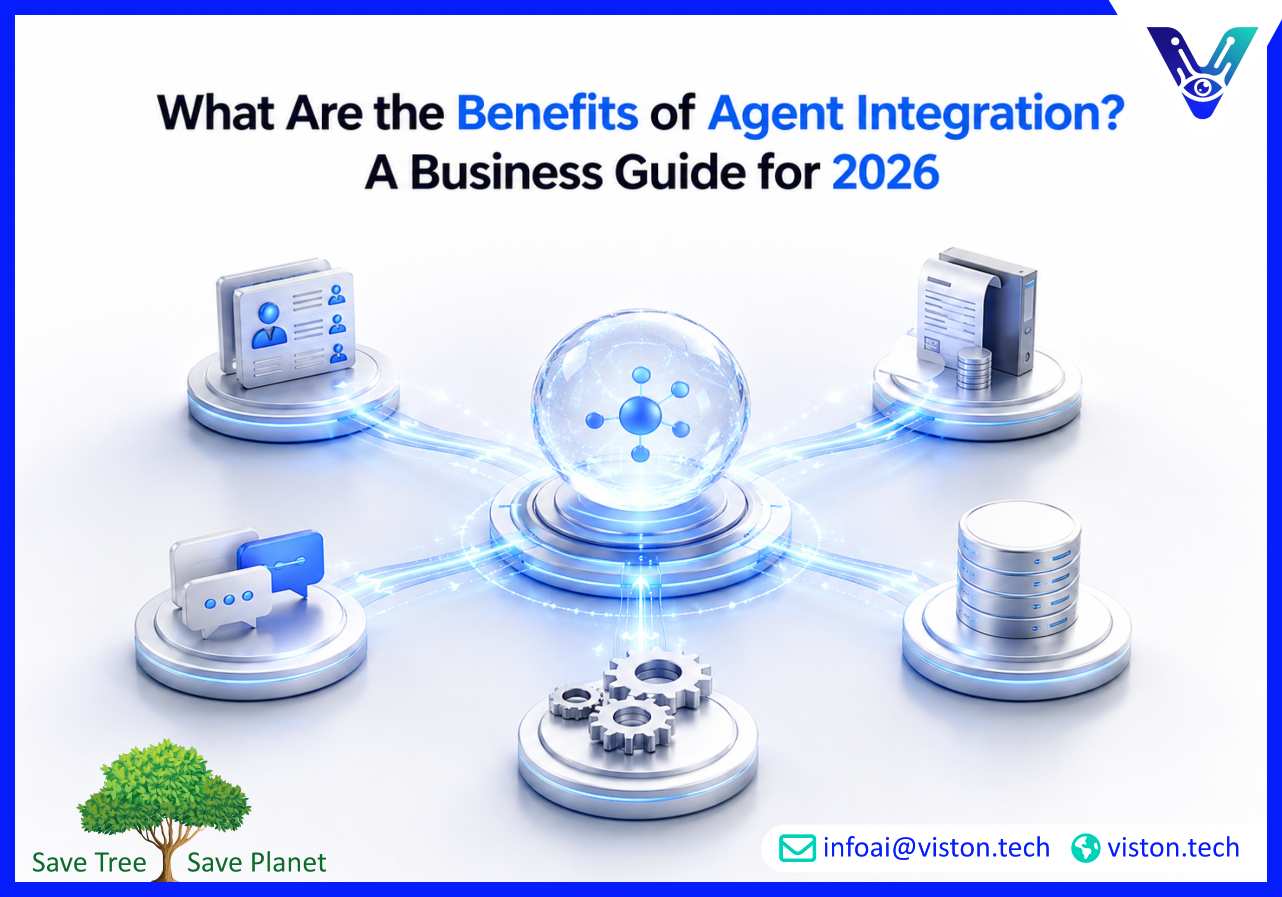
As businesses adopt AI at scale, the focus is shifting from standalone AI tools to integrated AI agents that can work directly within existing systems and workflows. Agent integration allows organizations to connect AI agents with business applications, data sources, and operational processes, creating more efficient, scalable, and intelligent workflows.
Many organizations invest in AI tools but struggle to achieve meaningful business outcomes because those tools operate in isolation. Agent integration bridges this gap by connecting AI agents to CRM systems, ERP platforms, databases, communication tools, helpdesks, internal knowledge bases, and other business applications.
Rather than requiring employees to switch between systems or manually transfer information, integrated AI agents can retrieve data, perform actions, coordinate tasks, and support decision-making within existing workflows.
In 2026, businesses increasingly view agent integration as a strategic capability that improves productivity, customer experiences, operational efficiency, and organizational agility.
One of the most significant benefits of agent integration is the reduction of manual work. Integrated agents can automate repetitive tasks such as data entry, document processing, ticket routing, report generation, and information retrieval.
By eliminating routine activities, employees can focus on higher-value responsibilities that require creativity, expertise, and strategic thinking.
Business decisions often depend on information stored across multiple systems. Agent integration enables AI agents to gather, analyze, and present relevant information from various sources in real time.
This allows managers and teams to make faster, more informed decisions without spending hours searching for data across disconnected platforms.
Integrated AI agents can access customer histories, support records, product information, and account details instantly. This enables more personalized interactions, quicker issue resolution, and consistent customer experiences.
Whether supporting customer service teams or powering self-service experiences, integrated agents help organizations respond more effectively to customer needs.
Many businesses possess large amounts of valuable data that remain underutilized because it is scattered across multiple systems.
Agent integration allows AI agents to access, process, and interpret data from various sources, helping organizations unlock insights that support growth, efficiency, and innovation.
As organizations grow, manual workflows often become bottlenecks. Integrated AI agents can support increasing workloads without requiring proportional increases in staffing.
This scalability makes agent integration particularly valuable for businesses managing large volumes of customer interactions, transactions, documents, or operational requests.
Agent integration plays a central role in modern automation strategies. Unlike traditional automation tools that follow predefined rules, AI agents can interpret context, retrieve information, and adapt to changing situations.
Integrated agents can move information between platforms, update records, trigger actions, and coordinate workflows across multiple systems without human intervention.
For example, an integrated sales agent may qualify leads, update CRM records, schedule meetings, and generate follow-up communications automatically.
Agent integration enables multiple AI agents to work together on complex workflows. Specialized agents can handle research, validation, communication, reporting, and execution while sharing information throughout the process.
This coordinated approach improves workflow reliability and operational consistency.
Manual processes often introduce inconsistencies and mistakes. Integrated agents can follow predefined workflows, validation rules, and business logic consistently, reducing errors while improving accuracy.
Organizations across industries are adopting agent integration to improve efficiency and customer outcomes.
These use cases demonstrate how agent integration extends beyond simple automation and supports broader operational transformation.
While the benefits are substantial, successful agent integration requires thoughtful planning and implementation.
Organizations should assess whether existing systems support API connectivity, automation workflows, and secure data exchange.
Integrated agents often access sensitive business information. Proper permissions, monitoring, audit trails, and governance frameworks are essential for maintaining security and compliance.
The most effective integrations are built around well-defined business processes. Companies should identify clear objectives, responsibilities, and success metrics before implementation.
Agent integration is not a one-time project. Businesses should continuously monitor performance, evaluate outcomes, and refine workflows to maximize value over time.
As organizations explore AI adoption, effective integration often determines whether projects deliver measurable business value. Viston AI provides Agent Integration Services that help businesses connect AI agents with existing systems, workflows, and operational processes.
Its approach focuses on practical implementation, enabling organizations to integrate agents with CRM platforms, business applications, databases, customer support systems, communication tools, and internal knowledge environments. By aligning agent capabilities with real business workflows, organizations can reduce operational friction and improve automation outcomes.
For businesses seeking to move beyond isolated AI experiments, agent integration creates a foundation for scalable automation, workflow optimization, and intelligent decision support. Viston AI helps organizations identify integration opportunities, design effective workflows, implement secure connections, and build systems that support long-term operational goals.
Agent integration is the process of connecting AI agents with business systems, applications, data sources, and workflows so they can perform tasks and support business operations effectively.
The main benefits include improved efficiency, faster decision-making, enhanced customer experiences, better use of business data, scalable workflows, and reduced manual effort.
Yes. Integrated agents can access and interact with multiple business platforms, including CRM systems, databases, helpdesks, ERP solutions, communication tools, and custom applications.
Yes. Businesses of all sizes can benefit from agent integration, particularly when they want to automate repetitive processes, improve customer support, or streamline operations.
Implementation timelines vary depending on workflow complexity, system requirements, integration scope, and business objectives. Simple integrations may take days or weeks, while larger projects may require several months.
Yes. Viston AI provides Agent Integration Services designed to help businesses connect AI agents with operational systems, automate workflows, and build scalable AI-driven processes.
The benefits of agent integration extend far beyond basic automation. By connecting AI agents to business systems, organizations can improve efficiency, accelerate decision-making, enhance customer experiences, and create scalable workflows that support growth. As AI adoption continues to expand in 2026, Agent Integration Services are becoming a critical component of successful digital transformation strategies. Businesses that invest in thoughtful, secure, and well-planned integration efforts are better positioned to unlock long-term value from their AI initiatives. Viston AI supports these efforts by helping organizations implement practical agent integration solutions aligned with real business objectives.
