
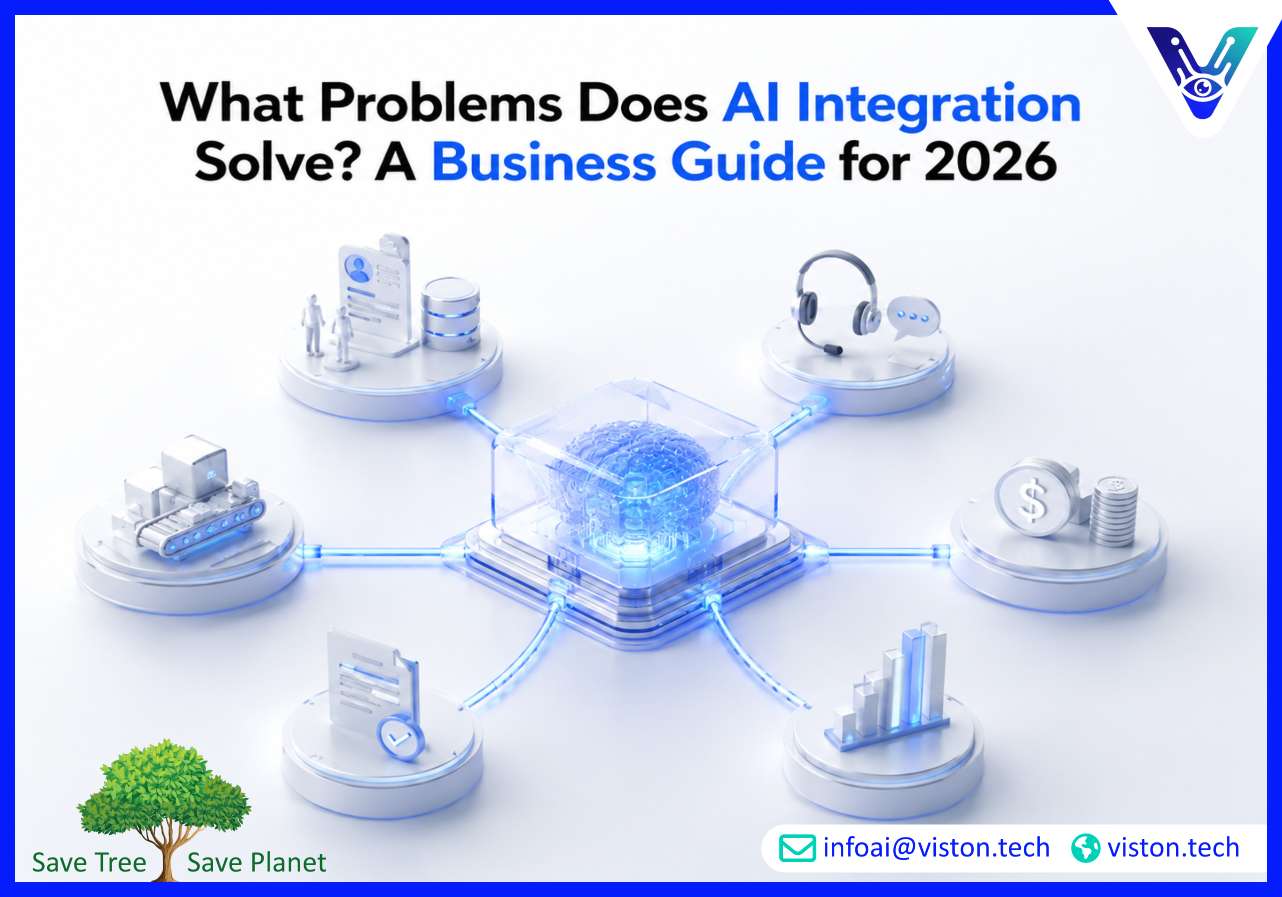
As businesses adopt artificial intelligence at a faster pace, many leaders are discovering that AI alone does not create value. The real impact comes when AI is integrated into existing systems, workflows, and business operations. AI integration helps organizations eliminate inefficiencies, improve decision-making, and create more connected digital processes that support growth and scalability.
Many organizations already use software platforms such as CRM systems, ERP solutions, customer support tools, communication platforms, and analytics applications. However, these systems often operate independently, creating data silos, manual work, and process bottlenecks.
AI integration connects intelligent automation capabilities with these existing systems, enabling businesses to automate repetitive tasks, access information faster, and improve operational efficiency.
In 2026, companies are increasingly focused on AI integration because they want practical business outcomes rather than isolated AI experiments. The goal is to embed intelligence directly into daily operations where measurable value can be achieved.
One of the most common business challenges is the amount of time employees spend on repetitive administrative tasks. Data entry, document processing, report generation, ticket routing, and information gathering can consume significant resources.
AI integration helps automate these activities by connecting AI agents with business systems and workflows. This reduces manual effort and allows teams to focus on higher-value work.
Many organizations struggle with fragmented technology environments. Customer information may reside in one platform, operational data in another, and communication records elsewhere.
AI integration enables systems to work together more effectively. AI agents can retrieve, process, and share information across multiple platforms, reducing data silos and improving visibility.
Business decisions often depend on gathering information from multiple sources. When data is scattered or difficult to access, decision-making slows down.
Integrated AI systems can analyze data from various business applications, summarize findings, identify patterns, and provide decision support in real time. This helps leaders respond more quickly to changing business conditions.
Customers expect fast and accurate responses. Support teams frequently deal with high ticket volumes, repetitive inquiries, and information retrieval challenges.
AI integration helps connect support platforms, knowledge bases, customer records, and communication channels. This allows AI-powered systems to provide faster responses, route issues correctly, and support agents with relevant information.
Many business processes involve multiple departments, approvals, and handoffs. Delays often occur when information must be manually transferred between teams or systems.
AI integration streamlines workflows by enabling intelligent automation across departments. AI agents can coordinate tasks, trigger actions, update systems, and escalate exceptions when necessary.
Data errors, duplicate records, and outdated information create operational problems and reduce confidence in reporting.
Integrated AI solutions can help validate data, identify inconsistencies, enrich records, and maintain higher-quality information across business systems.
As businesses grow, manual processes become increasingly difficult to manage. Hiring additional staff for every operational increase is rarely sustainable.
AI integration enables organizations to scale operations more efficiently by automating routine work while maintaining consistency and control.
Organizations that successfully integrate AI often experience benefits that extend beyond automation.
These outcomes make AI integration a strategic initiative rather than simply a technology upgrade.
AI agents can qualify leads, update CRM records, schedule follow-ups, generate summaries, and support sales teams with actionable insights.
Integrated AI systems can classify tickets, retrieve knowledge articles, draft responses, and assist support teams in resolving customer issues more efficiently.
Businesses use AI integration to automate invoice processing, reconcile transactions, detect anomalies, and support financial reporting workflows.
AI can streamline recruitment workflows, employee onboarding, document management, policy support, and internal service requests.
Organizations use AI integration to automate approvals, coordinate tasks, monitor workflows, and improve process visibility across departments.
Successfully integrating AI requires more than deploying a model or chatbot. Businesses need structured implementation that connects AI agents with existing systems, workflows, and operational requirements.
Agent Integration Services focus on designing, deploying, and managing AI-powered workflows that work within real business environments. This includes system integration, workflow orchestration, security controls, automation design, testing, monitoring, and optimization.
Organizations often achieve better outcomes when AI integration is approached as a business transformation initiative rather than a standalone technology project.
For businesses looking to solve operational inefficiencies through AI, Viston AI provides Agent Integration Services that help connect AI agents with existing business systems and workflows. Its approach focuses on practical implementation, enabling organizations to automate processes, improve information flow, and create more coordinated operations.
Whether the objective is workflow automation, customer support enhancement, sales process optimization, or intelligent business operations, effective AI integration requires careful planning, secure system connectivity, and ongoing optimization. Viston AI helps businesses identify opportunities where AI agents can deliver measurable value while ensuring integrations align with operational goals.
By focusing on scalable and business-oriented AI deployment, organizations can move beyond isolated AI tools and build integrated systems that support long-term growth and efficiency.
AI integration is the process of connecting artificial intelligence technologies with existing business systems, applications, data sources, and workflows to improve operational efficiency and business outcomes.
AI integration can address manual processes, disconnected systems, workflow bottlenecks, slow decision-making, customer service delays, data quality issues, and scalability challenges.
A chatbot is typically a standalone application, while AI integration connects AI capabilities directly with business systems and workflows to automate and support broader operational processes.
Sales, customer service, finance, operations, human resources, marketing, and data management teams can all benefit from integrated AI solutions.
Yes. Viston AI provides Agent Integration Services that help businesses connect AI agents with existing systems, automate workflows, and improve operational efficiency.
Understanding what problems AI integration solves is essential for organizations seeking meaningful business outcomes from artificial intelligence. AI integration addresses operational inefficiencies, disconnected systems, workflow bottlenecks, data challenges, and scalability limitations by embedding intelligent capabilities directly into business processes. Through effective Agent Integration Services, companies can create more efficient, connected, and responsive operations. For businesses exploring AI-driven transformation, Viston AI provides expertise in integrating AI agents into real-world workflows, helping organizations unlock practical and measurable value from their AI investments.
