
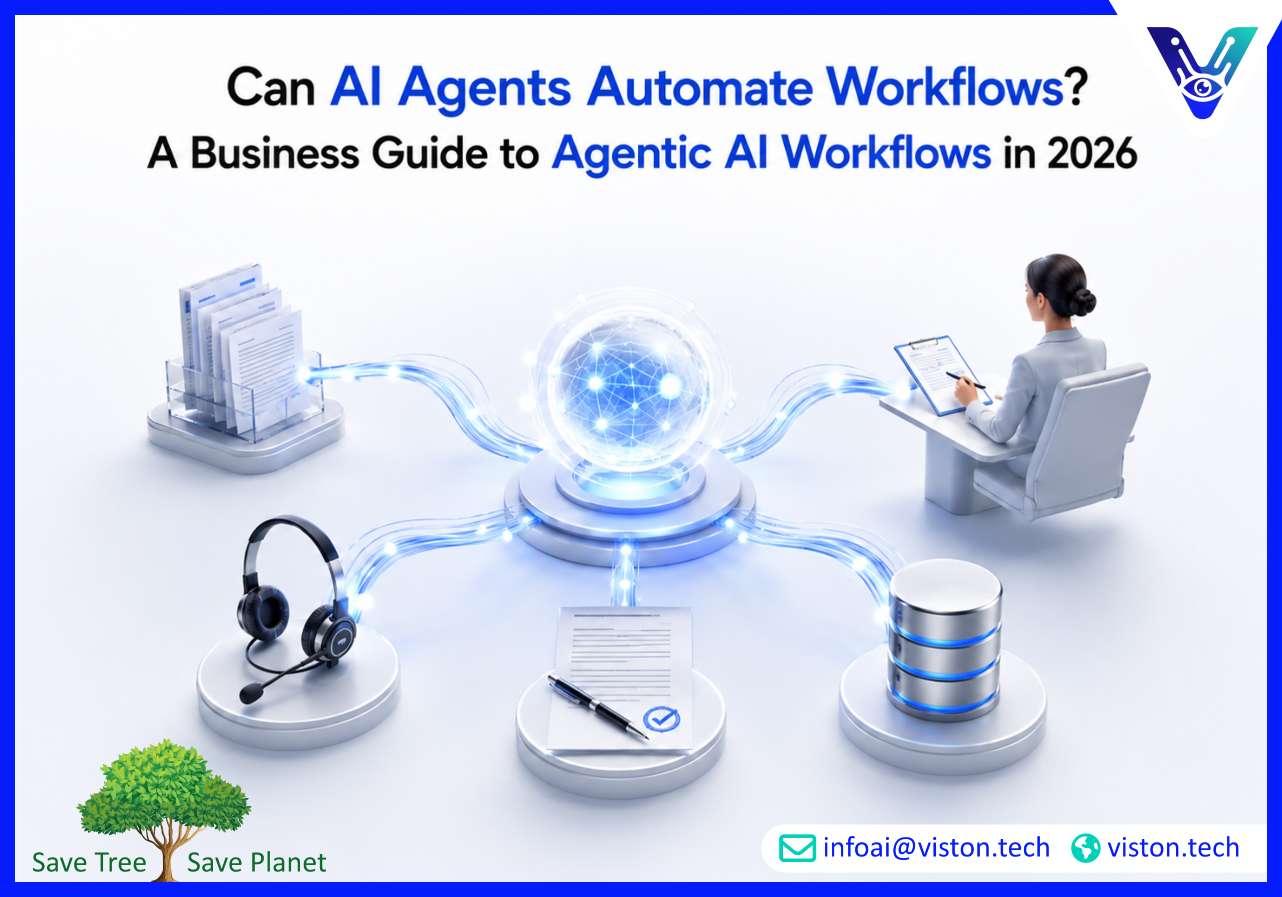
Businesses are under increasing pressure to improve efficiency, reduce manual effort, and respond faster to customers and operational demands. As artificial intelligence evolves, many organizations are asking a practical question: can AI agents automate workflows? In 2026, the answer is increasingly yes—but the value depends on how those agents are designed, integrated, and governed within real business processes.
AI agents are software systems capable of performing tasks, making decisions, interacting with tools, and executing actions with varying levels of autonomy. Unlike traditional automation that follows fixed rules, AI agents can interpret context, retrieve information, adapt to changing inputs, and coordinate multiple steps within a workflow.
Workflow automation with AI agents goes beyond simple task execution. An agent can:
This approach is commonly known as Agentic AI Workflows, where intelligent agents perform coordinated work across systems, departments, and business functions.
Organizations have spent years investing in automation platforms, yet many business processes still require significant manual coordination. Modern workflows often span CRM systems, ERP platforms, customer support tools, communication channels, databases, and document repositories.
AI agents help bridge these gaps by acting as operational participants rather than passive tools.
Businesses want to automate more than repetitive tasks. They need systems capable of handling exceptions, understanding business context, and making workflow decisions within predefined boundaries.
AI agents help organizations:
In 2026, organizations are increasingly adopting agentic architectures where multiple AI agents work together to execute business processes. Instead of relying on one general-purpose assistant, specialized agents perform dedicated roles within a larger workflow.
This creates more reliable, controllable, and scalable automation environments.
AI agents can support a wide range of workflows across departments. The most effective use cases involve repetitive, data-driven, and process-oriented activities that require coordination between systems.
Sales teams often spend significant time on administrative tasks. AI agents can automate:
This allows sales professionals to focus on relationship building and revenue generation.
Support workflows frequently involve information gathering, routing, response generation, and escalation.
AI agents can:
Financial workflows often involve repetitive document handling and verification tasks.
AI agents can support:
HR teams manage numerous operational processes that require consistency and compliance.
AI agents can assist with:
Many organizations struggle to access information spread across multiple systems.
AI agents can:
While AI agents can automate workflows, successful implementation requires more than deploying a language model. Businesses must focus on process design, governance, and integration.
AI agents need access to the systems where work happens. Effective workflow automation often requires integration with:
Without integration, agents remain isolated and deliver limited operational value.
Each agent should have a clearly defined purpose. Businesses often achieve better results when agents specialize in specific functions rather than attempting to handle every aspect of a workflow.
Not every business decision should be fully automated. Human-in-the-loop controls remain important for:
Well-designed workflows balance automation efficiency with appropriate oversight.
As AI agents gain access to enterprise systems and sensitive data, governance becomes critical. Organizations should establish clear controls around permissions, monitoring, audit logging, and compliance requirements.
For organizations exploring whether AI agents can automate workflows, the challenge is rarely the AI itself. The real challenge is designing workflows that connect business goals, operational processes, data sources, and technology systems effectively.
Viston AI specializes in Agentic AI Workflows that help businesses move beyond isolated automation projects and implement coordinated AI-driven operations. This includes workflow analysis, agent design, orchestration planning, system integration, governance implementation, and deployment support.
Agentic AI Workflows require more than task automation. They involve creating intelligent systems capable of executing business processes across applications, teams, and data environments while maintaining transparency and control.
Whether the objective is improving customer support, streamlining sales operations, automating internal processes, or enhancing knowledge management, a structured workflow architecture is essential for achieving measurable business outcomes. Viston AI helps organizations identify high-value automation opportunities and build scalable agentic systems aligned with operational requirements.
Some workflows can be largely automated, while others require human oversight for approvals, exceptions, compliance, or strategic decisions. The level of automation depends on workflow complexity and risk.
Traditional automation follows predefined rules. AI agents can interpret context, retrieve information, adapt to changing inputs, and make workflow decisions within approved boundaries.
Organizations across industries can benefit, particularly those managing repetitive processes, large data volumes, customer interactions, document workflows, or operational coordination challenges.
Yes. Effective workflow automation typically requires integration with CRM platforms, ERP systems, communication tools, databases, and other operational applications.
They can be when implemented with proper governance, access controls, monitoring, audit trails, and compliance safeguards. Security planning should be part of every deployment.
Yes. Viston AI provides expertise in Agentic AI Workflows, helping organizations design, integrate, orchestrate, and optimize AI-powered workflow automation aligned with business objectives.
So, can AI agents automate workflows? In 2026, they can automate many business processes more effectively than traditional automation alone by combining intelligence, adaptability, and system connectivity. However, successful automation depends on thoughtful workflow design, reliable integrations, governance controls, and clear operational objectives. Agentic AI Workflows enable businesses to automate complex processes while maintaining visibility and control. For organizations looking to transform operations through intelligent automation, Viston AI provides the expertise needed to build scalable, business-focused workflow solutions.
