
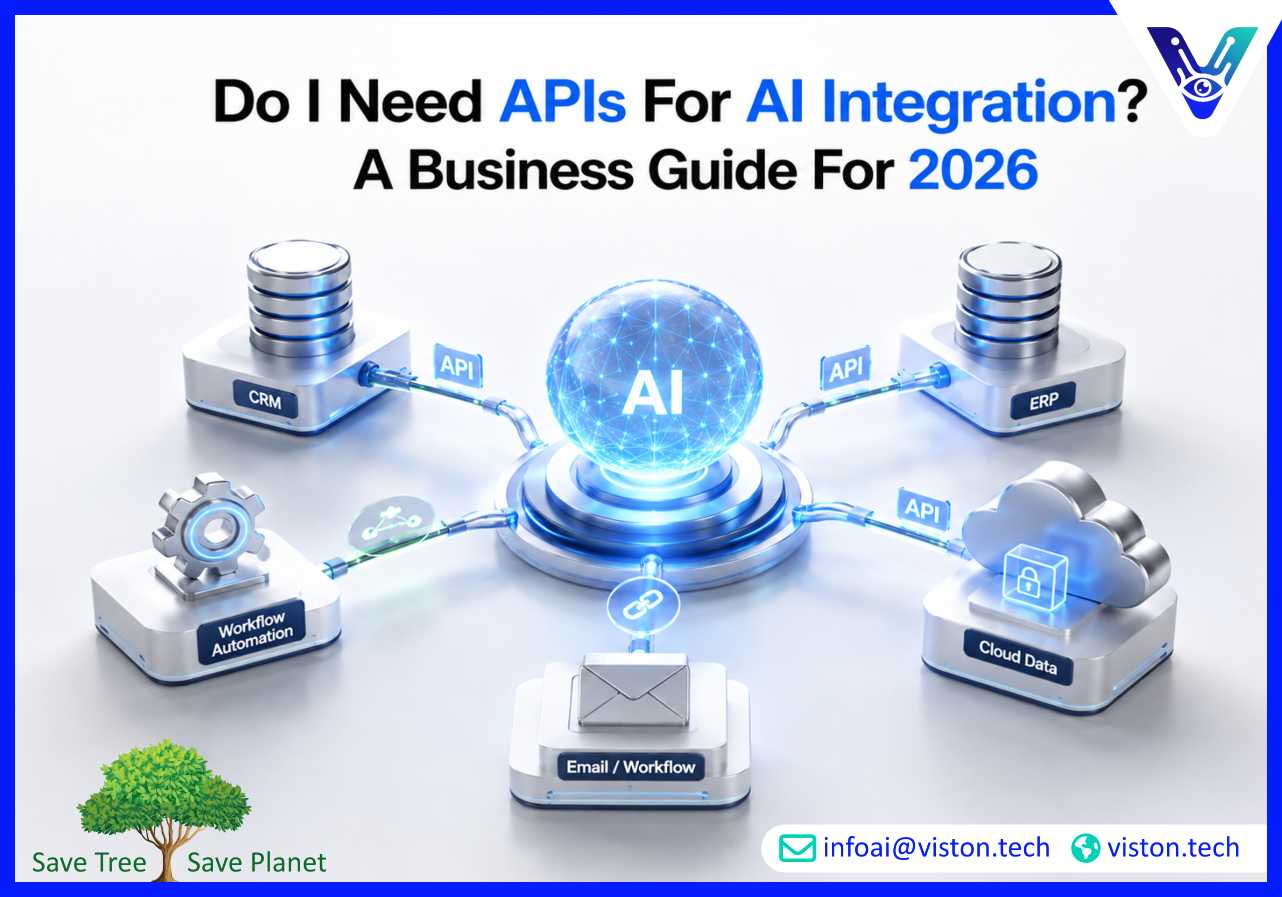
As businesses adopt AI agents to automate workflows, improve customer experiences, and streamline operations, one question comes up repeatedly: do you need APIs for AI integration? The short answer is no—not always. However, APIs often play a critical role in unlocking the full value of AI integration by enabling AI agents to communicate with business systems, applications, and data sources.
An API (Application Programming Interface) acts as a bridge that allows different software systems to exchange information and perform actions. In AI integration projects, APIs help AI agents access data, trigger workflows, update records, retrieve information, and interact with external platforms.
Without integration capabilities, an AI agent may only provide information within a standalone interface. With APIs, the same agent can become an active participant in business operations.
For example, an AI sales assistant could:
These actions are typically enabled through APIs or other integration methods.
No. The need for APIs depends on what the AI solution is expected to accomplish.
Some AI deployments operate independently without needing access to external systems. Examples include:
In these situations, the AI primarily processes information provided directly by users or stored within its environment.
APIs become important when AI agents need to interact with business systems and perform real operational tasks.
Common examples include:
In these scenarios, APIs allow AI systems to move beyond answering questions and actively support business processes.
While APIs are often the preferred integration method, they are not the only option available in 2026.
Many modern platforms offer pre-built connectors that allow businesses to connect AI solutions with popular applications without custom API development.
Examples include integrations with:
These integrations often simplify deployment and reduce development effort.
Some organizations use RPA tools to automate interactions with systems that do not provide modern APIs. This can be useful for legacy software environments where direct integration options are limited.
AI systems may access structured business data directly through secure database connections instead of relying solely on APIs.
This approach is often used for reporting, analytics, and internal business intelligence applications.
Although alternatives exist, APIs remain one of the most reliable methods for AI integration because they provide structured, secure, and scalable communication between systems.
AI agents can access current information rather than relying on outdated datasets or manual updates.
APIs allow AI agents to trigger actions automatically, reducing manual intervention across business processes.
Direct integration reduces data duplication and minimizes errors associated with manual data entry.
As businesses expand, API-driven integrations can support growing workloads, users, and operational complexity.
AI agents connected to customer systems can provide faster, more personalized, and more accurate responses.
Modern AI agent integration projects frequently involve connections to multiple platforms.
Common integration targets include:
The more operational responsibilities assigned to AI agents, the more important integration architecture becomes.
Before starting an AI integration project, businesses should evaluate several factors.
Determine whether existing applications provide APIs or require alternative integration approaches.
AI agents should only access authorized systems and data through secure authentication and permission controls.
Even the best integration architecture cannot compensate for poor-quality business data.
More complex processes often require multiple integrations, orchestration logic, and governance controls.
Organizations should design integrations that can support future AI capabilities, additional workflows, and expanding business requirements.
For businesses evaluating whether APIs are necessary for AI adoption, Viston AI’s Agent Integration Services help identify the most practical integration approach based on operational goals, existing systems, and workflow requirements.
Not every AI implementation requires extensive custom API development. In some cases, pre-built connectors, workflow automation platforms, or existing integrations may be sufficient. In others, secure API integration becomes essential for enabling AI agents to interact with CRMs, ERP systems, customer support platforms, internal databases, and other business-critical applications.
Viston AI helps organizations assess integration readiness, design scalable architectures, connect AI agents with operational systems, and implement workflow automation that supports measurable business outcomes. The focus is on creating reliable, secure, and business-aligned AI integrations rather than deploying isolated AI tools.
No. Basic AI applications can function without APIs, but AI agents that need to access systems, data, or workflows typically require APIs or alternative integration methods.
Yes. Businesses can use RPA tools, database connections, middleware platforms, or custom integration solutions when APIs are unavailable.
When properly designed, APIs can provide secure authentication, authorization, encryption, monitoring, and access controls that support enterprise security requirements.
AI agents often connect to CRM platforms, ERP systems, customer support software, knowledge bases, analytics tools, and communication platforms.
Yes. Viston AI’s Agent Integration Services help businesses evaluate whether APIs, connectors, workflow automation tools, or hybrid approaches are best suited for their AI integration objectives.
Whether you need APIs for AI integration depends on what you want your AI solution to achieve. Standalone AI tools may require little or no integration, while AI agents that automate workflows and interact with business systems typically rely on APIs to deliver meaningful operational value. As organizations increasingly adopt AI-driven automation in 2026, choosing the right integration strategy becomes as important as selecting the AI technology itself. Through Agent Integration Services, Viston AI helps businesses build practical, scalable, and secure AI integrations that align with real business processes and growth objectives.
