
Many organizations are interested in artificial intelligence but struggle to identify where it can deliver immediate value. The good news is that AI agent integration does not always require large-scale transformation projects. In 2026, businesses can achieve meaningful operational improvements through targeted, practical AI agent deployments that address specific workflow challenges and deliver measurable results quickly.
AI adoption has matured significantly, and business leaders are increasingly focused on outcomes rather than experimentation. Instead of deploying AI for the sake of innovation, organizations want solutions that reduce manual work, improve efficiency, and support business growth.
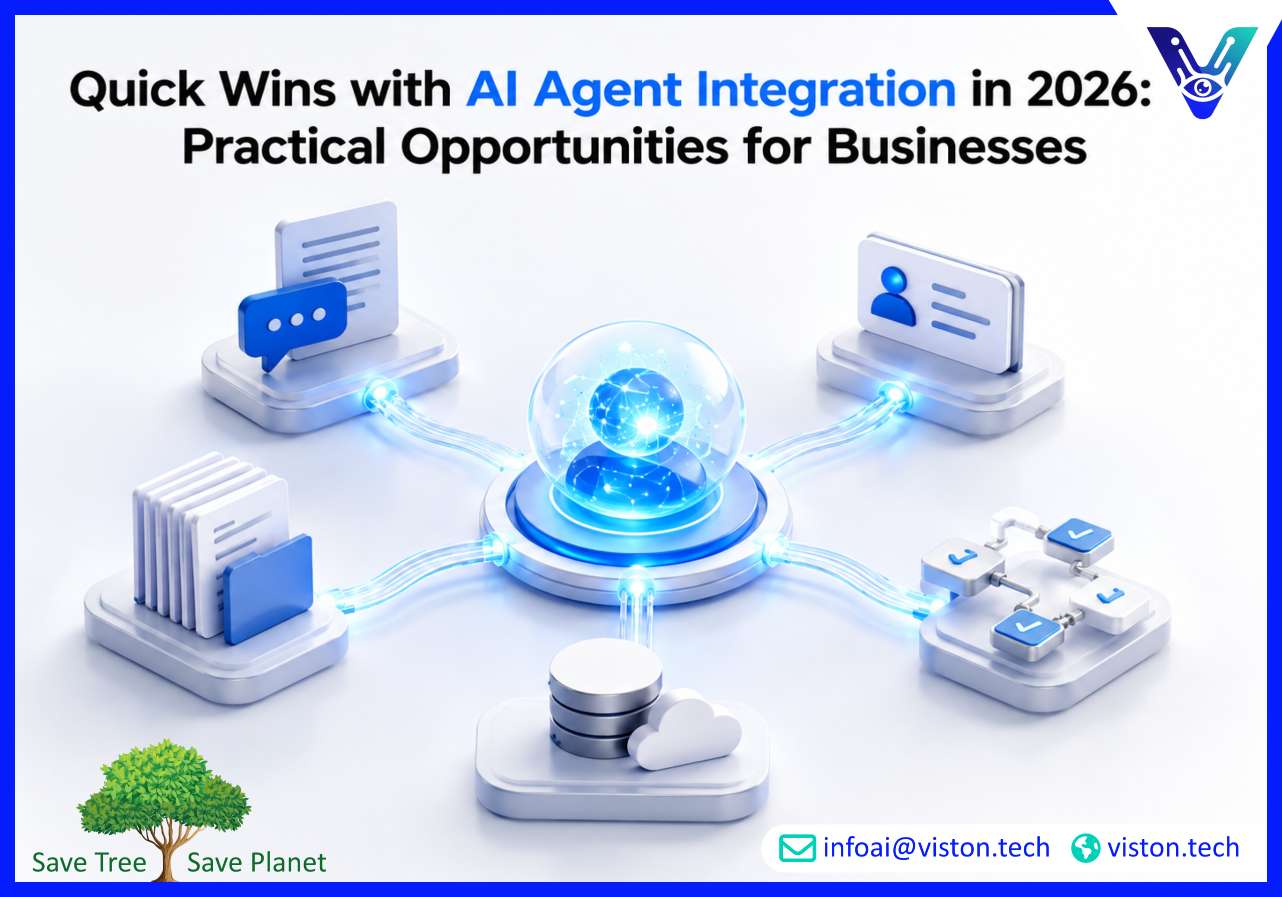
AI agent integration allows businesses to embed intelligent agents into existing workflows, systems, and processes. These agents can retrieve information, perform actions, communicate across platforms, automate repetitive tasks, and support decision-making without requiring complete operational redesign.
Quick wins are especially valuable because they help organizations:
Rather than attempting enterprise-wide deployment immediately, successful organizations often start with focused use cases that generate visible business impact within weeks or months.
Not every business process is suitable for immediate AI integration. The strongest opportunities typically involve repetitive tasks, information retrieval, workflow coordination, and routine decision support.
Support teams often spend significant time categorizing incoming tickets, identifying priority levels, and routing requests to the appropriate departments. AI agents can automatically analyze requests, classify issues, retrieve relevant context, and assign tickets to the right teams.
This reduces response delays while helping support staff focus on more complex customer issues.
Sales teams frequently lose time gathering prospect information and manually updating CRM systems. AI agents can enrich lead data, verify information, qualify prospects against predefined criteria, and update CRM records automatically.
These improvements help sales teams spend more time engaging qualified opportunities rather than performing administrative work.
Employees often waste valuable time searching for policies, procedures, technical documentation, or operational information across multiple systems.
AI agents connected to knowledge repositories can retrieve accurate answers quickly, improving productivity and reducing dependence on internal support teams.
Many organizations struggle with missed action items and inconsistent follow-up after meetings. AI agents can summarize discussions, generate action lists, assign responsibilities, and create reminders within project management systems.
This helps maintain momentum and accountability across teams.
Quick-win projects are most effective when they target specific operational pain points that already affect performance.
Manual data entry remains one of the most common sources of inefficiency and human error. AI agents can extract information from emails, forms, documents, and applications while updating business systems automatically.
This improves accuracy while freeing employees to focus on higher-value work.
Many businesses operate across multiple platforms that do not communicate effectively with one another. AI agents can act as connectors, retrieving information from different systems and presenting it within a unified workflow.
This improves visibility and reduces time spent switching between applications.
Whether in customer service, sales, operations, or HR, delayed responses can impact business performance. AI agents can monitor requests, gather information, and initiate actions immediately, helping organizations respond faster and more consistently.
Employees often spend substantial time on repetitive administrative tasks. AI agents can automate routine activities such as scheduling, information gathering, reporting, document processing, and workflow updates.
The result is improved productivity without increasing headcount.
Organizations that achieve fast results typically follow a structured implementation approach rather than deploying AI randomly across the business.
Select one process that is repetitive, measurable, and operationally important. Focusing on a single workflow reduces complexity and makes it easier to evaluate success.
The best quick wins often come from processes that employees already find frustrating. These areas usually provide the clearest opportunities for automation and improvement.
AI agents deliver greater value when connected to existing business tools such as CRM platforms, ticketing systems, communication tools, databases, and workflow software.
This allows businesses to improve operations without disrupting established processes.
While AI agents can automate many activities, human review remains important for high-impact decisions, customer-facing communications, financial actions, and compliance-sensitive processes.
Combining automation with appropriate oversight helps reduce risk while maintaining trust.
Successful projects establish metrics before implementation. Common measurements include time savings, reduction in manual tasks, response speed improvements, workflow completion rates, and operational cost reductions.
Clear metrics help demonstrate business value and guide future AI investments.
Organizations seeking practical AI adoption often need support identifying the right opportunities and implementing solutions effectively. Viston AI provides Agent Integration Services that help businesses connect AI agents with existing workflows, systems, and operational processes.
Rather than focusing solely on AI technology, the approach centers on solving business challenges through structured integration strategies. This includes evaluating workflows, identifying automation opportunities, designing agent interactions, integrating business systems, and establishing governance controls.
For businesses looking for quick wins, Agent Integration Services can support initiatives such as lead qualification automation, customer support workflow optimization, knowledge management enhancement, document processing, internal operations automation, and workflow orchestration.
By aligning AI agent capabilities with specific business objectives, organizations can achieve measurable improvements without undertaking large-scale transformation projects. This practical approach helps businesses realize value faster while building a foundation for broader AI adoption over time.
AI agent integration services help businesses connect AI agents with existing systems, workflows, applications, and business processes to automate tasks and improve operational efficiency.
Customer support ticket routing, lead qualification automation, knowledge retrieval systems, and document processing workflows are often among the fastest and highest-impact implementations.
Simple AI agent integrations can begin delivering measurable improvements within a few weeks, depending on workflow complexity, integration requirements, and business readiness.
Most business-focused AI agents are designed to support employees by automating repetitive tasks and improving productivity rather than replacing human expertise.
Yes. Modern AI agents can integrate with CRM systems, helpdesk platforms, databases, communication tools, document repositories, ERP systems, and many other business applications.
Viston AI provides Agent Integration Services that help businesses identify practical AI opportunities, integrate agents with existing workflows, and implement scalable automation solutions aligned with business goals.
Quick wins with AI agent integration offer businesses a practical way to capture value from artificial intelligence without committing to large-scale transformation efforts. By targeting repetitive workflows, operational bottlenecks, and productivity challenges, organizations can achieve measurable improvements in efficiency, responsiveness, and workflow performance. Agent Integration Services play a critical role in ensuring these implementations align with business objectives and existing systems. For companies exploring practical AI adoption strategies in 2026, Viston AI provides expertise that helps turn AI potential into meaningful operational outcomes.
