
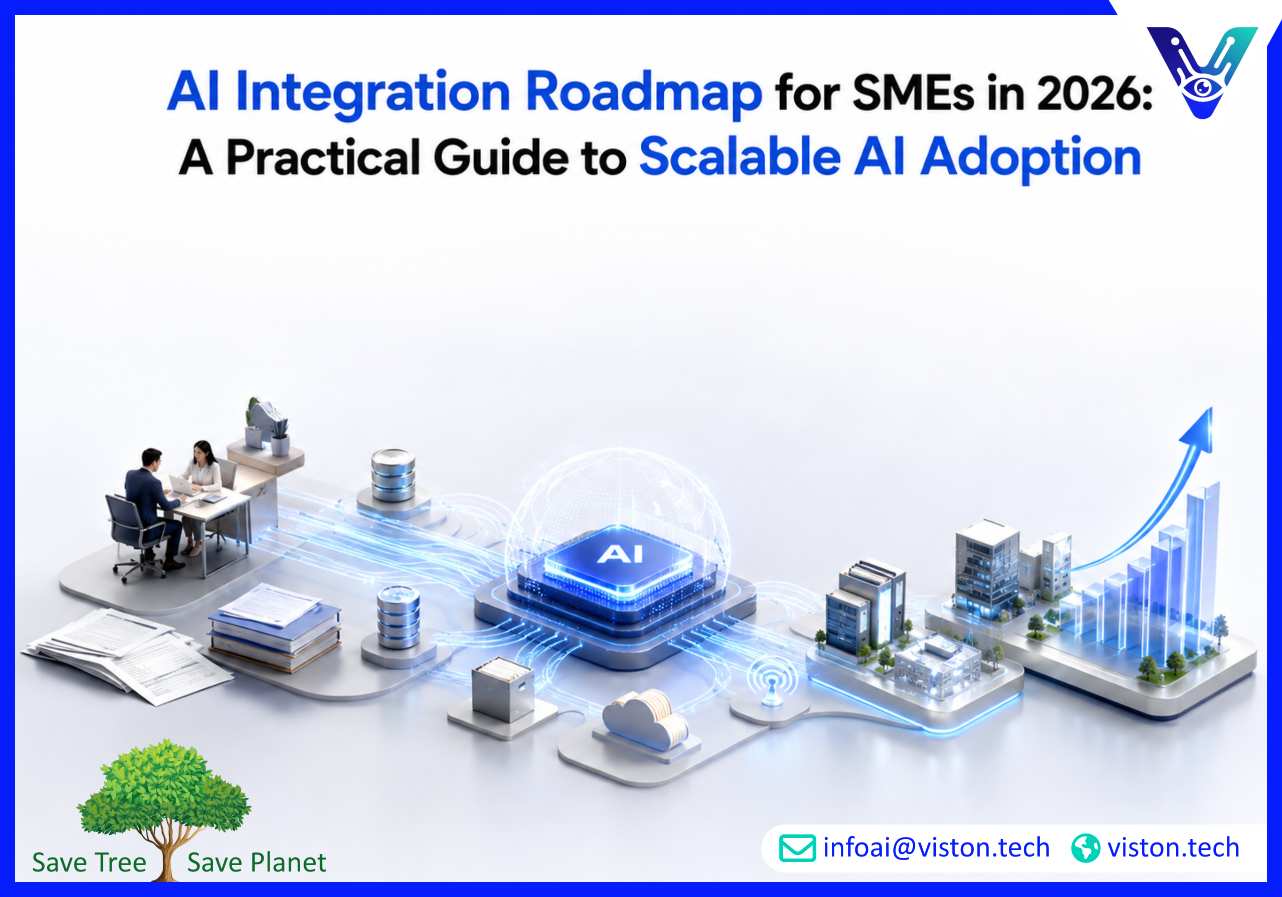
Small and medium-sized enterprises are increasingly exploring artificial intelligence to improve efficiency, automate repetitive work, and make better business decisions. However, many SMEs struggle with where to begin, which technologies to prioritize, and how to implement AI without disrupting operations. A structured AI integration roadmap helps businesses adopt AI strategically, reduce risk, and achieve measurable outcomes.
Artificial intelligence is no longer limited to large enterprises with extensive budgets and dedicated data science teams. Modern AI platforms, cloud infrastructure, automation tools, and industry-specific solutions have made AI more accessible for growing businesses.
However, successful adoption requires more than purchasing software or deploying a chatbot. SMEs often face challenges such as limited resources, fragmented systems, unclear priorities, and uncertainty about return on investment. Without a roadmap, AI initiatives can become disconnected experiments that fail to deliver business value.
An AI integration roadmap provides a structured approach to identifying opportunities, prioritizing investments, managing implementation risks, and aligning AI initiatives with business goals.
Key benefits include:
Before selecting AI tools or launching projects, SMEs should evaluate their current business environment. The most successful AI implementations begin with operational assessment rather than technology selection.
Businesses should identify workflows that consume significant time, involve repetitive tasks, rely heavily on manual data processing, or create operational bottlenecks. These areas often provide the strongest opportunities for AI-driven improvements.
AI systems depend on access to accurate and organized information. SMEs should assess whether customer data, operational records, sales information, support interactions, and business documentation are accessible and reliable.
Existing software platforms, cloud systems, databases, CRM tools, ERP applications, and communication systems should be reviewed to determine integration requirements.
AI initiatives should support specific outcomes such as improving customer service, increasing sales efficiency, reducing costs, accelerating workflows, improving forecasting, or enhancing operational visibility.
A clear understanding of business priorities helps prevent unnecessary investments and ensures AI projects focus on measurable value.
An AI integration roadmap should follow a phased approach that balances quick wins with long-term transformation goals.
SMEs should begin by targeting business functions where AI can deliver immediate operational improvements.
Common starting points include:
Prioritizing achievable projects helps build organizational confidence and demonstrates value early in the adoption journey.
Once use cases are identified, businesses should determine how AI systems will interact with existing platforms.
Typical integration requirements include:
Integration planning ensures AI solutions operate within existing workflows rather than creating isolated systems.
As AI becomes more involved in business operations, governance becomes increasingly important.
SMEs should define:
Responsible AI governance helps protect business data while maintaining operational trust.
Rather than attempting enterprise-wide deployment immediately, SMEs should launch controlled pilot initiatives.
Pilot projects allow businesses to:
Successful pilots create a foundation for broader AI adoption.
Once initial projects demonstrate measurable results, organizations can expand AI capabilities across departments and workflows.
Continuous optimization may include:
The roadmap should remain flexible to accommodate evolving business priorities and technological advancements.
Although every organization has unique requirements, several AI applications consistently deliver value for growing businesses.
AI-powered support systems can assist with ticket routing, knowledge retrieval, customer inquiries, and service workflows while improving response times.
AI can support lead scoring, prospect research, follow-up recommendations, CRM updates, and sales forecasting.
Businesses can use AI for audience segmentation, campaign analysis, content assistance, personalization, and performance reporting.
Routine administrative tasks such as document processing, data entry, reporting, scheduling, and workflow management can often be streamlined through AI-driven automation.
AI search and retrieval systems help employees access information quickly, reducing time spent searching for documents, policies, and business knowledge.
These use cases often provide practical starting points for SMEs building their AI capabilities.
Many SMEs understand the potential of AI but lack the internal expertise required to evaluate technologies, prioritize opportunities, design implementation strategies, and manage deployment risks. This is where AI & ML Strategic Consulting becomes valuable.
Strategic consulting helps organizations move beyond technology experimentation by aligning AI initiatives with business objectives. Instead of focusing solely on tools, consultants evaluate operational workflows, identify high-value use cases, assess readiness, and develop realistic implementation roadmaps.
Consulting support often includes:
This strategic approach helps SMEs invest confidently while minimizing implementation uncertainty.
For SMEs exploring artificial intelligence, developing a practical adoption strategy is often more challenging than selecting individual tools. Viston AI provides AI & ML Strategic Consulting services designed to help organizations evaluate opportunities, prioritize initiatives, and create scalable implementation plans aligned with business objectives.
Its consulting approach focuses on understanding operational workflows, identifying automation opportunities, assessing technology readiness, and building roadmaps that support sustainable AI adoption. Rather than pursuing AI for its own sake, the emphasis is placed on measurable business outcomes such as efficiency improvements, workflow optimization, customer experience enhancement, and operational scalability.
As AI technologies continue to evolve in 2026, SMEs increasingly require guidance that balances innovation with practical execution. Viston AI supports organizations by helping them navigate integration challenges, align AI investments with strategic goals, and establish a structured foundation for long-term growth.
An AI integration roadmap is a structured plan that helps businesses identify AI opportunities, prioritize initiatives, manage implementation risks, and align AI adoption with business objectives.
SMEs often have limited resources and must ensure technology investments deliver measurable value. A roadmap helps focus efforts on high-impact opportunities while reducing costly implementation mistakes.
Timelines vary depending on project complexity, infrastructure readiness, integration requirements, and business goals. Many SMEs begin with pilot projects that can be implemented within a few months.
Customer support automation, document processing, sales assistance, reporting automation, marketing optimization, and knowledge management systems are common starting points.
Not necessarily. Many modern AI solutions can provide value using existing business data, provided that information is accessible, organized, and relevant to the intended use case.
Yes. Viston AI’s AI & ML Strategic Consulting services help businesses assess readiness, identify opportunities, prioritize initiatives, and create structured AI adoption strategies aligned with operational goals.
An effective AI integration roadmap provides SMEs with a clear path from experimentation to meaningful business transformation. By focusing on readiness assessment, high-impact use cases, integration planning, governance, and phased implementation, businesses can adopt AI with greater confidence and measurable results. AI & ML Strategic Consulting plays a critical role in helping organizations navigate complexity, prioritize investments, and build scalable strategies. For SMEs seeking a structured approach to AI adoption in 2026, Viston AI offers expertise that helps connect artificial intelligence initiatives with practical business outcomes.
