
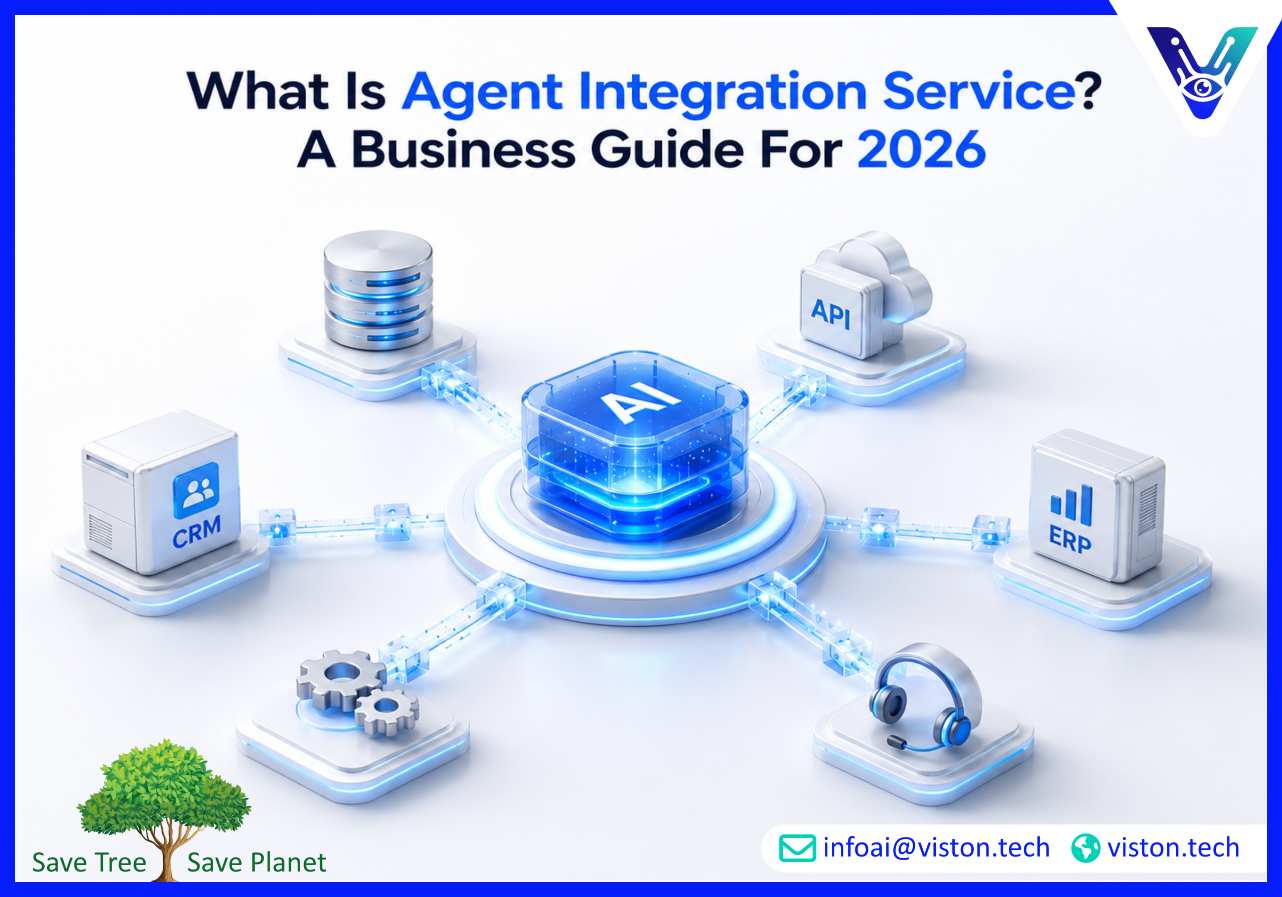
As AI adoption continues to accelerate, businesses are moving beyond standalone chatbots and experimenting with AI agents that can perform real operational tasks. However, an AI agent delivers value only when it can connect with business systems, access relevant data, and execute workflows. This is where agent integration services become important. In 2026, organizations are increasingly investing in agent integration to connect AI capabilities with their day-to-day operations.
Agent integration services involve connecting AI agents with business applications, databases, workflows, APIs, communication tools, and operational systems so they can perform meaningful business tasks.
An AI agent is designed to understand goals, retrieve information, make decisions within defined boundaries, and perform actions. Without integration, an AI agent functions primarily as a conversational tool. With integration, it becomes part of the organization’s operational infrastructure.
For example, an integrated AI agent may:
Agent integration services ensure these capabilities work securely, reliably, and in alignment with business objectives.
Many businesses discover that AI tools alone do not automatically improve productivity. Real value comes when AI agents can access the systems employees use every day.
As organizations adopt AI across departments, integrated agents help reduce manual work, improve process efficiency, and create more connected digital operations.
Rather than functioning as isolated assistants, integrated AI agents become active participants in business workflows.
AI agents often need access to multiple platforms, including CRM systems, ERP solutions, project management tools, support platforms, communication systems, and databases. Integration services establish secure connections between these systems and the agent environment.
Modern software platforms provide APIs that allow AI agents to retrieve information and perform actions. Agent integration specialists design and manage these connections to ensure reliable communication between systems.
Integrated agents can automate business processes such as lead qualification, ticket routing, document processing, customer onboarding, and internal approvals. Workflow design ensures agents operate according to business rules.
Agents require access to accurate and relevant information. Integration services help connect agents to approved data sources while maintaining security controls and governance requirements.
Enterprise AI implementations require strict access management, auditing, monitoring, permission controls, and compliance safeguards. Agent integration services help ensure AI operates within approved organizational boundaries.
Organizations across industries are using integrated AI agents to support operational efficiency and customer experience improvements.
The strongest results typically come from workflows that combine multiple systems, repetitive tasks, and high operational volume.
Successful agent integration projects require more than deploying an AI model. Organizations should evaluate:
A structured integration strategy helps ensure AI agents deliver measurable business value rather than creating operational risks.
As a provider of Agent Integration Services, Viston AI helps businesses connect AI agents with existing systems, workflows, and operational processes. The focus is not simply on deploying AI agents but on ensuring they can interact effectively with business tools, data sources, and enterprise applications.
Organizations often require integrations across CRM platforms, customer support systems, internal databases, APIs, workflow automation tools, and communication platforms. Viston AI supports the design, implementation, and optimization of these integrations so agents can perform meaningful business functions while maintaining security, governance, and operational reliability.
Whether businesses are exploring workflow automation, customer service enhancement, operational efficiency improvements, or multi-agent systems, effective integration is a critical component of successful AI adoption. Viston AI’s Agent Integration Services help bridge the gap between AI capabilities and real-world business execution.
Agent integration services connect AI agents with business systems, applications, data sources, and workflows so they can perform real operational tasks and automate business processes.
Chatbots primarily focus on conversations, while integrated AI agents can access systems, retrieve data, execute actions, and participate in business workflows.
AI agents can integrate with CRM platforms, ERP systems, databases, customer support tools, project management software, communication platforms, analytics systems, and custom applications.
Benefits include workflow automation, reduced manual effort, faster response times, improved operational efficiency, better data utilization, and enhanced scalability.
Yes. Businesses of all sizes can benefit from integrating AI agents into customer support, sales operations, administrative workflows, and business process automation.
Viston AI provides Agent Integration Services that help businesses connect AI agents with operational systems, workflows, APIs, and data sources to support practical business automation and AI adoption.
Agent integration services play a critical role in helping businesses move from isolated AI tools to practical AI-driven operations. By connecting AI agents with business systems, workflows, and data environments, organizations can automate tasks, improve efficiency, and create scalable operational processes. As AI adoption continues to mature in 2026, effective integration is becoming one of the most important factors in achieving measurable business outcomes. For organizations exploring AI-powered automation, Viston AI’s Agent Integration Services provide the expertise needed to connect AI capabilities with real business requirements.
