
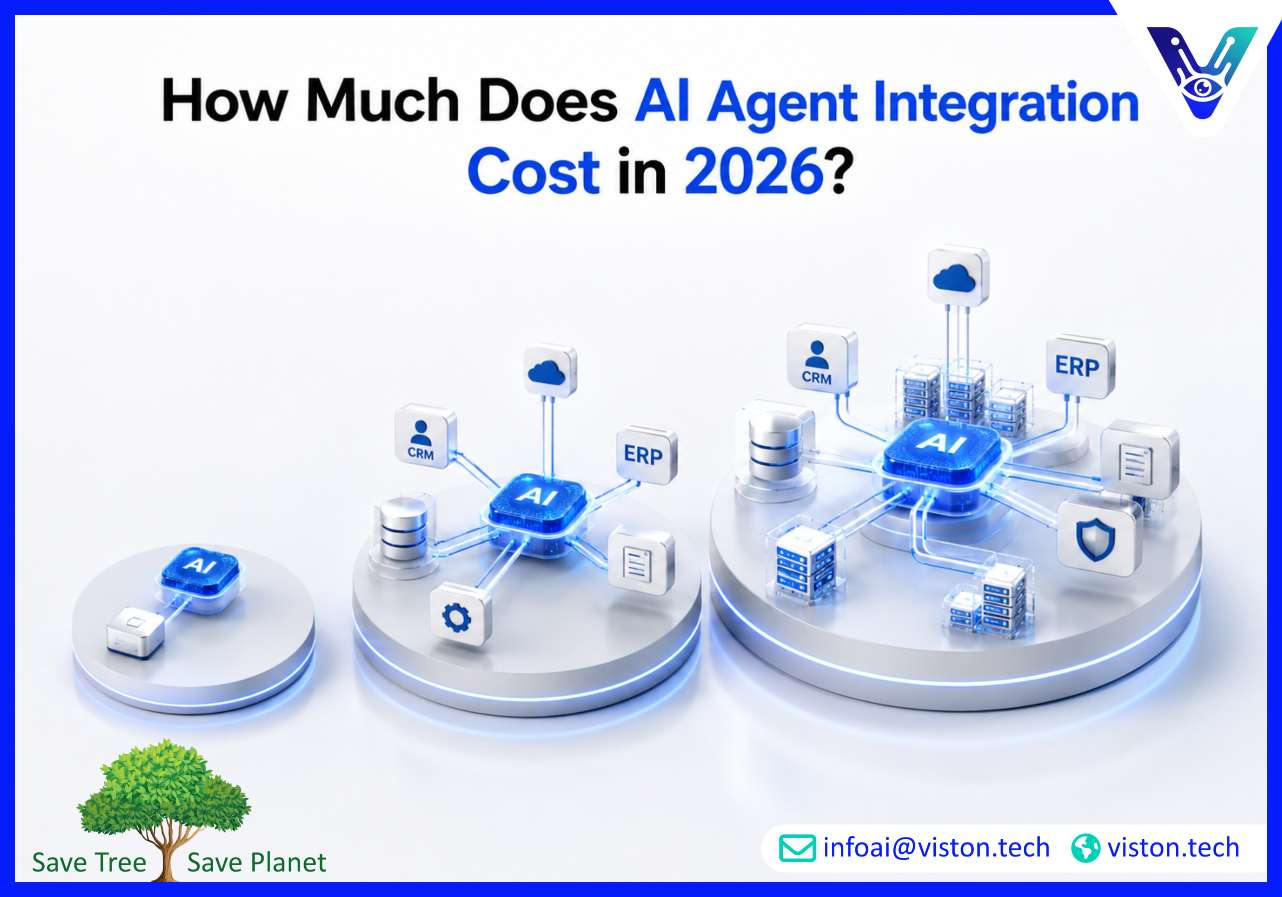
As businesses increasingly adopt AI agents to automate workflows, improve customer experiences, and streamline operations, one of the most common questions decision-makers ask is: how much does AI agent integration cost? The answer depends on the complexity of the integration, the systems involved, the level of automation required, and the business objectives behind the project.
AI agent integration is more than connecting a chatbot to a website. Modern AI agents often interact with CRMs, ERP systems, databases, communication platforms, knowledge bases, APIs, and workflow tools. The cost reflects both technical implementation and business process design.
Typical cost components include:
The more systems and workflows an AI agent must interact with, the greater the implementation effort.
A simple integration may involve connecting an AI agent to a website and CRM. More advanced projects may require integration with multiple internal platforms, databases, customer service systems, document repositories, and third-party APIs.
Each additional system introduces technical requirements, security considerations, and testing needs that can increase project costs.
AI agents handling straightforward tasks such as lead capture or FAQ responses are generally less expensive than agents managing complex workflows involving approvals, escalations, document processing, or multi-step decision-making.
Businesses seeking end-to-end automation often require more sophisticated orchestration and workflow design.
Organizations with unique business processes may require custom integrations, specialized workflows, proprietary system connections, or industry-specific functionality. These requirements typically increase implementation time and cost.
Many AI agents rely on company knowledge bases, operational documentation, customer records, or internal databases. Preparing and organizing this information often represents a significant portion of project effort.
Industries handling sensitive information often require additional security controls, access management, audit logging, governance frameworks, and compliance reviews. These measures contribute to overall project investment but are critical for reliable deployment.
While pricing varies by provider and project scope, businesses can generally expect the following ranges:
These ranges should be viewed as directional estimates rather than fixed pricing because every integration project has unique requirements.
The most successful organizations focus on high-value use cases first rather than attempting to automate everything at once.
Implementing a targeted workflow allows businesses to validate ROI before expanding AI agent usage across additional departments.
Integrating with well-documented platforms and modern APIs can reduce implementation complexity and shorten project timelines.
Projects with clearly defined outcomes tend to avoid unnecessary development costs and scope expansion.
Building a flexible foundation allows future workflows and integrations to be added more efficiently.
Cost should not be the only evaluation factor. Businesses should assess whether a provider can deliver reliable, scalable, and secure integrations aligned with business goals.
Important evaluation criteria include:
The lowest-cost solution often becomes more expensive if it requires significant rework or fails to achieve operational objectives.
For organizations evaluating AI agent integration costs, understanding the implementation approach is just as important as understanding the budget. Viston AI provides Agent Integration Services focused on connecting AI agents with real business workflows, systems, and operational processes.
Its approach emphasizes practical implementation, including workflow analysis, system integration planning, API connectivity, orchestration design, automation strategy, testing, and deployment support. Rather than treating AI agents as standalone tools, the focus is on integrating them into existing business operations where they can create measurable value.
Whether businesses are exploring customer service automation, lead management workflows, operational efficiency initiatives, or internal process automation, effective integration requires careful planning and execution. Viston AI helps organizations build AI agent solutions that align with operational requirements while supporting scalability and long-term business goals.
Basic AI agent integrations typically range from $3,000 to $10,000, depending on workflow complexity, customization requirements, and system integrations.
Costs depend on factors such as the number of connected systems, workflow complexity, data requirements, security needs, custom development, and ongoing support requirements.
Most projects include initial implementation costs along with ongoing expenses for maintenance, monitoring, optimization, model updates, and infrastructure usage.
High-volume workflows with repetitive manual tasks often generate the fastest ROI because they reduce operational effort while improving consistency and response times.
Yes. Many small and mid-sized businesses begin with focused automation projects that deliver measurable value before expanding into larger AI initiatives.
Yes. Viston AI’s Agent Integration Services can help businesses assess workflow requirements, integration complexity, and implementation scope to develop realistic project plans and cost expectations.
Understanding how much AI agent integration costs requires evaluating business goals, workflow complexity, system requirements, security needs, and long-term scalability. While basic projects can start with relatively modest investments, enterprise-grade implementations often involve broader integration, governance, and orchestration requirements. The most successful organizations focus on business outcomes rather than technology alone. By approaching AI agent integration strategically, businesses can achieve meaningful operational improvements while maximizing the return on their automation investments. For companies exploring Agent Integration Services, Viston AI offers expertise that helps align AI integration initiatives with practical business objectives.
