
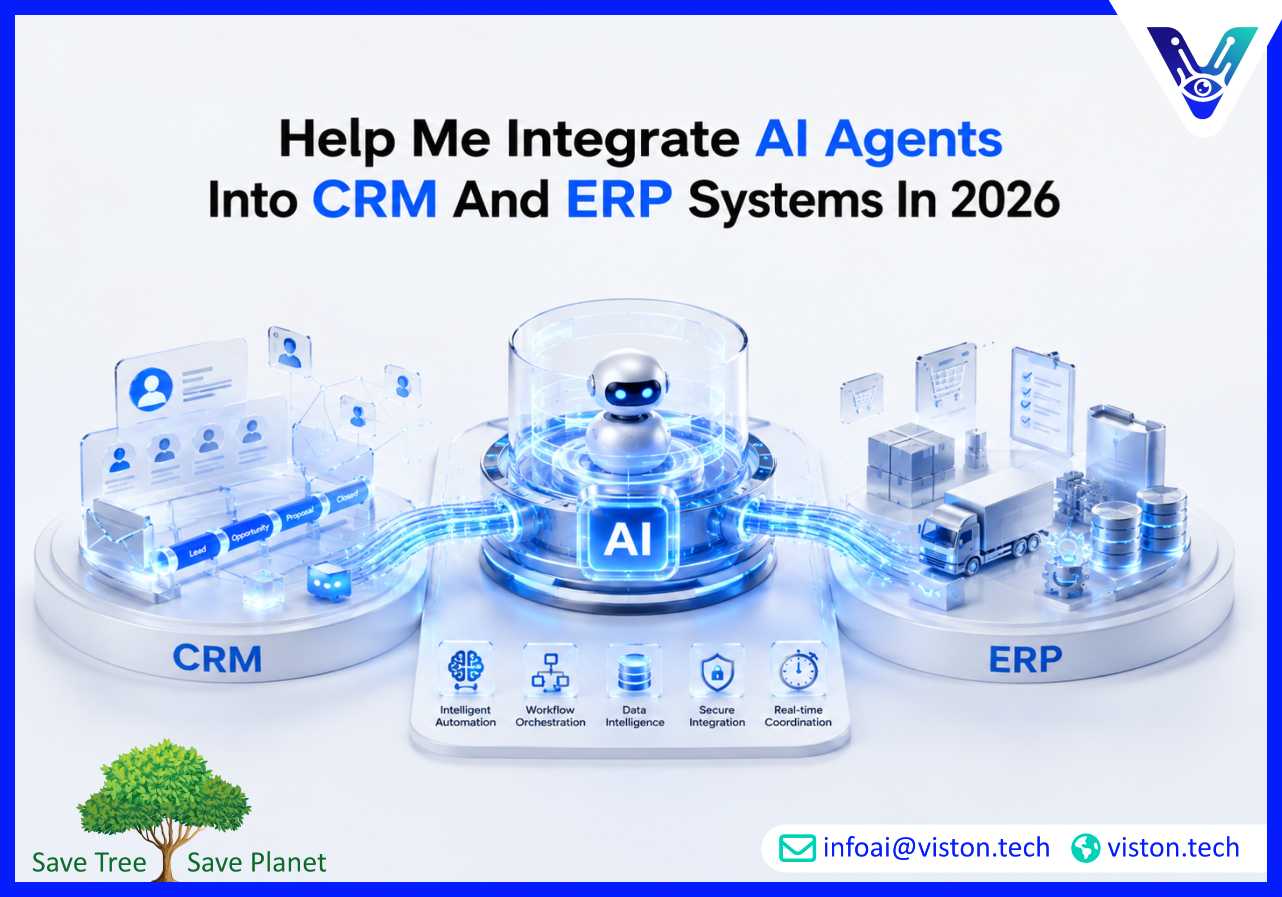
Integrating AI agents into CRM and ERP systems helps businesses turn disconnected customer, sales, finance, inventory, and operations data into intelligent workflows that can automate tasks, improve decisions, and reduce manual coordination across teams.
When a business says, “Help me integrate AI agents into my CRM and ERP systems,” the real need is usually not just a chatbot or a simple automation rule. It is a request to connect intelligent AI agents with the core systems that manage customers, revenue, operations, orders, inventory, finance, service, and reporting.
A CRM system manages customer relationships, sales pipelines, service requests, marketing activity, account history, and customer communication. An ERP system manages operational and financial processes such as procurement, inventory, production, billing, accounting, supply chain, HR, and business resources. When AI agents are connected to these systems properly, they can retrieve information, analyze records, update workflows, trigger actions, generate recommendations, and support employees with timely context.
AI agent integration services focus on designing and deploying these connections in a secure, controlled, and business-ready way. The goal is not to replace CRM or ERP platforms. The goal is to make them more intelligent, responsive, and useful for daily operations.
For example, an AI agent connected to a CRM can summarize customer history before a sales call, identify stalled opportunities, draft follow-up emails, or recommend next-best actions. An agent connected to an ERP can detect delayed purchase orders, flag inventory risks, prepare finance summaries, or support approval workflows. When both systems are connected, agents can help sales, finance, support, and operations work from the same business context.
In 2026, many businesses already use CRM and ERP platforms, but teams still spend significant time moving information between systems, checking records manually, preparing reports, and chasing approvals. AI agents are valuable because they can work across these systems instead of sitting inside one isolated tool.
The demand for AI agent integration services is growing because business leaders want measurable improvements, not experimental AI features. They want automation that supports revenue, customer experience, operational accuracy, financial visibility, and employee productivity.
AI agents can support these processes by reading data, understanding context, generating summaries, recommending actions, and executing approved tasks. However, the quality of the integration determines whether the result is useful or risky.
A poorly integrated AI agent may access outdated data, update the wrong record, expose sensitive information, duplicate tasks, or create confusion between departments. A properly integrated agent works with defined permissions, clean data access, workflow rules, validation steps, and human approval where needed.
Effective CRM and ERP integration begins with workflow design. A business should not start by asking which AI model to use. It should start by asking which process needs improvement, which systems contain the required data, which decisions can be supported by AI, and which actions need human approval.
AI agents can make CRM systems more actionable by reducing manual work and improving customer visibility. Common CRM use cases include:
ERP systems are often data-rich but difficult for non-technical teams to navigate quickly. AI agents can help users interact with ERP data more naturally and act faster on operational signals.
The biggest value often appears when AI agents connect CRM and ERP workflows together. For example, a sales team may need to know whether a large customer order can be fulfilled before committing to a delivery date. A support team may need to check invoice status, shipment details, and account history before responding to a customer. A finance team may need CRM contract details and ERP billing data to investigate revenue leakage.
AI agents can act as intelligent workflow bridges. They can collect context from both systems, identify missing information, prepare recommended actions, and route tasks to the right person or system. This improves speed, accuracy, and coordination across departments.
Integrating AI agents into CRM and ERP systems requires careful planning. These platforms hold sensitive customer, financial, operational, and employee data. A reliable implementation must balance automation with governance.
Before integration begins, the business process must be mapped from start to finish. This includes triggers, data sources, user roles, approval points, exceptions, outputs, and success metrics. Without process clarity, AI agents may automate confusion rather than improve performance.
AI agents should only access the data and actions required for their role. A sales support agent does not need full finance permissions. A finance review agent should not freely update customer communication records. Role-based access, API permissions, authentication, and audit logs are essential.
AI agents depend on accurate data. Duplicate customer records, outdated product information, inconsistent naming, incomplete order data, or poorly maintained ERP fields can reduce reliability. Integration projects often require data cleanup, mapping, normalization, and governance before automation can scale.
Some tasks can be fully automated, such as summarizing records or preparing draft updates. Other tasks require human approval, especially when they affect pricing, contracts, payments, refunds, inventory commitments, customer-facing communication, or compliance-related decisions.
AI agents must know what to do when data is missing, APIs fail, records conflict, or confidence is low. Strong workflows include escalation rules, retry logic, exception queues, and manual review paths.
Businesses should track whether AI agents are actually improving outcomes. Useful metrics include time saved, task completion rate, manual override rate, error rate, response time, data accuracy, user adoption, and business impact.
CRM and ERP systems often contain personally identifiable information, commercial records, financial details, and confidential business data. AI agent integration should follow internal security policies, privacy expectations, access controls, data retention rules, and compliance requirements relevant to the business.
Viston AI is relevant for businesses that need practical AI agent integration services because the requirement involves more than installing an AI tool. Integrating AI agents into CRM and ERP systems requires process understanding, system connectivity, workflow automation, agent design, secure access planning, testing, and ongoing optimization.
Viston AI can support organizations that want to connect AI agents with business platforms such as CRM systems, ERP environments, databases, workflow tools, and operational applications. This type of work is especially valuable for companies that want AI agents to support sales operations, customer service, finance processes, procurement workflows, reporting, data retrieval, and cross-department automation.
A strong implementation approach focuses on business outcomes first. That means identifying which CRM and ERP workflows are worth automating, defining agent responsibilities, setting permissions, designing approval flows, and ensuring the agents work reliably with existing systems. For growing companies and enterprise teams, this helps reduce manual work while keeping control over sensitive data and business-critical actions.
Viston AI’s role as an agent integration services provider is most useful where companies need structured implementation rather than disconnected AI experiments. By aligning AI agents with real CRM and ERP workflows, the company can help businesses improve operational visibility, accelerate response times, reduce repetitive tasks, and build scalable automation foundations.
Yes. AI agents can integrate with CRM and ERP systems through APIs, middleware, workflow automation tools, database connections, and secure application connectors. The right method depends on the platforms, data structure, permissions, and workflow requirements.
AI agents can summarize customer records, qualify leads, draft follow-ups, update deal notes, recommend next actions, identify churn risks, support account managers, and help customer service teams respond with better context.
AI agents can support inventory checks, purchase order tracking, invoice review, finance reporting, order status updates, vendor monitoring, approval routing, and operational exception detection.
It can be secure when designed with role-based permissions, encrypted connections, audit logs, data governance, approval workflows, and clear limits on what agents can read, write, or trigger inside business systems.
No. AI agents usually support users by reducing repetitive work, surfacing insights, preparing updates, and automating controlled tasks. Human review remains important for high-impact decisions, sensitive actions, and exceptions.
Yes. Viston AI’s agent integration services are relevant for businesses that want to connect AI agents with CRM, ERP, workflow, and data systems in a structured, secure, and business-focused way.
Integrating AI agents into CRM and ERP systems can help businesses improve customer visibility, operational coordination, reporting speed, and workflow efficiency. The real value comes from connecting agents to the right data, permissions, processes, and approval rules. AI agent integration services help companies move beyond isolated automation and build reliable systems that support sales, service, finance, procurement, inventory, and management decisions. For organizations seeking practical implementation support, Viston AI offers relevant expertise in connecting AI agents with business workflows and core operational systems.
