
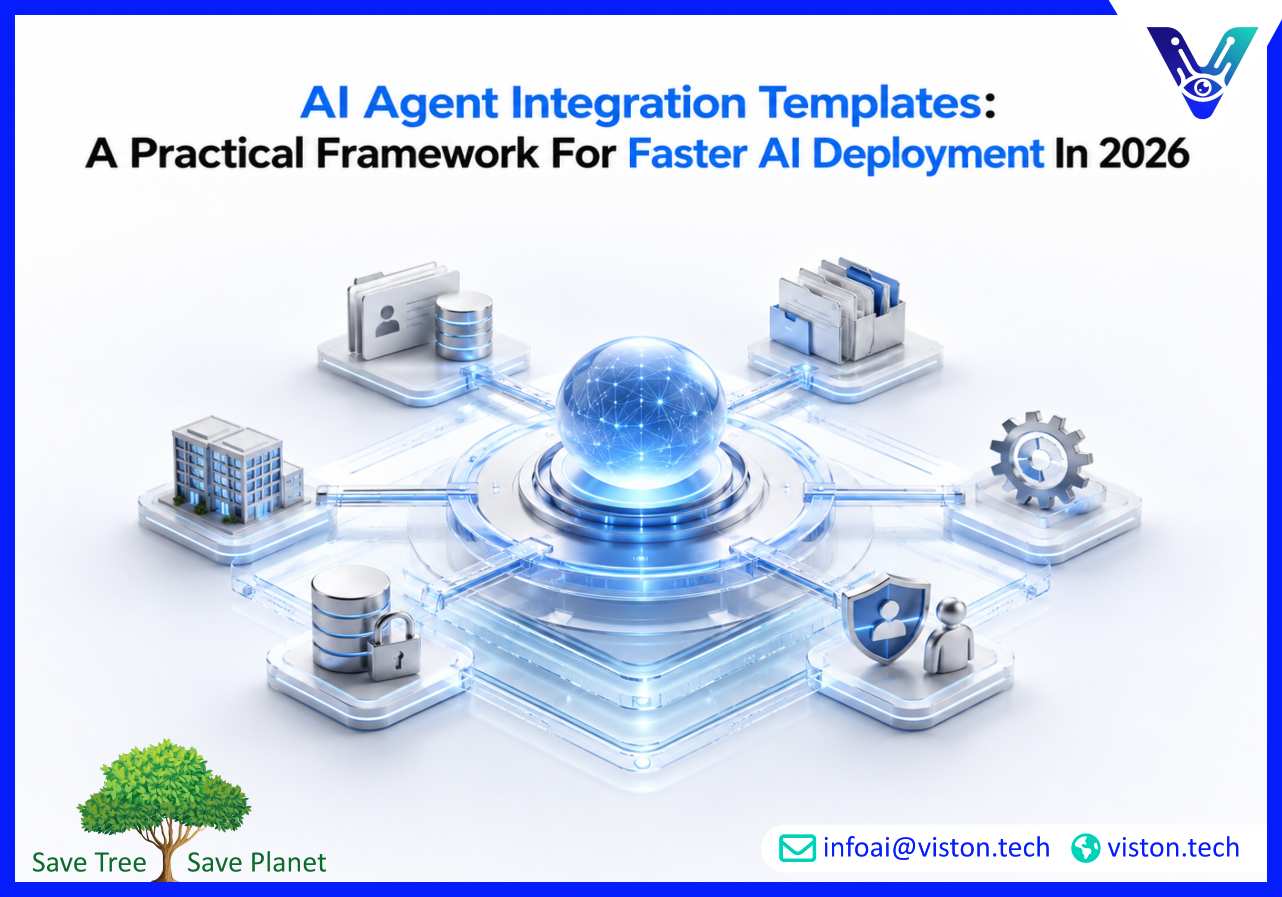
As businesses accelerate AI adoption, one of the biggest challenges is moving from experimentation to production-ready implementation. AI agent integration templates help organizations standardize deployment, reduce development time, and create reliable workflows that connect AI agents with existing business systems. For companies exploring AI-driven automation in 2026, templates provide a structured path to scalable AI integration.
AI agent integration templates are predefined frameworks, architectures, workflows, and integration patterns used to connect AI agents with business applications, data sources, and operational processes. Rather than building every implementation from scratch, organizations can use proven templates to accelerate deployment while maintaining consistency and governance.
An AI agent integration template typically includes:
These templates help organizations avoid common implementation mistakes while creating repeatable deployment models across departments and business functions.
Modern businesses rarely operate with a single platform or workflow. Customer data may reside in CRM systems, operational data in ERP platforms, support records in helpdesk software, and internal knowledge across multiple repositories. AI agents become valuable when they can access and act across these environments.
Without structured integration approaches, organizations often face:
AI agent integration templates address these challenges by establishing repeatable deployment standards that support both operational efficiency and long-term growth.
For organizations deploying multiple AI initiatives, templates create a foundation that supports sustainable adoption rather than isolated experiments.
Different business objectives require different integration approaches. The most effective templates align agent capabilities with operational requirements.
This template focuses on ticket classification, knowledge retrieval, response generation, escalation management, and CRM updates. AI agents work alongside support teams to improve response speed while maintaining service quality.
Sales-focused integrations often connect AI agents with CRM platforms, lead databases, communication tools, and reporting systems. Typical tasks include lead qualification, research, follow-up recommendations, and pipeline management.
Organizations handling large volumes of documents can deploy templates that automate extraction, validation, classification, routing, and storage workflows. These are frequently used in finance, legal, insurance, and administrative operations.
Knowledge-focused agents retrieve information from internal repositories, policies, documentation, and databases to support employees with accurate and context-aware responses.
Complex processes often require multiple specialized agents working together. One agent may gather information, another validate data, another execute actions, and another perform quality assurance before completion.
These multi-agent templates are becoming increasingly important as organizations seek more sophisticated workflow automation.
Successful AI agent integration extends beyond connecting APIs. Businesses need frameworks that support reliability, accountability, and measurable outcomes.
Every agent should have a specific purpose. Defining clear responsibilities reduces overlap and improves performance monitoring.
Templates should specify how tasks move between agents, systems, and human reviewers. Orchestration rules help ensure consistent execution and predictable outcomes.
Most AI agents generate value through integrations with:
Templates should include standardized integration patterns for these environments.
Agent permissions should align with organizational security policies. Templates should define authentication methods, authorization levels, data access restrictions, and audit logging requirements.
Many workflows require human oversight for sensitive decisions, regulatory compliance, financial approvals, or customer-facing actions. Effective templates define when agents can act autonomously and when escalation is required.
Templates should include reporting mechanisms that measure accuracy, completion rates, processing times, exception frequency, and business impact.
Monitoring enables continuous optimization and supports long-term operational success.
Organizations can maximize the value of AI agent integration templates by following a structured deployment approach.
Focus on processes that are repetitive, time-consuming, and operationally significant. Early success helps build organizational confidence and demonstrates measurable value.
Establish integration standards before deploying agents across multiple departments. Standardization reduces complexity and simplifies future expansion.
Even the most advanced AI agents depend on reliable information. Organizations should address data quality issues before large-scale deployment.
Governance should not be added after deployment. Security, compliance, approvals, monitoring, and auditing should be embedded within the integration framework from the beginning.
AI technologies, business requirements, and operational priorities evolve over time. Templates should be regularly updated to reflect new capabilities, lessons learned, and changing business needs.
For organizations seeking practical AI adoption, Viston AI provides Agent Integration Services that help businesses connect AI agents with existing workflows, applications, and operational processes. AI agent integration templates play an important role in accelerating deployments while ensuring consistency, governance, and scalability.
Rather than approaching each implementation as a standalone project, Viston AI focuses on creating structured integration frameworks that align AI capabilities with real business requirements. This includes workflow analysis, agent architecture design, system integration planning, orchestration development, testing, monitoring, and ongoing optimization.
Businesses often require AI agents to interact with CRM systems, support platforms, internal databases, knowledge repositories, and custom applications. Viston AI helps organizations establish integration patterns that support reliable automation while maintaining operational controls and business oversight.
As AI adoption continues to expand in 2026, companies increasingly need deployment approaches that are repeatable, secure, and scalable. Well-designed AI agent integration templates help reduce implementation complexity and support sustainable business outcomes across a wide range of operational use cases.
An AI agent integration template is a predefined framework that outlines how AI agents connect with systems, workflows, data sources, and business processes to achieve specific operational goals.
Templates accelerate deployment, improve consistency, reduce development effort, strengthen governance, and make AI initiatives easier to scale across the organization.
Yes. Most templates are designed to connect AI agents with CRM platforms, ERP systems, support tools, databases, communication platforms, and custom applications.
Yes. Enterprise deployments often benefit significantly from templates because they provide standardized approaches to security, governance, monitoring, and workflow orchestration.
Templates can define how specialized agents collaborate, exchange information, hand off tasks, validate outputs, and escalate exceptions within a coordinated workflow.
Viston AI provides Agent Integration Services that help organizations design, integrate, deploy, and optimize AI agents using structured frameworks that align with operational and business objectives.
AI agent integration templates have become an essential component of successful AI deployment strategies in 2026. They help organizations move beyond isolated experiments by providing structured frameworks for connecting AI agents with business systems, workflows, and operational processes. By standardizing integration approaches, businesses can reduce implementation risk, accelerate deployment timelines, and improve scalability. For organizations pursuing reliable AI adoption, Agent Integration Services from Viston AI can help establish integration frameworks that support long-term operational value while maintaining governance, security, and business alignment.
