
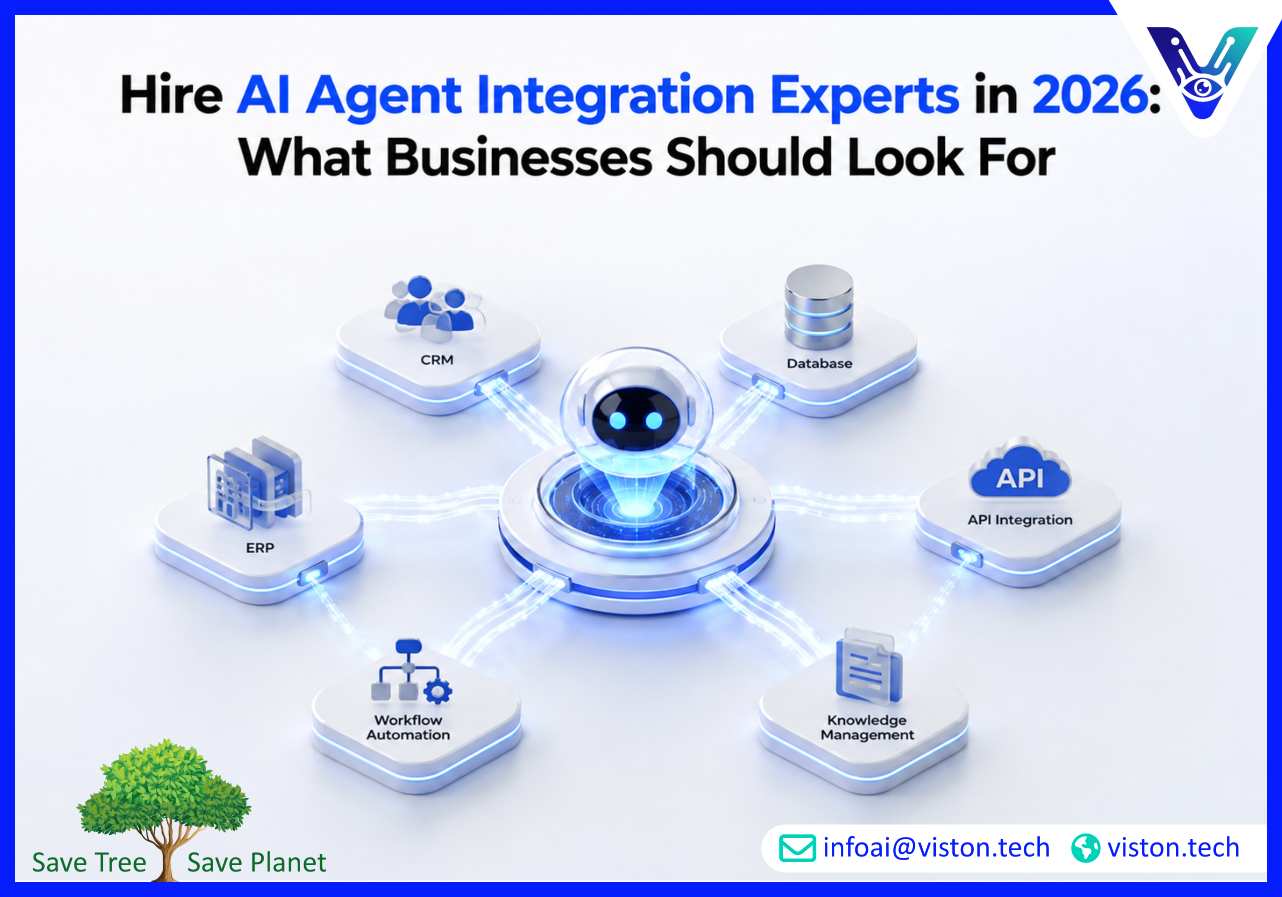
As organizations adopt AI across operations, customer service, sales, and internal workflows, integrating AI agents into existing business systems has become a critical priority. Hiring AI agent integration experts helps businesses ensure that AI agents work reliably with enterprise applications, data sources, workflows, and governance requirements rather than operating as isolated tools.
AI agents can perform tasks such as retrieving information, analyzing data, automating workflows, assisting customers, and supporting business decisions. However, their value depends on how effectively they connect with existing systems and processes.
Many businesses quickly discover that deploying an AI model is only a small part of the challenge. The larger task involves connecting agents to CRMs, ERPs, customer support platforms, internal databases, APIs, communication tools, and business workflows while maintaining security, compliance, and operational reliability.
This is why organizations increasingly choose to hire AI agent integration experts who can design, implement, and manage these complex connections.
Without proper integration planning, AI agents may provide inconsistent outputs, lack business context, or create operational risks.
Professional AI agent integration services focus on connecting AI capabilities with real business operations. The goal is not simply to deploy an agent but to ensure it can securely perform useful work across the organization.
AI agents often need access to multiple business platforms. Integration experts establish secure connections between agents and systems such as:
Businesses increasingly use AI agents to automate operational workflows. Integration specialists map processes, define decision points, establish approval paths, and create structured automation that aligns with business goals.
Most enterprise AI projects require API connectivity. Experts build integrations that allow agents to retrieve information, update records, trigger actions, and synchronize data across systems.
Modern AI deployments must follow strict security practices. Integration experts implement authentication, authorization, role-based access controls, audit logging, and data protection measures.
Successful AI agent deployments require continuous monitoring. Experts establish performance tracking, workflow analytics, error reporting, and optimization processes that support long-term reliability.
Not all AI service providers have the expertise required to integrate AI agents into production environments. Businesses should evaluate technical capabilities alongside operational experience.
Look for providers with experience connecting AI systems to enterprise platforms, APIs, databases, cloud services, and workflow automation tools.
Successful integrations require more than technical skills. Integration experts should understand business operations and how workflows function across departments.
Data security, privacy protection, access management, and governance should be incorporated into every integration project.
AI initiatives often expand over time. Experts should build flexible architectures that support future growth, additional agents, and evolving business requirements.
As businesses adopt multiple specialized AI agents, integration experts should understand orchestration, agent collaboration, workflow routing, memory management, and context sharing.
AI systems require ongoing maintenance and optimization. Businesses benefit from providers who offer continuous monitoring, updates, integration enhancements, and performance improvements.
Organizations that invest in professional AI agent integration often achieve better outcomes than those relying solely on standalone AI tools.
Integrated agents can access information, perform actions, and coordinate workflows without requiring employees to manually move data between systems.
Direct system integrations reduce manual entry, duplicate records, and inconsistencies across platforms.
AI agents connected to customer data and support systems can deliver faster, more personalized responses.
Integrated workflows provide monitoring, reporting, audit trails, and operational transparency.
Businesses can expand AI adoption across departments without creating disconnected automation projects.
Well-integrated AI systems help reduce repetitive manual work and improve workforce efficiency.
In 2026, AI adoption is moving beyond experimentation. Organizations increasingly expect AI agents to participate directly in operational workflows rather than simply providing recommendations.
Examples include:
These use cases require reliable integration frameworks that connect AI capabilities with the systems where business operations actually occur.
Organizations looking to hire AI agent integration experts often need more than technical implementation. They need a partner capable of aligning AI capabilities with real business processes, operational objectives, and long-term scalability requirements.
Viston AI specializes in Agent Integration Services designed to help businesses connect AI agents with enterprise systems, business applications, workflows, and operational environments. Its expertise extends beyond agent deployment to include workflow design, system integration, automation strategy, API connectivity, orchestration planning, and operational optimization.
For companies implementing AI-driven processes, successful outcomes depend on how effectively agents interact with existing infrastructure. Viston AI helps organizations establish secure integrations, enable efficient data flows, automate business processes, and create scalable AI ecosystems that support ongoing growth.
Whether businesses are deploying customer service agents, workflow automation solutions, internal knowledge assistants, or multi-agent systems, Viston AI focuses on practical implementation that aligns AI technology with measurable business objectives.
An AI agent integration expert connects AI agents with business systems, workflows, databases, APIs, and operational processes to ensure they function effectively in production environments.
Without integration, AI agents often operate in isolation. Integration enables agents to access data, perform actions, automate workflows, and support business operations more effectively.
Project timelines vary depending on workflow complexity, system requirements, security considerations, and the number of integrations involved.
Yes. Modern AI agents can connect with CRM systems, ERP platforms, helpdesks, cloud applications, databases, APIs, and many other business systems.
Organizations should assess technical expertise, integration experience, security practices, workflow knowledge, scalability capabilities, and long-term support offerings.
Yes. Viston AI offers Agent Integration Services that help businesses connect AI agents with workflows, enterprise systems, APIs, and operational processes to support scalable AI adoption.
Businesses that hire AI agent integration experts gain access to the technical and operational expertise required to transform AI from isolated tools into productive business assets. Effective Agent Integration Services help organizations connect AI agents with systems, workflows, and data sources while maintaining security, reliability, and scalability. As AI adoption accelerates in 2026, companies that invest in professional integration capabilities will be better positioned to achieve measurable operational improvements. For organizations seeking practical implementation expertise, Viston AI provides specialized Agent Integration Services that support successful AI deployment and long-term business value.
