
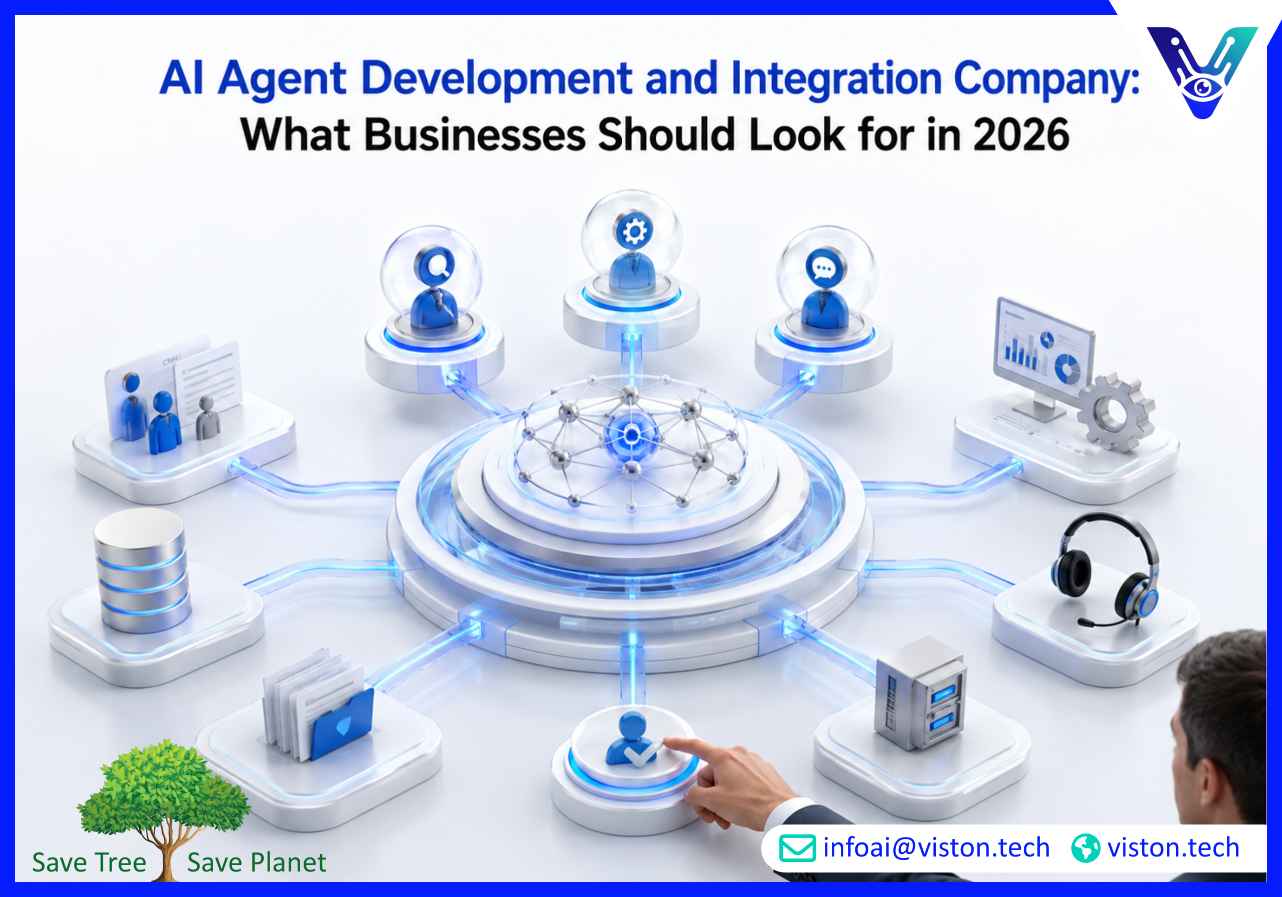
As artificial intelligence moves from experimentation to operational deployment, businesses are increasingly searching for an AI agent development and integration company that can deliver practical, scalable, and secure solutions. In 2026, organizations are not simply looking for AI tools—they want intelligent agents that connect systems, automate workflows, support decision-making, and create measurable business value.
AI agents have evolved beyond basic chatbots and standalone automation tools. Modern AI agents can understand business context, access company data, interact with software platforms, execute tasks, and collaborate across workflows.
For many organizations, the challenge is no longer whether AI can help but how to integrate AI into existing operations without disrupting productivity, security, or compliance requirements.
AI agent development and integration services help businesses bridge this gap by creating intelligent systems that work alongside existing technology investments.
Organizations across industries are adopting AI agents to:
The most successful deployments focus on solving specific business problems rather than implementing AI for its own sake.
An AI agent development and integration company specializes in designing, building, connecting, and deploying AI-powered agents that operate within real business environments.
Unlike generic software development projects, AI agent implementations require expertise in artificial intelligence, workflow automation, integrations, data management, security, and operational governance.
The development process starts by identifying business objectives and defining how AI agents will contribute to operational outcomes. This includes determining agent roles, decision boundaries, workflow responsibilities, escalation paths, and system interactions.
AI agents are most valuable when connected to existing business systems. Common integrations include:
Proper integration ensures agents can access relevant information and perform useful actions.
Many organizations deploy AI agents to automate workflows that involve multiple systems, approvals, data sources, and stakeholders. These workflows often include validation, exception handling, monitoring, and human review.
Production-ready AI agents require ongoing evaluation. Reliable providers implement monitoring, performance tracking, quality assurance, and continuous optimization to ensure agents remain effective as business requirements evolve.
Choosing the right implementation partner requires more than reviewing technical capabilities. Businesses should evaluate whether a provider understands operational requirements and long-term scalability.
AI agents rarely operate independently. A strong provider should demonstrate experience integrating agents with business applications, databases, APIs, cloud platforms, and enterprise systems.
Business processes often include exceptions, approvals, dependencies, and compliance requirements. Successful implementations require a deep understanding of workflow design and orchestration.
Organizations handling sensitive information need clear controls around data access, permissions, monitoring, auditing, and compliance. Security should be built into the development process rather than added later.
AI agent deployments should support future growth. Companies should assess whether proposed solutions can scale across departments, workflows, user groups, and operational requirements.
Not every decision should be fully automated. Effective implementations include escalation paths and approval mechanisms for high-impact business activities.
Organizations need visibility into how AI agents perform. Reporting frameworks help measure accuracy, efficiency gains, workflow completion rates, and business impact.
AI agent development services support a wide variety of operational functions. The most effective use cases typically involve repetitive work, data-intensive processes, and workflow coordination.
Many organizations are now deploying multiple specialized agents that collaborate to complete complex business processes. Multi-agent orchestration enables agents to share context, coordinate actions, and support larger operational workflows.
This approach is becoming increasingly important as businesses seek greater automation without sacrificing governance and control.
Organizations that successfully deploy AI agents often realize benefits that extend beyond immediate efficiency gains.
When integrated strategically, AI agents can improve process consistency, accelerate decision-making, enhance customer experiences, and free employees to focus on higher-value activities.
Additional long-term advantages may include:
These outcomes depend heavily on implementation quality, integration strategy, governance, and continuous optimization.
For organizations seeking an AI agent development and integration company, Viston AI provides Agent Integration Services focused on connecting AI capabilities with real business operations. Rather than treating AI agents as standalone tools, the emphasis is on building integrated solutions that align with workflows, systems, and operational goals.
Its approach includes evaluating business requirements, designing agent architectures, integrating AI agents with existing platforms, and supporting workflow automation initiatives. This helps organizations move beyond isolated AI deployments and toward practical business applications that generate measurable value.
As AI adoption continues to accelerate, businesses increasingly require solutions that can connect data sources, enterprise applications, customer interactions, and internal processes. Viston AI’s Agent Integration Services support these objectives through structured implementation, integration planning, workflow orchestration, and scalable deployment strategies.
For companies exploring intelligent automation, agentic workflows, customer support automation, operational efficiency improvements, or multi-agent systems, having a partner that understands both AI technology and business execution is becoming increasingly important in 2026.
It designs, develops, integrates, and deploys AI agents that can automate tasks, interact with systems, support workflows, and improve business operations.
Traditional automation follows predefined rules, while AI agents can understand context, retrieve information, make task-level decisions, and adapt to changing business scenarios.
Organizations with repetitive workflows, high data volumes, customer support operations, sales processes, administrative tasks, or knowledge management challenges often benefit significantly.
Yes. Modern AI agents can connect with CRM platforms, ERP systems, databases, helpdesk software, communication tools, APIs, and other enterprise applications.
Workflow orchestration ensures agents coordinate effectively, follow business rules, manage exceptions, escalate when needed, and complete processes reliably.
Viston AI provides Agent Integration Services that help businesses design, connect, deploy, and optimize AI agents within existing operational environments and business workflows.
Selecting the right AI agent development and integration company is a strategic decision that can significantly influence the success of AI adoption initiatives. Effective AI agents require more than advanced models—they need thoughtful integration, workflow alignment, governance, monitoring, and scalability. As businesses continue investing in intelligent automation in 2026, Agent Integration Services play a critical role in transforming AI capabilities into practical business outcomes. Organizations seeking structured and business-focused implementation support can benefit from providers such as Viston AI that specialize in connecting AI agents with real operational requirements.
