
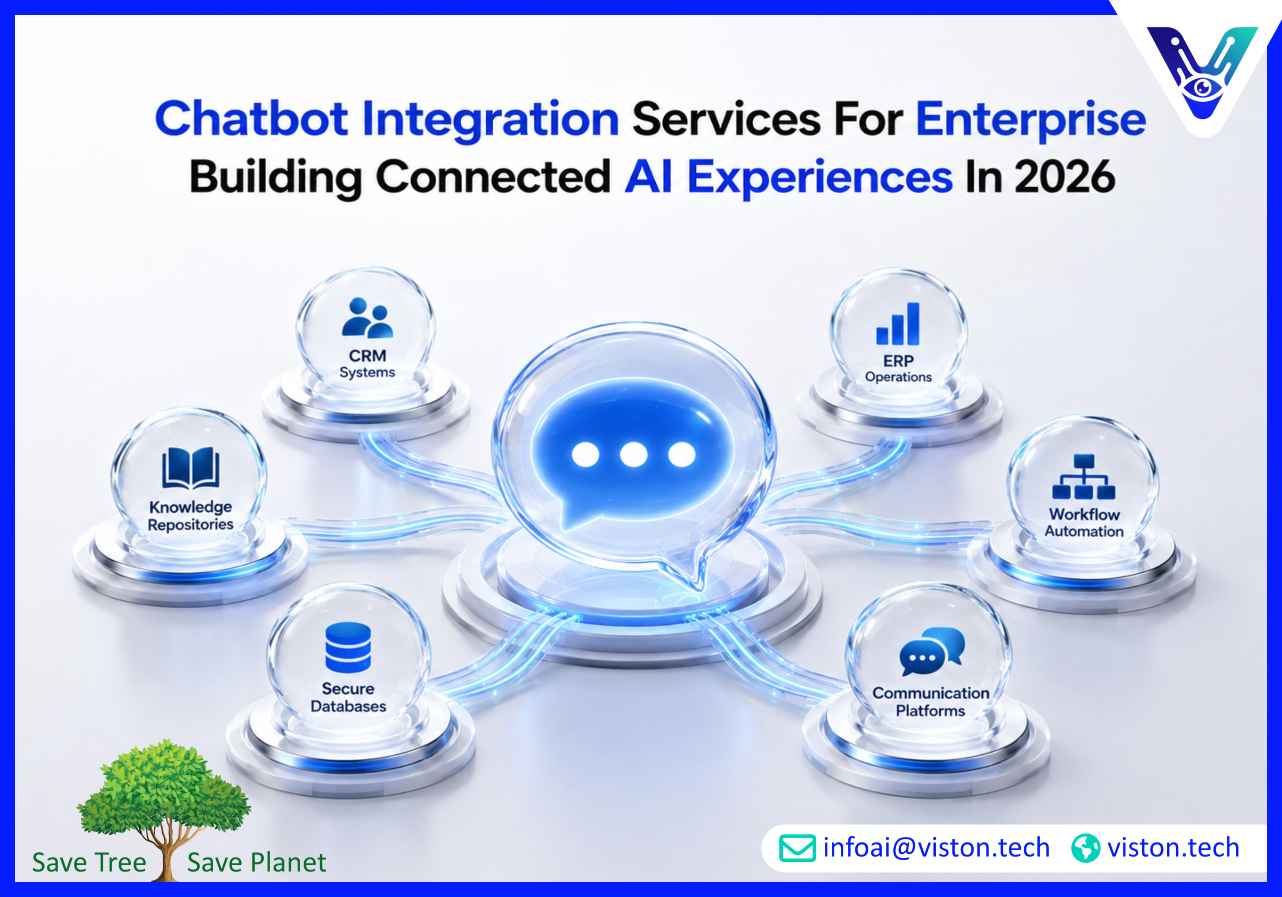
Enterprise organizations are rapidly adopting AI-powered chatbots to improve customer engagement, streamline internal operations, and enhance service delivery. However, chatbot success depends less on the chatbot itself and more on how effectively it integrates with existing business systems. In 2026, chatbot integration services have become a critical requirement for enterprises seeking scalable, reliable, and business-driven AI outcomes.
Many organizations initially deploy chatbots as standalone tools. While these deployments may answer basic questions, they often fail to deliver meaningful business value because they cannot access business data, interact with workflows, or perform actions across enterprise systems.
Enterprise chatbot integration connects AI chatbots with the platforms employees and customers already use. This includes customer relationship management (CRM) systems, enterprise resource planning (ERP) platforms, customer support software, databases, knowledge bases, document repositories, communication tools, and custom applications.
When properly integrated, chatbots move beyond answering questions and become operational assistants capable of retrieving information, updating records, triggering workflows, and supporting business processes.
Organizations investing in chatbot integration services typically seek to:
As enterprise AI adoption accelerates, integration has become the foundation that determines whether chatbot projects succeed or remain limited pilots.
Integrating chatbots into enterprise environments involves more than connecting APIs. Organizations must address technical, operational, security, and governance considerations to ensure successful deployment.
Enterprise information is often distributed across multiple systems. Customer records, support tickets, product documentation, internal policies, financial data, and operational information may reside in separate platforms. Chatbots need secure and accurate access to these sources to provide meaningful responses.
Many enterprises continue to operate legacy applications that were not originally designed for AI integration. Creating reliable connections between modern chatbot platforms and older business systems requires careful planning and technical expertise.
Enterprise chatbots frequently interact with sensitive business data. Organizations must implement authentication, authorization, encryption, audit logging, and role-based access controls to maintain security and compliance requirements.
Business processes often include approvals, exceptions, escalations, and multiple decision points. Effective chatbot integration must account for these operational realities rather than assuming simple linear workflows.
Enterprise environments demand reliable performance under heavy workloads. Integration architectures must support growth, increased user activity, and evolving business requirements without compromising stability.
Organizations that achieve long-term success with chatbot integration typically focus on several critical areas during implementation.
Before deployment, enterprises should identify which processes, customer journeys, and operational workflows will benefit most from chatbot support. Understanding business objectives helps ensure integration efforts focus on measurable outcomes.
Enterprise chatbots often require integration with:
Reliable system connectivity enables chatbots to access information and perform business actions in real time.
Modern AI chatbots perform best when connected to trusted organizational knowledge sources. This allows users to receive accurate, context-aware answers based on approved business information rather than generic AI responses.
Integrated chatbots can initiate workflows, update records, assign tasks, create tickets, schedule appointments, process requests, and trigger approvals. This transforms chatbots into active participants in business operations.
In 2026, enterprises increasingly combine chatbots with AI agents capable of handling more complex actions. Rather than simply responding to questions, these systems can coordinate tasks, retrieve information, execute workflows, and support decision-making processes.
AI chatbot integration services support a wide range of business functions across industries. The most successful implementations focus on solving specific operational challenges.
Integrated chatbots can access customer history, support tickets, knowledge bases, and service workflows. This enables faster issue resolution and improved customer experiences while reducing support team workload.
Chatbots connected to CRM systems can qualify leads, collect information, schedule meetings, update records, and assist sales teams throughout the customer journey.
Internal chatbot deployments help employees access policies, HR information, IT support resources, operational procedures, and company knowledge without searching through multiple systems.
Organizations use integrated chatbots to automate requests, approvals, reporting, task assignments, and operational workflows that previously required significant manual effort.
Enterprise knowledge bases often contain large volumes of information that employees struggle to navigate. Chatbot integration improves accessibility by providing conversational access to organizational knowledge.
These use cases demonstrate how integration transforms chatbots from simple communication tools into valuable business assets.
Choosing the right chatbot integration approach requires evaluating several factors beyond chatbot functionality.
Organizations should assess:
Enterprises should also consider how integration services align with broader digital transformation initiatives. The most effective implementations support measurable business outcomes rather than simply deploying new technology.
Organizations seeking AI Chatbot Integration services often need more than chatbot deployment. Successful implementation requires connecting AI capabilities with existing business systems, workflows, and operational requirements.
Viston AI helps businesses design and implement integrated chatbot solutions that align with real-world business objectives. Its focus on AI automation, workflow integration, intelligent assistants, and enterprise AI solutions enables organizations to move beyond standalone chatbot deployments and create connected digital experiences.
For enterprises exploring chatbot integration, the process often includes identifying high-value use cases, integrating with business applications, connecting organizational knowledge sources, implementing security controls, and establishing governance frameworks. These elements help ensure chatbot initiatives deliver practical value while supporting scalability and reliability.
As businesses increasingly adopt AI-powered customer engagement and operational automation strategies, Viston AI’s AI Chatbot Integration capabilities can support organizations seeking structured implementation, system connectivity, workflow enablement, and sustainable AI adoption.
Chatbot integration services connect AI chatbots with business systems, applications, databases, workflows, and knowledge sources to enable more useful and actionable interactions.
Without integration, chatbots often provide limited value. Enterprise integration allows chatbots to access data, automate processes, support employees, and improve customer experiences.
Common integrations include CRM platforms, ERP systems, customer support tools, helpdesks, databases, document repositories, communication platforms, and custom business applications.
Yes, when implemented properly. Enterprise chatbot integrations should include authentication controls, role-based permissions, encryption, monitoring, audit logs, and compliance safeguards.
Project timelines vary depending on system complexity, integration scope, data availability, security requirements, and workflow customization needs.
Yes. Viston AI provides AI Chatbot Integration services that help organizations connect chatbot solutions with business systems, workflows, and operational processes to support practical business outcomes.
Chatbot integration services have become an essential part of enterprise AI strategies in 2026. While chatbot technology continues to evolve, the real business value comes from connecting chatbots with enterprise systems, workflows, and organizational knowledge. Effective AI Chatbot Integration enables businesses to improve customer experiences, streamline operations, enhance productivity, and support scalable automation initiatives. For organizations seeking a structured approach to enterprise chatbot deployment, Viston AI offers expertise that helps bridge the gap between conversational AI and practical business execution.
