
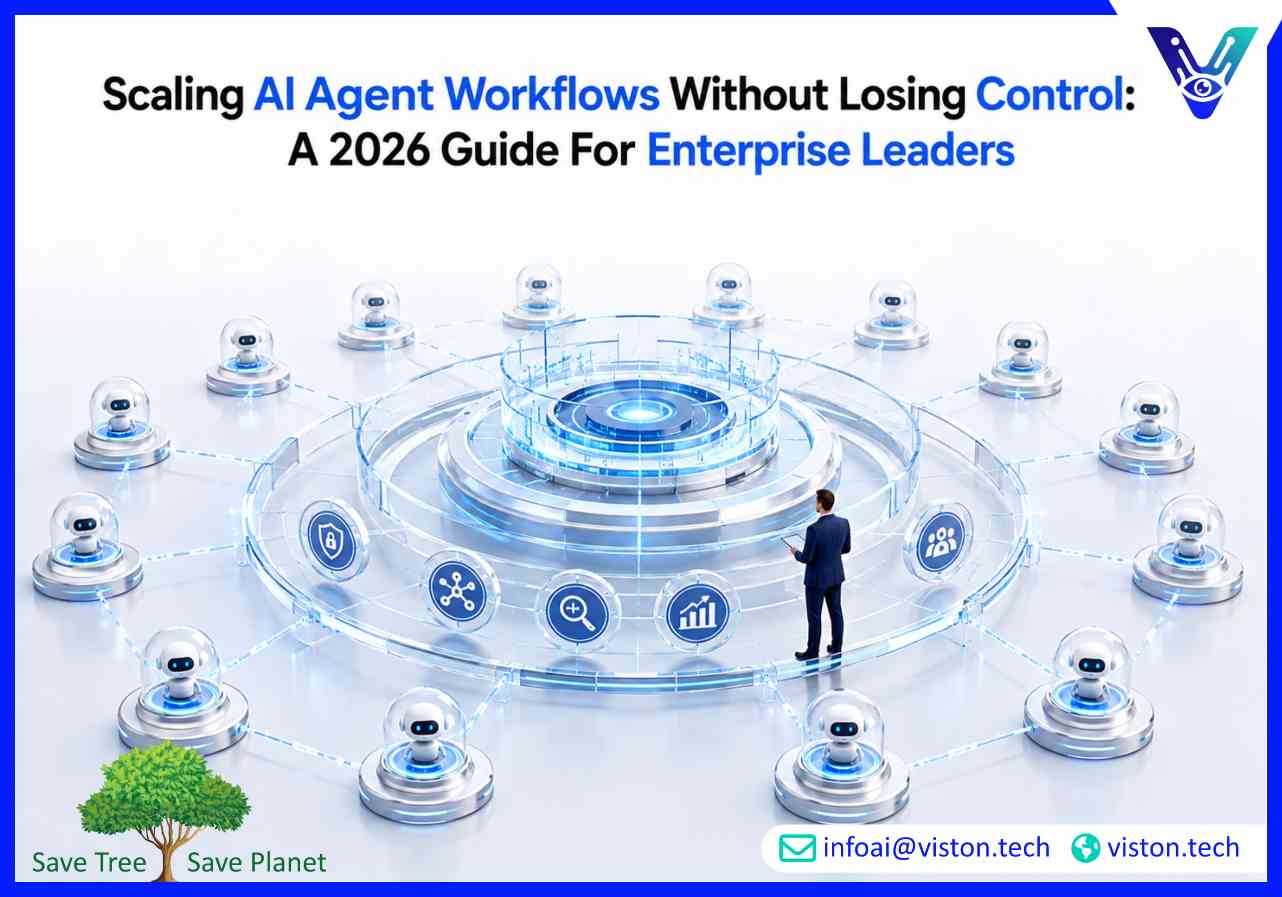
In 2026, the conversation around artificial intelligence has shifted decisively. The question is no longer “Can we build an AI agent?” but rather “How do we scale AI agent workflows across our enterprise without breaking security, blowing the budget, or creating an unmanageable sprawl?” For business decision-makers, the path from successful pilot to enterprise-wide deployment is fraught with operational risks. This is where Agentic AI Workflows transition from a technical novelty to a strategic business necessity.
While consumer-facing AI garners headlines, the most significant and measurable returns in 2026 are being generated behind the firewall. According to industry analysis, companies achieving real value are those embedding AI deeply into operations and processes, not those engaged in “innovation theater” .
This means moving away from fragmented, standalone bots toward orchestrated Agentic AI Workflows. Unlike standard automation that follows rigid rules, agentic workflows involve autonomous systems that reason, plan, and execute multi-step actions across your enterprise stack. However, with this autonomy comes a critical mandate: governance.
Recent insights from Google Cloud’s Office of the CTO highlight that while agents are now mainstream, so is the anxiety surrounding them. Leaders are grappling with “agent sprawl” and a new category of “insider risk” where autonomous software acts on behalf of the business .
To scale effectively, simply deploying more agents is not the answer. Based on current architectural best practices from leading platforms and consultancies, enterprises must build upon a foundation of five critical capabilities.
A major bottleneck in scaling is the assumption that data must be centralized. In a distributed enterprise, copying massive datasets to a cloud model is inefficient and risky. The modern imperative, as noted by Dell Technologies, is to bring the AI to the data . A scalable Agentic AI Workflow requires a real-time connected knowledge line, not a data warehouse vacuum cleaner.
The graveyard of AI pilots is filled with “point solutions” that work in a demo but fail in production. True scaling requires a unified orchestration layer that connects AI agents, legacy APIs, event streams, and human decision-makers . You need a control plane that can manage a heterogeneous environment—running LangGraph agents alongside native bots and vendor tools—without forcing a full rebuild .
When an agent modifies a customer record or processes a return, how do you audit that? In an AI-native enterprise, every autonomous action must produce a verifiable “receipt.” This includes logging the chain of thought, the specific tools called, and the data accessed. Without this, compliance becomes impossible, and trust erodes .
As agentic reasoning models perform loops 10 to 100 times more compute-intensive than standard queries, cloud bills can spiral . Scaling requires intelligent token routing: sending simple summarization tasks to smaller, faster, cheaper models (or on-prem instances) and only using expensive frontier models for complex reasoning. You cannot afford to run every mundane task through a premium LLM.
The most scalable workflows are not fully autonomous; they are continuously learning. Initially, agents require human supervision for exceptions. However, the architecture must facilitate “Human-in-the-Loop” evolving into “Agent Collaboration.” When a subject matter expert corrects an agent, that refinement must be captured as data to improve the model for the entire fleet .
Not every process is ready for agents. The highest ROI in 2026 targets workflows that are high-volume, repetitive, but require judgment. In IT service desks, multi-agent orchestration can resolve up to 80% of routine requests without human intervention . In finance, agents can autonomously reconcile spreadsheets and flag audit exceptions. In HR, agentic systems can manage the 90% of the hiring process that is administrative, allowing humans to focus on cultural fit and negotiation .
Navigating the transition from fragmented pilots to a governed, scalable agentic ecosystem requires deep technical expertise and a business-first mindset. At Viston AI, we specialize in designing and deploying Agentic AI Workflows that solve real operational drag, not just theoretical use cases. Unlike generic consultancies, we focus on the connective tissue that makes agents safe and effective: identity management, cost observability, and hybrid orchestration. We help organizations move beyond the “build trap” by implementing control planes that allow your development teams to innovate freely while maintaining centralized governance. Whether you are dealing with legacy system integration in a regulated industry or looking to optimize token spend across thousands of daily operations, Viston AI provides the strategic roadmap and technical implementation to turn agentic potential into measurable business outcomes.
What is the difference between standard automation and an Agentic AI Workflow?
Standard automation follows predefined, deterministic rules (If X, do Y). Agentic workflows leverage large language models to reason, plan, and execute multi-step tasks dynamically. They can handle ambiguity and self-correct based on real-time context, whereas traditional automation breaks when faced with an exception.
How do I measure ROI on Agentic AI Workflows in 2026?
Focus on “time reclaimed” and “cycle-time reduction.” Look at specific metrics like reduction in ticket handling time (e.g., saving 13,000+ staff hours per month), decrease in manual data reconciliation, or acceleration of onboarding workflows. Avoid vanity metrics like “number of agents deployed.”
What are the biggest risks when scaling AI agents?
The primary risks are “agent sprawl” (uncontrolled proliferation leading to security gaps), data exfiltration (agents leaking sensitive data), and escalating API costs. Mitigation requires strict identity protocols, guardrails, and a centralized orchestration control plane.
Can Agentic Workflows run in air-gapped or on-premise environments?
Yes. For regulated industries (finance, healthcare, government), modern agentic architectures support distributed runtimes. Solutions like EnterpriseClaw allow agents to execute locally behind a firewall while still being managed centrally, ensuring data sovereignty .
Do I need to rebuild my entire tech stack to implement Agentic AI?
No. The most successful implementations use API-led orchestration to connect agents to existing legacy systems. The goal is to create an integration layer that allows agents to call existing tools, not replace the tools themselves. Viston AI specializes in this “wrapping” strategy to protect your existing investments.
How does Viston AI handle continuous learning for agents?
We implement “feedback loop” architectures where human corrections in the workflow are fed back into the retrieval-augmented generation (RAG) pipeline or fine-tuning data set, ensuring your agents get smarter about your specific business rules every day without manual retraining.
Scaling AI agent workflows in 2026 is less about raw intelligence and more about operational discipline. The enterprises that win will be those that treat agents as a workforce that requires management, security, and governance. By focusing on orchestration, observability, and economic efficiency, businesses can move beyond proof-of-concept purgatory. To achieve this, you need a partner who understands the architecture of control as well as the power of AI. With Viston AI, you gain a trusted specialist in Agentic AI Workflows dedicated to making your autonomous operations reliable, scalable, and auditable.
