
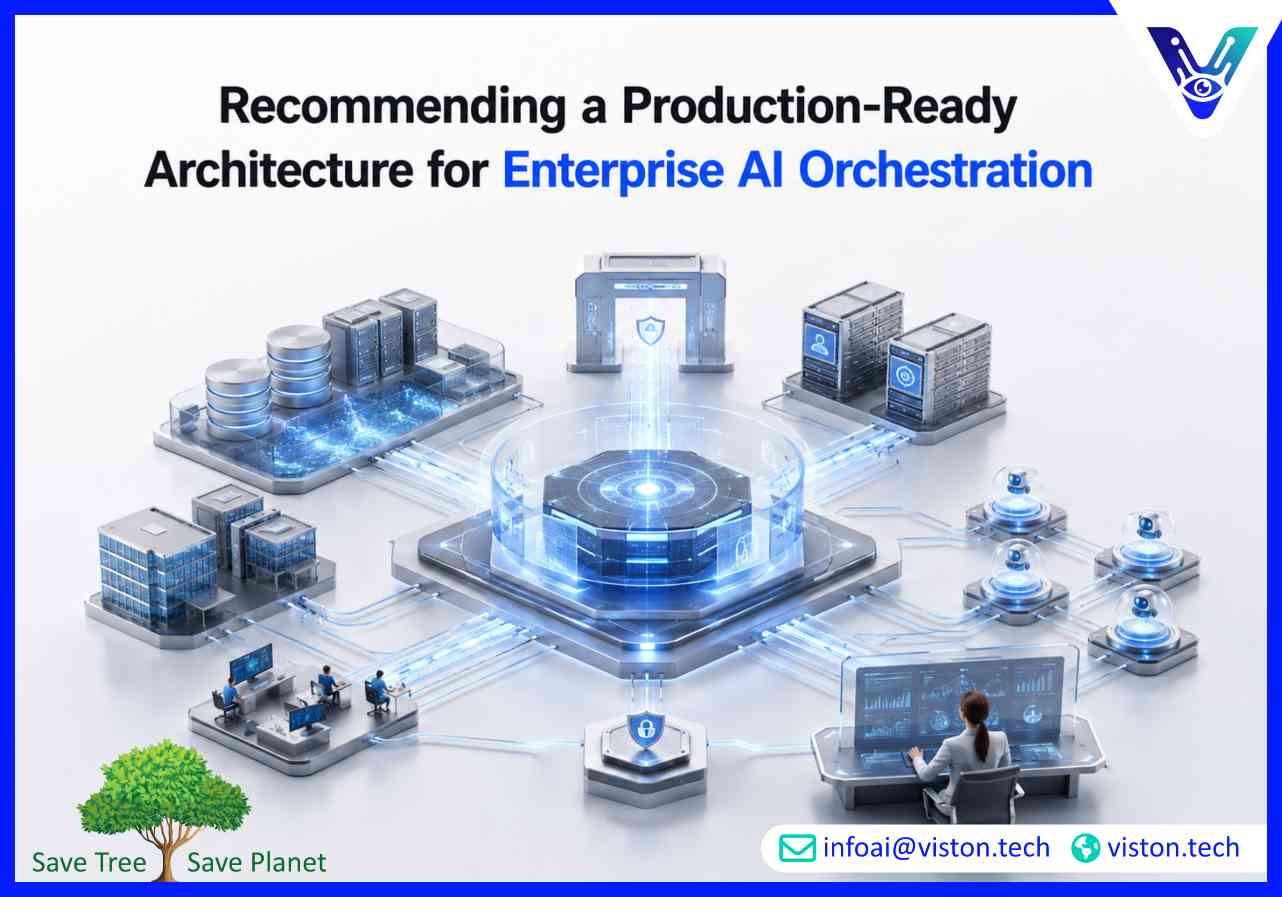
In 2026, the conversation around artificial intelligence has shifted decisively. It is no longer about whether generative AI can draft an email or summarize a document. For enterprise leaders, the pressing question is how to move from fragmented, proof-of-concept AI projects to a reliable, scalable, and governed operational model. The answer lies in a robust architecture for enterprise AI orchestration. Without it, organizations risk “agent sprawl,” runaway costs, and integration failures that stall digital transformation before it delivers real ROI.
The era of the single, monolithic AI platform is ending. The modern enterprise runs on a federation of systems—SAP, Salesforce, Workday, and bespoke internal tools—each holding governed, context-rich data that no external model can easily replicate . A successful orchestration architecture does not rip and replace these systems; it intelligently connects them.
Current data shows that while over 60% of organizations are experimenting with agentic AI, less than 5% have successfully scaled these systems across departments . The primary bottleneck is not model capability but architectural readiness. In 2026, a production-ready architecture must be federated, layered, and built on a foundation of real-time data and semantic understanding . This means moving beyond simple API calls to a structured stack that separates data ingestion, reasoning, and execution.
To achieve reliable automation, enterprises must adopt a layered architecture that separates concerns and embeds governance at every level. Based on current industry blueprints, a mature stack includes the following integrated layers:
Orchestration is only as intelligent as the data it accesses. The foundation layer must consist of a curated data lake or lakehouse (powered by platforms like Databricks or Microsoft Fabric) that ingests governed data from systems of record. Crucially, this layer must now include semantic context. “Data context engineering”—the process of preparing the right information for an agent before it reasons—is the single most critical success factor in 2026 . Without this, agents act on stale or ambiguous data, leading to faulty decisions.
This is the “brain” of the operation. Instead of hard-coding sequences, the orchestration layer uses a mix of design patterns suited to the task. For high-volume, regulated transactions, deterministic peer nodes (pre-scripted automation) are safest and most cost-effective. For complex, multi-step tasks like lead routing or claims processing, an Agent Workflow pattern sequences specialized agents (e.g., a classifier, then an extractor, then a validator) . This control plane manages the handoffs, maintains state, and prevents the “agent sprawl” that plagues ungoverned deployments.
A critical, often missing piece is the AI gateway. AI models lack native security features like access control and identity management . An AI gateway sits between the agents and your internal systems, enforcing policies, masking sensitive data, and logging every action (tool call, reasoning step, token usage). Given that Gartner predicts 40% of agentic AI projects will be canceled by 2027 due to cost and governance failures , this observability layer is not a “nice to have”—it is your operating license.
One size does not fit all. The architecture for enterprise AI orchestration must support different patterns based on risk and complexity. Leaders must distinguish between three primary models to avoid architectural misalignment :
Most enterprises will operate a hybrid of these patterns. The goal is to apply the 80/20 rule: 80% deterministic execution for safety, and 20% agentic reasoning where complexity actually requires judgment.
In regulated industries like finance and healthcare, the EU AI Act and sector-specific regulations make observability non-negotiable . Your architecture must embed “human-on-the-loop” (autonomous but logged), “human-in-the-loop” (approval required), and “human-over-the-loop” (policy definition) controls . Every inter-agent call must be traceable, every decision timestamped. Without this, enterprises cannot prove compliance or trust the output of their AI systems.
Building this layered architecture requires specialized expertise in integration, security, and agentic workflow design. At Viston AI, we specialize in exactly this: the AI Agent Development & Deployment that turns architectural blueprints into live, value-generating systems. We do not sell generic chatbots; we build the custom, governed orchestration layers that enterprises actually need.
Recognizing that integration complexity is the primary cause of AI failure , our approach focuses on connecting your existing ERP, CRM, and data lake assets through a secure, policy-driven control plane. We implement the AI gateways and observability tooling necessary to prevent agent sprawl and runaway costs. Whether you need a deterministic workflow for compliance or a dynamic agent workflow for revenue operations, Viston AI provides the ISO-certified security, data governance, and real-time integration expertise to deploy agents that are auditable, scalable, and aligned with your business outcomes . We help you move from a stalled pilot to a federated, human-centric architecture that delivers measurable ROI.
An AI agent is an autonomous system that performs a specific task (e.g., answering a question or updating a record). AI orchestration is the control layer that manages how multiple agents discover each other, communicate, share context, and execute workflows in a specific sequence. Orchestration prevents chaos by ensuring agents do not conflict or duplicate work.
No. A modern architecture for enterprise AI orchestration is federated. It connects to your existing systems of record (SAP, Salesforce, etc.) via APIs and governed data pipelines. The goal is to augment your current stack with AI agents that query these systems, not to replace the systems themselves.
Cost control is a critical architectural requirement. Unlike simple API calls, agent reasoning is token-intensive. A robust architecture includes an AI gateway that enforces token budget caps per session, limits reasoning cycles, and automatically routes tasks to cheaper deterministic scripts when high autonomy is not required.
An AI gateway is a control plane that manages all interactions between AI agents and your internal systems. It enforces identity and access management, masks sensitive data, logs all tool calls for audit trails, and prevents direct, ungoverned access to your core databases. It is essential for security and compliance .
While applicable across sectors, regulated industries (Finance, Healthcare, Insurance) and operations-heavy sectors (Manufacturing, Logistics, Supply Chain) benefit most due to the high volume of rule-governed, data-intensive workflows that require auditability and error reduction .
As we progress through 2026, the competitive advantage will not belong to the companies with the most advanced large language models, but to those with the most resilient and intelligent architecture for enterprise AI orchestration. The path forward requires moving beyond isolated pilots and embracing a layered, federated stack where data governance, an orchestration control plane, and security gateways are first-class citizens. Success depends on deploying AI Agent Development & Deployment strategies that prioritize human oversight and deterministic reliability alongside autonomous reasoning. By grounding your strategy in these architectural realities, you can transform fragile experiments into durable, scalable business assets.
