
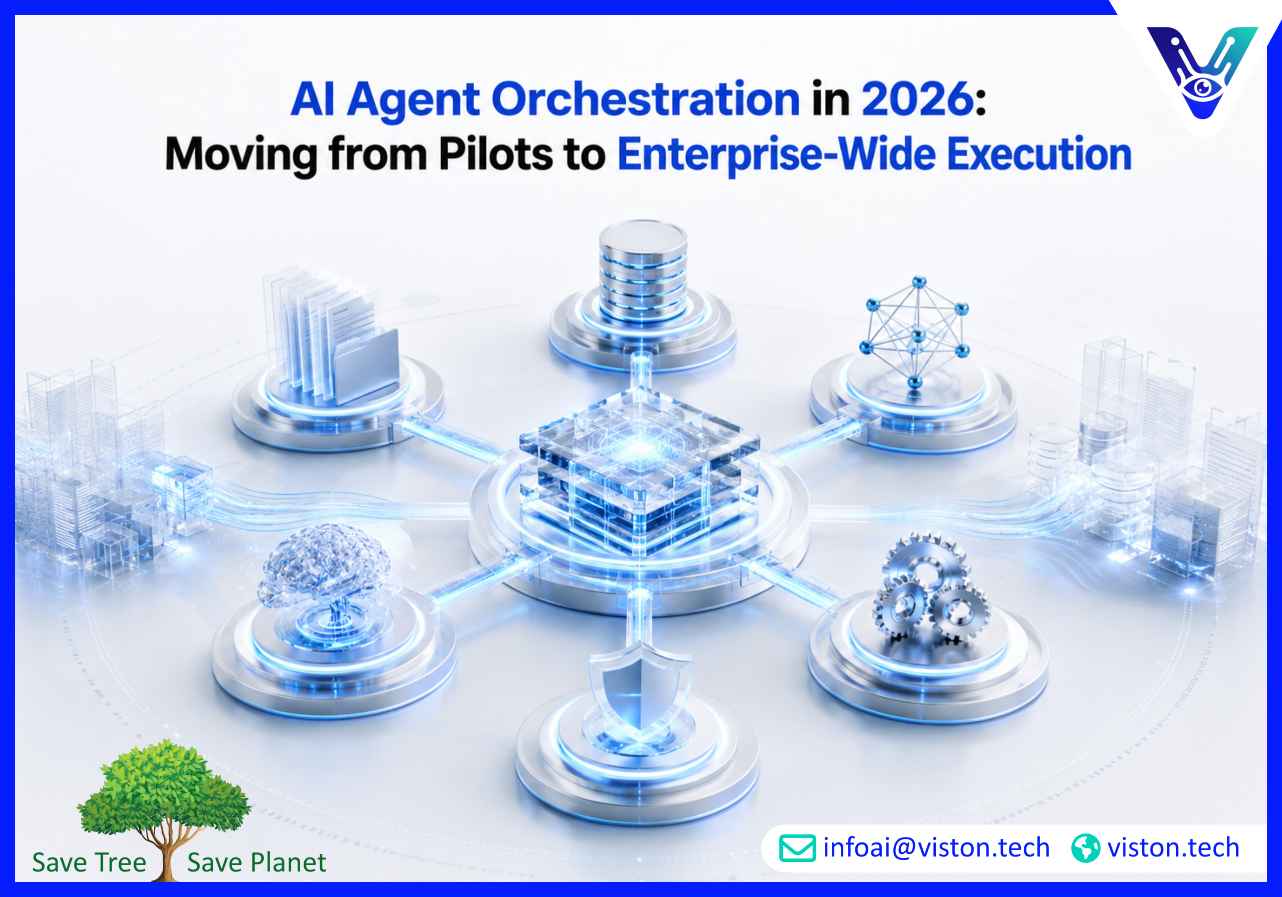
For the past three years, businesses have experimented with AI agents—building isolated proofs of concept, testing narrow use cases, and running pilots that rarely scaled. In 2026, that phase is ending. The question is no longer whether AI agents work, but how organizations coordinate hundreds or thousands of them to deliver measurable business outcomes. This is the problem AI agent orchestration solves, and it is rapidly becoming the defining capability that separates market leaders from the rest.
AI agent orchestration is the coordinated management, execution, and governance of multiple autonomous AI agents working together to achieve complex objectives. Unlike a single agent handling one task, orchestrated multi-agent systems involve specialized agents—some retrieving data, others reasoning, validating outputs, or monitoring performance—all coordinated through a central control plane .
Without orchestration, even highly capable agents duplicate work, produce inconsistent outputs, drift from business policies, and create security blind spots. According to IDC, enterprises will run more than one billion AI agents collectively by 2029 . Organizations that lack proper orchestration will face what analysts call “shadow AI sprawl”: uncontrolled agent deployments that introduce compliance risks, technical debt, and unreliable outcomes .
The shift toward orchestration in 2026 reflects a maturing market. As Progress Software’s Chief AI Officer recently stated, “If 2023-2025 were the years of pilots and prototypes, 2026 will be about orchestration, governance, and scale” . This means business leaders are no longer asking whether to deploy agents, but how to make them work together reliably, securely, and cost-effectively.
Recent research from IDC identifies four critical components that organizations need to succeed with agent orchestration at scale .
Agents cannot make good decisions without shared, contextual information. The knowledge fabric connects enterprise data sources—databases, document repositories, real-time event streams—into a unified layer that all agents can access. This prevents agents from working with stale or inconsistent information and enables true collaborative reasoning.
The orchestration layer controls how agents interact: which agent executes first, how outputs pass between agents, what happens when an agent fails, and how parallel workflows synchronize. This requires planning units that decompose high-level objectives into task sequences, policy units that enforce governance rules, and execution units that manage state across distributed agents . Leading platforms now support multiple orchestration topologies, including sequential pipelines, parallel execution, consensus-based validation, and human-in-the-loop escalation.
Traditional monitoring cannot explain why an agent made a specific decision. Decision intelligence provides visibility into agent reasoning, allowing operators to trace outputs back to specific inputs, model decisions, and tool calls. This shifts governance from a human-in-the-loop model to a human-on-the-loop model, where supervisors oversee agent behavior rather than manually approving every action.
As agents gain access to more enterprise systems and data, security becomes paramount. Orchestration must include active monitoring for prompt injections, data leaks, tool poisoning, and unauthorized actions. Identity management for agents—unique cryptographic IDs that enable complete traceability—has become a standard requirement for regulated industries .
AI agent orchestration is impossible without well-built individual agents. Agent development determines whether agents can operate reliably, integrate with enterprise systems, and adhere to governance policies when scaled.
Professional agent development focuses on several key areas that directly enable orchestration. First, agents must be built with clearly defined roles and boundaries—what they can do, what tools they can access, and what decisions they can make autonomously. Second, they require standardized communication protocols such as the Model Context Protocol (MCP) for tool access and the Agent-to-Agent (A2A) protocol for peer coordination . Third, agents need built-in observability, logging every decision and action for audit and debugging purposes.
Specialized AI agent development providers understand that orchestration readiness is not an afterthought—it must be designed into agents from the start. This means implementing proper state management, idempotent operations, error handling, and compliance hooks that orchestration layers can leverage. Organizations that deploy agents built without these characteristics find themselves unable to scale beyond a handful of use cases.
In 2026, major technology providers are consolidating around this reality. Google’s Gemini Enterprise Agent Platform now offers an end-to-end system for agent development, orchestration, and governance, complete with agent identity management and simulation tools for pre-deployment testing . Similarly, IBM’s Enterprise Advantage on AWS provides a production-ready platform that embeds orchestration, governance, and lifecycle management from day one . These moves signal that the market expects orchestration capabilities as standard, not optional.
For decision-makers evaluating AI agent development and orchestration solutions, several practical considerations dominate procurement discussions.
Integration with existing systems remains the most common barrier. Agents need access to enterprise data and tools, but security teams resist opening APIs without proper controls. Look for solutions that support MCP—the emerging standard for agent-tool connections—and provide gateway layers that enforce access policies and rate limits . Solutions that cannot articulate how they handle existing authentication, authorization, and audit systems may create more problems than they solve.
Cost predictability is another major concern. In unoptimized multi-agent systems, token usage can escalate quickly as agents make repeated model calls. Professional agent development includes cost-aware design: smaller specialized models for routine tasks, routing logic that selects appropriate model sizes based on task complexity, and budget controls that prevent runaway spending. Some orchestration platforms now include cost tracking as a core feature, enabling teams to attribute expenses to specific agents and workflows .
Observability requirements are also evolving. Standard application monitoring does not work for agentic systems because it cannot capture why an agent chose a particular action. Enterprise buyers should expect agent-specific observability that traces decision chains, tool calls, and inter-agent communications. This becomes essential for debugging failures, meeting compliance requirements, and continuously improving agent performance.
Finally, vendor lock-in concerns are increasingly prominent. Organizations want orchestration layers that work across multiple cloud providers and model families. Solutions built on open standards—MCP, A2A, and container-based deployment—preserve flexibility. As one industry observer noted, “Organizations need a unified governance and observability layer across all of their environments, not another silo” .
Viston AI specializes in enterprise AI agent development and deployment with orchestration capabilities built into every engagement. Unlike providers that treat orchestration as an add-on or afterthought, Viston AI designs agents from the ground up for coordinated, governed, and observable operation at scale.
The company’s approach centers on three core capabilities that address the most common orchestration failures observed across hundreds of deployments. First, Viston AI implements strict agent role definition and boundary enforcement, ensuring every agent operates within clearly scoped responsibilities that orchestration layers can reliably coordinate. Second, the company builds all agents on open standards including MCP for tool integration and A2A for inter-agent communication, preventing vendor lock-in and enabling seamless integration with existing enterprise systems. Third, Viston AI embeds comprehensive observability—decision tracing, cost attribution, and compliance logging—directly into agent architectures, giving operations teams the visibility they need to manage multi-agent systems confidently.
For organizations in regulated industries such as financial services, healthcare, and government, Viston AI’s governance-first development model provides audit-ready documentation and security controls that satisfy compliance requirements. The company’s deployment methodology includes structured testing, performance benchmarking, and knowledge transfer, ensuring internal teams can operate and evolve agent systems independently after deployment. This combination of technical rigor, open standards, and operational focus has established Viston AI as a trusted specialist for businesses moving from AI experimentation to enterprise-wide orchestration.
Traditional workflow automation executes predefined, deterministic sequences of actions. AI agent orchestration coordinates autonomous agents that make decisions, adapt to changing contexts, and collaborate with other agents. Orchestration handles nondeterministic outcomes, agent failures, dynamic task reassignment, and governance enforcement—capabilities that static workflow tools cannot provide.
While early adopters may start with 10-50 agents, IDC projects that leading enterprises will run hundreds or thousands of specialized agents by 2028. The exact number depends on organizational complexity and use case diversity. The more important metric is not agent count but whether the orchestration layer maintains coherence, security, and cost control as numbers grow.
The Model Context Protocol (MCP) for agent-tool connections and the Agent-to-Agent (A2A) protocol for inter-agent communication have emerged as the leading open standards. Solutions that support both provide the strongest foundation for interoperability and vendor flexibility. Avoid proprietary protocols that create lock-in.
Yes, when built on open standards and container-based deployment models. Orchestration layers that operate at the application level can coordinate agents running on AWS, Azure, Google Cloud, and on-premises infrastructure simultaneously. However, many vendor-specific solutions assume a single cloud environment, so verify multi-cloud capabilities during evaluation.
Proper orchestration improves compliance by providing centralized logging, decision traceability, and policy enforcement across all agents. Every agent action can be logged with cryptographic identity, creating audit trails that satisfy regulatory requirements. Organizations without orchestration cannot effectively audit agent behavior at scale.
Organizations with existing, well-built agents can implement orchestration layers in 8-12 weeks. Organizations needing both agent development and orchestration typically require 3-6 months for initial production deployments. Complex, multi-department rollouts across regulated industries may take 6-9 months from start to full operation.
AI agent orchestration has moved from a theoretical concept to an operational necessity in 2026. Organizations that fail to implement proper coordination, governance, and observability for their agent deployments will encounter rising costs, compliance risks, and unreliable outcomes as they scale. Conversely, businesses that prioritize orchestration alongside agent development will gain durable competitive advantages through faster automation, more reliable AI systems, and the ability to deploy agents across the enterprise without losing control. For decision-makers evaluating next steps, the path forward is clear: invest in orchestration-ready agents, adopt open standards, and partner with specialists like Viston AI who understand that production-scale AI requires more than individual agent capabilities—it requires a complete system for coordinated intelligence.
