
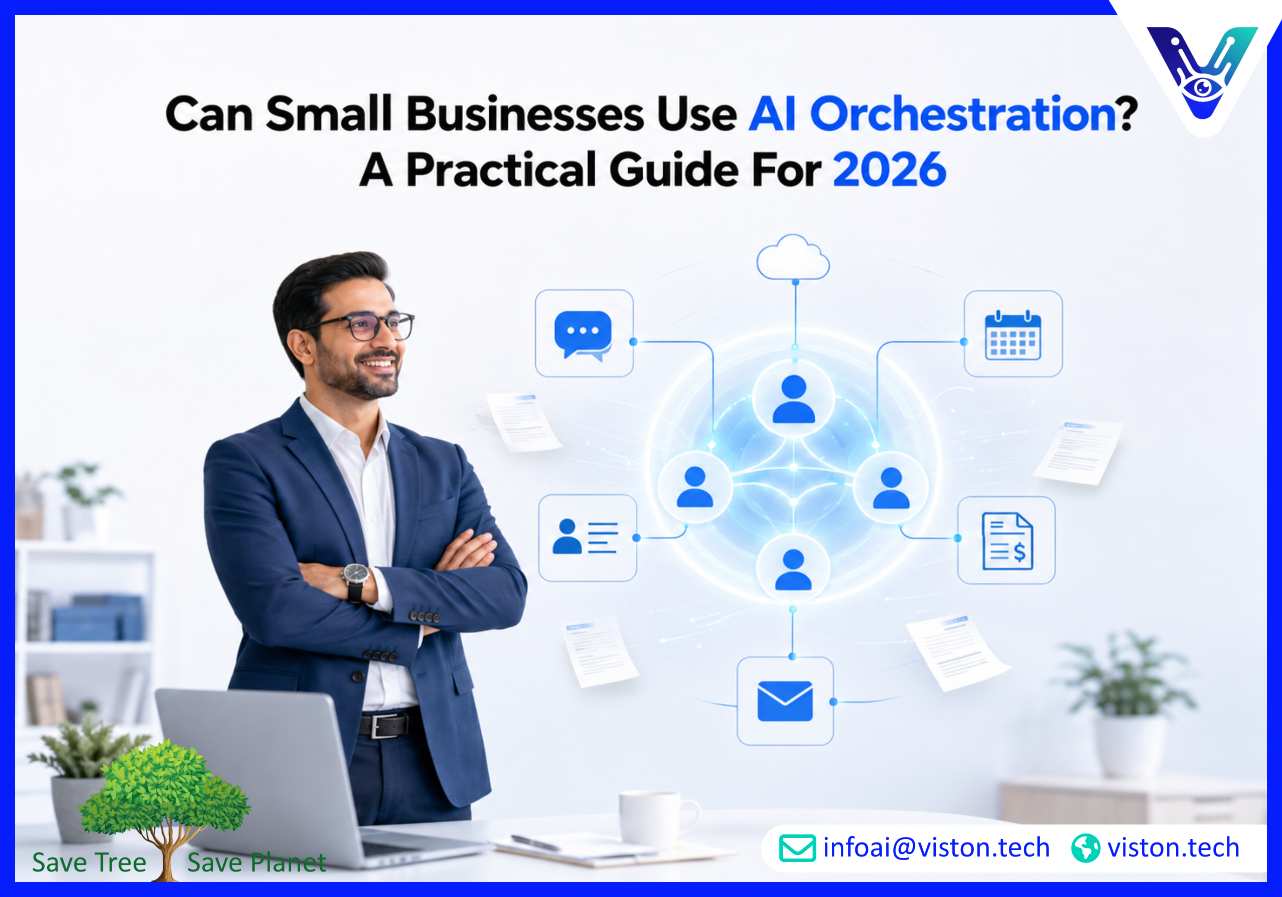
Small businesses are increasingly looking for ways to automate operations, improve efficiency, and compete with larger organizations without significantly increasing headcount. AI orchestration has emerged as a practical solution, allowing businesses to connect AI agents, workflows, data sources, and business systems into coordinated processes that deliver measurable operational value.
AI orchestration refers to the coordination of multiple AI agents, tools, systems, and workflows to complete business tasks efficiently. Rather than using standalone AI tools for isolated activities, orchestration creates structured workflows where different AI agents perform specialized functions while sharing information and working toward a common outcome.
For small businesses, this can mean automating customer inquiries, lead qualification, appointment scheduling, invoice processing, reporting, internal knowledge management, and other repetitive operational tasks.
Instead of replacing employees, AI orchestration helps teams focus on higher-value work by reducing manual administrative effort and improving process consistency.
Historically, advanced automation was often limited to large enterprises with significant budgets and dedicated technology teams. However, AI technologies have evolved rapidly, making orchestration platforms and AI agent frameworks more accessible to smaller organizations.
Several factors have contributed to this shift:
As a result, small businesses can now deploy solutions that were previously available only to larger organizations.
Small businesses often struggle to provide fast customer responses while managing limited resources. AI orchestration can connect chatbots, knowledge bases, ticketing systems, and escalation workflows.
For example, an AI agent can answer common questions, retrieve relevant information, create support tickets when necessary, and route complex issues to human staff.
Many small businesses lose opportunities because lead follow-up processes are inconsistent. Orchestrated AI workflows can automatically capture leads, enrich prospect information, qualify inquiries, update CRM systems, and notify sales teams when action is required.
This helps improve response times and ensures potential customers do not fall through the cracks.
Administrative work consumes valuable time in smaller organizations. AI orchestration can automate:
These efficiencies can significantly reduce operational overhead.
Marketing teams in small businesses frequently manage multiple platforms with limited resources. AI orchestration can coordinate campaign monitoring, lead tracking, content workflows, reporting, audience segmentation, and performance analysis.
This creates a more organized marketing operation without requiring additional staff.
One of the biggest misconceptions is that AI orchestration requires extensive technical expertise. While sophisticated implementations can become complex, many modern orchestration solutions are designed for practical business deployment and can be introduced gradually.
Businesses often start with a single workflow before expanding into broader automation initiatives.
Small businesses are naturally cautious about technology investments. The key is focusing on workflows where automation can generate measurable returns through time savings, improved productivity, reduced errors, or increased revenue opportunities.
Many organizations discover that automating one high-volume process can quickly justify the investment.
As AI adoption increases, security becomes a major consideration. Small businesses should evaluate:
Proper orchestration includes safeguards that ensure AI agents operate within clearly defined boundaries.
The most successful implementations begin with a focused approach rather than attempting to automate every process at once.
Look for tasks that consume significant time, follow predictable patterns, and occur frequently. These often represent the strongest opportunities for automation.
Understanding how work currently moves through the business helps identify bottlenecks, inefficiencies, and areas where AI agents can add value.
Businesses should establish measurable goals such as:
After validating success with one workflow, organizations can expand orchestration across additional business functions while maintaining governance and control.
For small businesses exploring AI orchestration, implementation success often depends on choosing the right workflows, designing effective AI agents, and ensuring reliable integration with existing systems. This is where Viston AI’s expertise in AI Agent Development & Deployment becomes particularly relevant.
AI orchestration is not simply about deploying a chatbot or connecting a few automation tools. Effective solutions require agent design, workflow architecture, business system integration, testing, governance, monitoring, and ongoing optimization. Viston AI helps organizations develop AI agents that can perform specialized tasks while operating within orchestrated workflows aligned with business objectives.
Whether the goal is improving customer support, streamlining sales processes, automating operational tasks, or enhancing internal workflows, AI agent deployment must be practical, secure, and scalable. By focusing on business outcomes rather than technology experimentation, Viston AI can help small businesses implement AI orchestration solutions that deliver real operational improvements while maintaining oversight and control.
Yes. Modern AI orchestration solutions are significantly more accessible than traditional enterprise automation platforms. Costs vary based on workflow complexity, integrations, and deployment scope, but many small businesses can begin with focused projects and expand over time.
Basic automation typically follows fixed rules. AI orchestration coordinates multiple AI agents, tools, and systems that can handle context, decision-making, communication, and workflow management across business processes.
Not necessarily. Many organizations work with specialist providers or use modern platforms that simplify deployment. However, successful implementation still requires clear business objectives and process planning.
Customer service, sales, marketing, finance, operations, and administrative functions often see the strongest benefits because they contain repetitive workflows that can be automated and optimized.
Yes. Viston AI’s AI Agent Development & Deployment services align with the design, implementation, integration, and optimization of AI agents that support orchestrated business workflows.
Businesses should assess workflow complexity, expected business outcomes, integration requirements, security needs, governance controls, available data, and long-term scalability objectives.
Small businesses can absolutely use AI orchestration in 2026. Advances in AI agent technology, cloud infrastructure, and workflow orchestration platforms have made sophisticated automation more accessible than ever before. The key is starting with well-defined business challenges, selecting the right workflows, and implementing solutions that deliver measurable operational value. When combined with effective AI Agent Development & Deployment, AI orchestration can help small businesses improve efficiency, enhance customer experiences, reduce manual work, and create scalable operational processes. For organizations seeking a practical path to AI adoption, Viston AI provides expertise that aligns closely with these objectives.
