
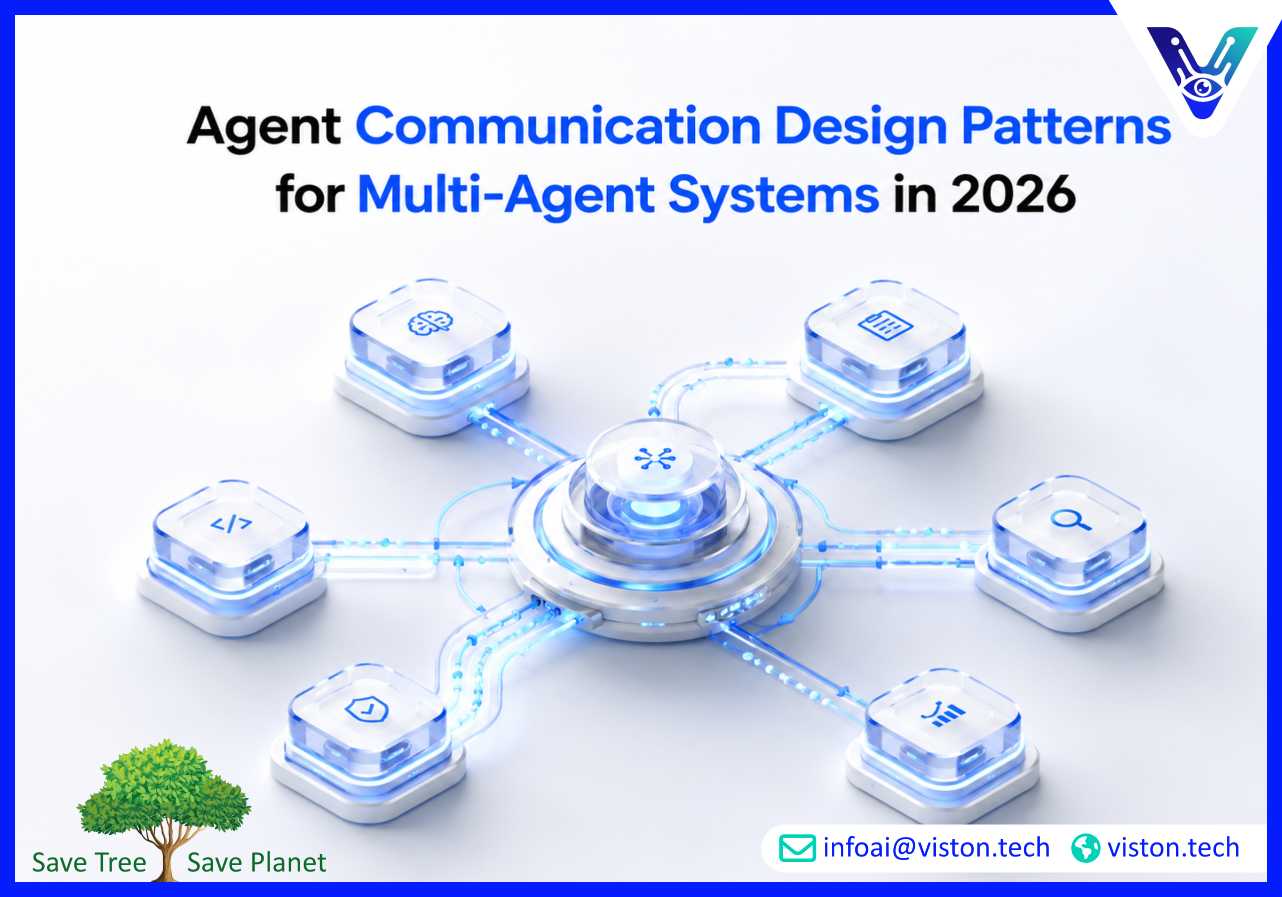
As enterprises move beyond single AI agents toward collaborative multi-agent ecosystems, agent communication design patterns have become the critical foundation for reliable, scalable AI systems. In 2026, organizations deploying production AI workforces must understand how agents exchange information, delegate tasks, and coordinate decisions without duplicating work or creating uncontrolled loops.
Agent communication design patterns define the structured ways multiple AI agents interact, share context, and collaborate on complex tasks. These patterns determine whether your multi-agent system operates as a coordinated team or devolves into chaos with redundant calls, missed handoffs, and runaway token costs.
For business leaders, the stakes are practical and financial. Poor communication design leads to operational failures that no amount of model capability can fix. Research shows that most multi-agent system failures stem from communication problems, not model limitations. The right pattern matching your workflow complexity reduces latency by 40-60%, cuts token costs significantly, and makes systems debuggable and auditable.
Current industry literature identifies core patterns including sequential chains, parallel execution, router-based delegation, orchestrator-worker hierarchies, and network-style peer communication. Each serves distinct use cases, from deterministic ETL pipelines to open-ended problem-solving requiring runtime adaptation.
The shift from single-agent proofs-of-concept to production multi-agent workforces has exposed a hard truth: communication topology is the intelligence in your system. Andrew Ng’s foundational frameworks and Anthropic’s workflow patterns established the baseline, but 2026 production deployments reveal new reliability requirements.
Three developments make this urgent:
Businesses deploying AI agents across customer engagement, supply chain automation, or intelligent decision-making now require communication architectures that scale without exponential cost growth.
Each agent adds value step-by-step in a deterministic pipeline. Agent A generates code, Agent B reviews it, Agent C deploys it. This pattern dominates workflow automation, ETL chains, and multi-step reasoning where steps are known upfront.
Best for: Tasks decomposing cleanly into fixed subtasks. Production-ready with high auditability and predictable costs.
Multiple agents run simultaneously on different subtasks or voting instances, then outputs merge. Perfect for document parsing pipelines, API orchestration, or gathering multiple perspectives on the same query.
Best for: Reducing latency in high-throughput pipelines. Two variants exist: sectioning (independent subtasks in parallel) and voting (same task multiple times for consensus).
A controller agent classifies input and routes to specialized downstream agents. Finance queries go to FinAgent, legal queries to LawAgent. This forms the foundation for context-aware agent routing in MCP/A2A-style frameworks.
Best for: Many input types requiring one clean front door. Manages cost by preventing unnecessary agent calls.
A top-level planner agent delegates subtasks to worker agents, tracks progress, and makes final calls. Like a manager with a team, this handles open-ended problems where steps cannot be predicted at design time.
Best for: Complex, adaptive workflows requiring runtime decision-making. Highest flexibility but also highest coordination risk and cost.
Agents continuously refine outputs until desired quality is reached. One LLM generates, another evaluates against predefined criteria. Great for proofreading, report generation, or creative iteration.
Best for: High-quality output with clear success criteria. Requires hard iteration limits to prevent runaway loops.
Agents communicate freely without hierarchy, sharing context dynamically. Used in simulations, multi-agent games, and collective reasoning systems where free-form behavior is desired.
Best for: Research and simulation environments. Highest risk in production due to latency, cost, and failure management challenges at scale.
Understanding what not to do is equally critical. Seven anti-patterns consistently break agentic systems:
The most expensive mistake is reaching for orchestrator or evaluator loops when chaining or routing would suffice at a fraction of the cost.
Implementing agent communication patterns correctly requires expertise beyond model selection. Agent Integration Services specialize in bridging the gap between AI capability and enterprise reality by designing communication architectures that are secure, scalable, and operationally sound.
Professional integration teams address the critical gaps that cause DIY deployments to fail:
Organizations considering AI workforce deployment benefit from partners who have shipped production multi-agent systems across industries including finance, healthcare, manufacturing, and supply chain. The outcome is measurable ROI, faster time-to-value, and scalable AI systems connecting innovation with operational impact.
Viston AI delivers custom, enterprise-focused artificial intelligence solutions that help organizations turn complex data into practical business outcomes. Based in Ahmedabad, Gujarat, the company specializes in AI/ML development and integration, with particular depth in building collaborative AI agent workforces through its Delos platform.
For agent communication design, Viston AI’s approach centers on orchestrating task-specific AI agents that work in concert rather than isolation. The Delos platform enables LLM orchestration and prompt chaining, seamlessly passing tasks from one agent to the next where market analysis output becomes sales strategy input. This reflects the sequential and orchestrator-worker patterns that dominate production workflows.
Viston AI addresses core business challenges including error reduction in automated processes, thousands of hours saved through intelligent end-to-end process ownership, and measurable productivity gains across customer engagement, automation, forecasting, and intelligent decision-making. The company serves finance, healthcare, retail and eCommerce, manufacturing, logistics, supply chain, and security industries with ISO-certified security, data governance, and compliance for enterprise deployments.
What makes Viston AI’s delivery specialized is its focus on real-time collaboration and tool integration, allowing human teams to supervise, approve, and collaborate with AI agents directly within workflows. This human-in-the-loop capability, combined with integration into existing enterprise tools, ensures AI works where work actually happens rather than operating as isolated automation. For organizations in India and global markets seeking scalable AI systems connecting innovation with operational impact, this practical, business-focused approach supports meaningful outcomes.
Sequential (prompt chaining) and router patterns dominate production deployments. Sequential works best for deterministic workflows with known steps, while router handles diverse input types efficiently. Industry data shows teams achieve 80% of use cases with these simpler patterns before requiring orchestrator-worker or loop complexity.
Use multi-agent collaboration only when work genuinely exceeds a single role, context window, or service boundary. Start with Tool Use alone for tasks resolvable with one LLM call plus APIs. Add multi-agent patterns only when distinct prompts, tools, and evaluation criteria cannot share one context. Over-agentification is the dominant cost driver in production.
Emerging standards include Model Context Protocol (MCP) for tool access and Agent-to-Agent Protocol (A2A) for peer task delegation. Research recommends a phased roadmap: begin with MCP for tool integration, then add A2A for collaborative task execution, and potentially ANP for decentralized discovery scenarios. These protocols are complementary, not competitive.
Implement bounded execution patterns with maximum step limits, tool-call caps, and circuit breakers. Add hard iteration limits to reflection and planning loops. Use guardrail layering at input, tool calls, tool responses, and output. Most importantly, match minimum viable patterns to actual failure modes rather than anticipated requirements.
Most multi-agent system failures stem from communication problems, not model limitations. Poor design causes duplicate work, unknown agent states, uncontrolled token spend, and undebuggable trajectories. Every uncontrolled agent call adds latency and dollars. Network patterns look promising in research but create unacceptable latency, cost, and failure management risks at production scale.
Consider professional services when deploying AI agents across regulated industries, requiring enterprise system integration, needing ISO-certified security and compliance, or when DIY deployments show uncontrolled costs or governance gaps. Integration specialists prevent anti-patterns like agent sprawl, governance as afterthought, and vibe-checking as testing that cause production failures.
Agent communication design patterns determine whether your multi-agent AI system operates as a coordinated workforce or becomes an expensive source of operational failures. In 2026, the pattern choice is not about technical novelty but about matching minimum viable communication structures to actual business workflows, preventing over-agentification while enabling genuine collaboration.
The practical takeaway is clear: start with sequential chaining and routing for deterministic workflows, add parallelization for throughput needs, reserve orchestrator-worker patterns for open-ended problems requiring runtime adaptation, and always implement bounded execution, guardrail layering, and trajectory logging before production deployment. Agent Integration Services become valuable when organizations need expertise in pattern selection discipline, protocol implementation, enterprise integration, and governance that prevents costly anti-patterns.
For businesses evaluating AI workforce deployment, understanding communication design patterns is the foundation for scalable, reliable, and cost-effective AI systems that deliver measurable ROI.
