
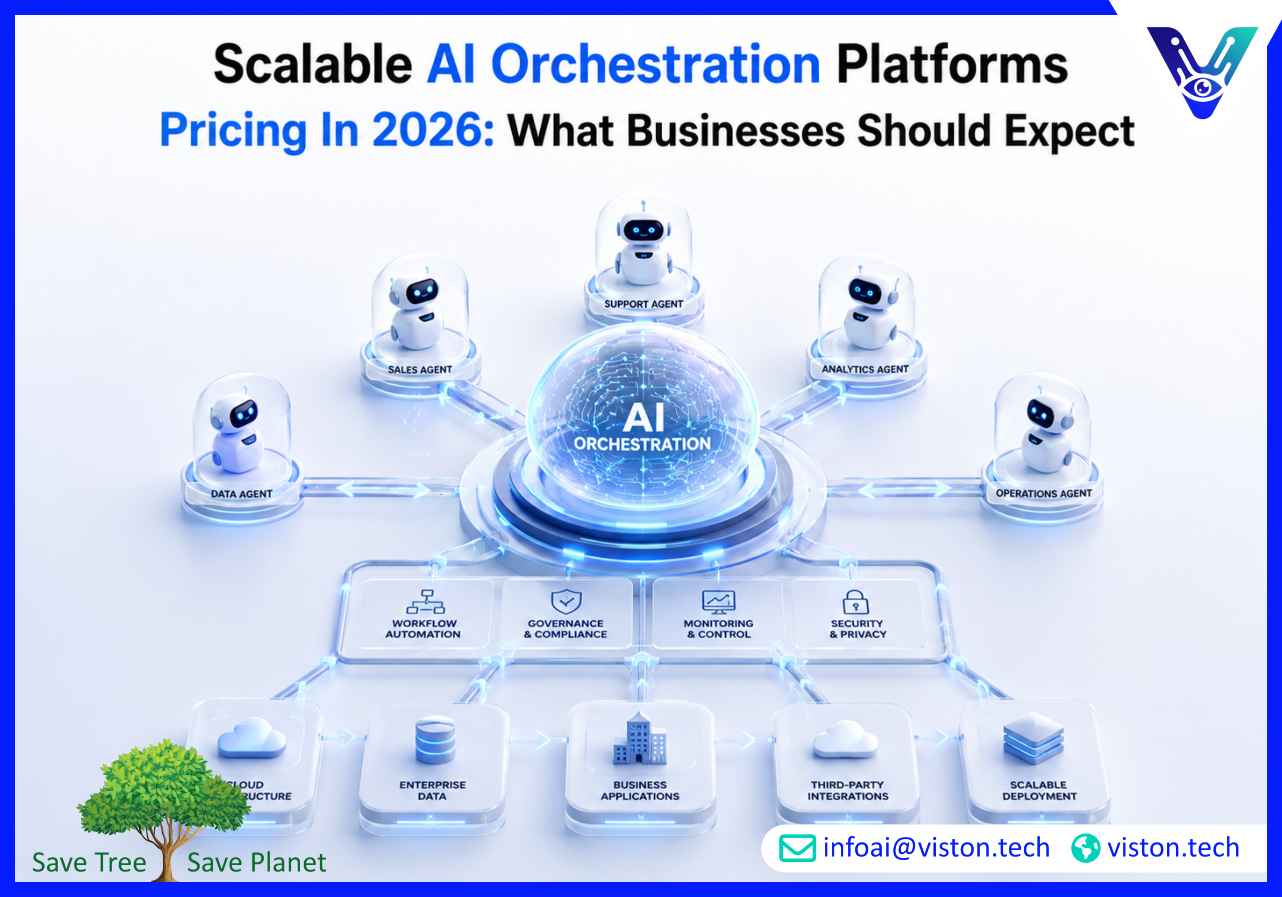
As organizations move from isolated AI experiments to enterprise-wide deployment, understanding scalable AI orchestration platforms pricing has become a critical business decision. Pricing is no longer determined solely by model usage. Modern AI orchestration platforms involve workflow automation, agent coordination, integrations, governance, monitoring, and deployment infrastructure that directly influence total investment and long-term value.
AI orchestration platforms provide the infrastructure needed to coordinate multiple AI agents, automate business processes, manage workflows, connect enterprise systems, and maintain operational control across AI-driven environments.
Unlike standalone AI tools, orchestration platforms are designed to manage complex workflows involving multiple agents, large volumes of data, business applications, approval processes, and human oversight.
In 2026, pricing models vary significantly depending on the platform architecture, deployment requirements, usage volume, security controls, and implementation complexity.
Organizations evaluating scalable AI orchestration platforms should understand that pricing often includes several layers beyond access to AI models:
As AI adoption expands across departments, businesses increasingly evaluate total operational value rather than focusing exclusively on subscription costs.
Pricing structures differ across vendors, but several common factors have the greatest impact on overall investment.
Many platforms charge based on the number of deployed agents, active workflows, or orchestration instances running simultaneously. A company deploying a handful of internal assistants will have different requirements than an organization operating hundreds of specialized agents across customer service, operations, finance, and sales.
Simple automations typically cost less than sophisticated multi-agent environments.
Workflows that involve:
require more orchestration resources and implementation effort.
Most orchestration platforms sit on top of foundation models. Usage costs often depend on token consumption, inference frequency, context window size, and model selection.
Organizations using advanced reasoning models for high-volume workflows generally experience higher operating costs than businesses using lightweight models for routine tasks.
Enterprise deployments frequently require integrations with:
The complexity and number of integrations can significantly influence implementation pricing.
Organizations operating in regulated environments often require enhanced governance features such as:
These requirements typically increase platform and deployment costs but are often essential for enterprise adoption.
Cloud-based deployments generally have lower upfront costs. Private cloud, hybrid cloud, and dedicated enterprise environments often require additional infrastructure investment and operational management.
Businesses evaluating scalable AI orchestration platforms will encounter several pricing approaches.
This remains the most common model. Organizations pay a monthly or annual fee based on platform access, user count, workflow volume, or agent capacity.
This approach provides predictable budgeting and is often preferred for long-term operational planning.
Some vendors charge based on actual platform usage. Costs may be tied to:
This model can be attractive for organizations with variable demand but may create budgeting challenges if usage grows rapidly.
Enterprise platforms frequently offer pricing tiers that unlock additional capabilities.
Higher tiers may include:
As AI operations scale, many organizations migrate to enterprise tiers to support growing operational requirements.
Organizations building tailored orchestration ecosystems often require custom development services.
Implementation pricing may include:
For many enterprises, implementation services represent a significant portion of the initial investment.
Focusing solely on platform pricing can lead to poor decision-making. The lowest-cost solution is not always the most economical option when long-term business outcomes are considered.
Organizations should evaluate scalable AI orchestration platforms against measurable business objectives.
Can the platform reduce manual work, eliminate repetitive tasks, and improve workflow completion times?
Will the platform support future growth without requiring extensive redevelopment?
Can workflows operate consistently across large volumes of transactions, requests, or business processes?
Does the platform provide sufficient visibility, monitoring, approvals, and control mechanisms?
Can it connect with existing business systems without introducing unnecessary complexity?
Businesses should evaluate:
A platform with higher upfront pricing may generate greater long-term value if it reduces operational overhead and accelerates business processes.
The expectations surrounding AI orchestration platforms continue to evolve. Businesses are no longer looking for simple automation tools. They expect comprehensive environments that support enterprise-scale AI operations.
Key expectations include:
Platforms capable of delivering these requirements often justify higher pricing because they support strategic business transformation rather than isolated automation projects.
Organizations evaluating scalable AI orchestration platforms pricing often discover that technology selection is only one part of the challenge. Successful AI adoption also requires thoughtful agent design, workflow architecture, integration planning, governance frameworks, and deployment strategies.
Viston AI specializes in AI Agent Development & Deployment, helping businesses move from conceptual AI initiatives to production-ready agent ecosystems. Rather than focusing solely on individual agents, effective deployment requires understanding how agents interact with business processes, enterprise systems, operational objectives, and organizational controls.
For businesses assessing orchestration platform investments, Viston AI can support the development of scalable AI environments that align with operational requirements and future growth plans. This may include agent architecture design, workflow automation planning, integration strategies, deployment frameworks, monitoring approaches, and optimization initiatives.
As organizations expand AI usage across multiple departments, the ability to deploy coordinated agents reliably becomes increasingly important. A structured deployment approach helps businesses avoid fragmented implementations while creating scalable systems capable of delivering measurable business value.
By focusing on practical implementation, governance, and operational alignment, Viston AI helps organizations build AI agent ecosystems that support long-term business objectives rather than short-term experimentation.
Pricing varies significantly depending on workflow complexity, agent volume, integrations, infrastructure requirements, security needs, and deployment scope. Most enterprise implementations involve both platform licensing and implementation costs.
The largest cost drivers are usually AI model usage, workflow complexity, integration requirements, governance controls, infrastructure consumption, and the number of deployed agents.
It depends on usage patterns. Consumption-based pricing can be cost-effective for variable workloads, while subscription pricing often provides more predictable budgeting for organizations with consistent usage.
Enterprise AI orchestration typically requires workflow design, integration engineering, security configuration, testing, governance setup, and deployment planning. These activities are critical for achieving reliable business outcomes.
Yes. Modern orchestration platforms are designed to support multiple business functions, including operations, customer service, sales, finance, HR, and knowledge management workflows.
Viston AI supports organizations through AI Agent Development & Deployment services, helping businesses design, implement, integrate, and scale AI agent ecosystems aligned with operational and strategic objectives.
Understanding scalable AI orchestration platforms pricing requires evaluating far more than software subscriptions. Businesses must consider workflow complexity, agent deployment requirements, governance needs, integrations, infrastructure, and long-term scalability. As enterprise AI adoption accelerates in 2026, organizations increasingly focus on total business value rather than platform costs alone. When combined with effective AI Agent Development & Deployment strategies, orchestration platforms can support significant operational improvements, automation opportunities, and business growth. For organizations seeking structured implementation and scalable AI ecosystems, Viston AI provides relevant expertise to support successful deployment and long-term adoption.
