
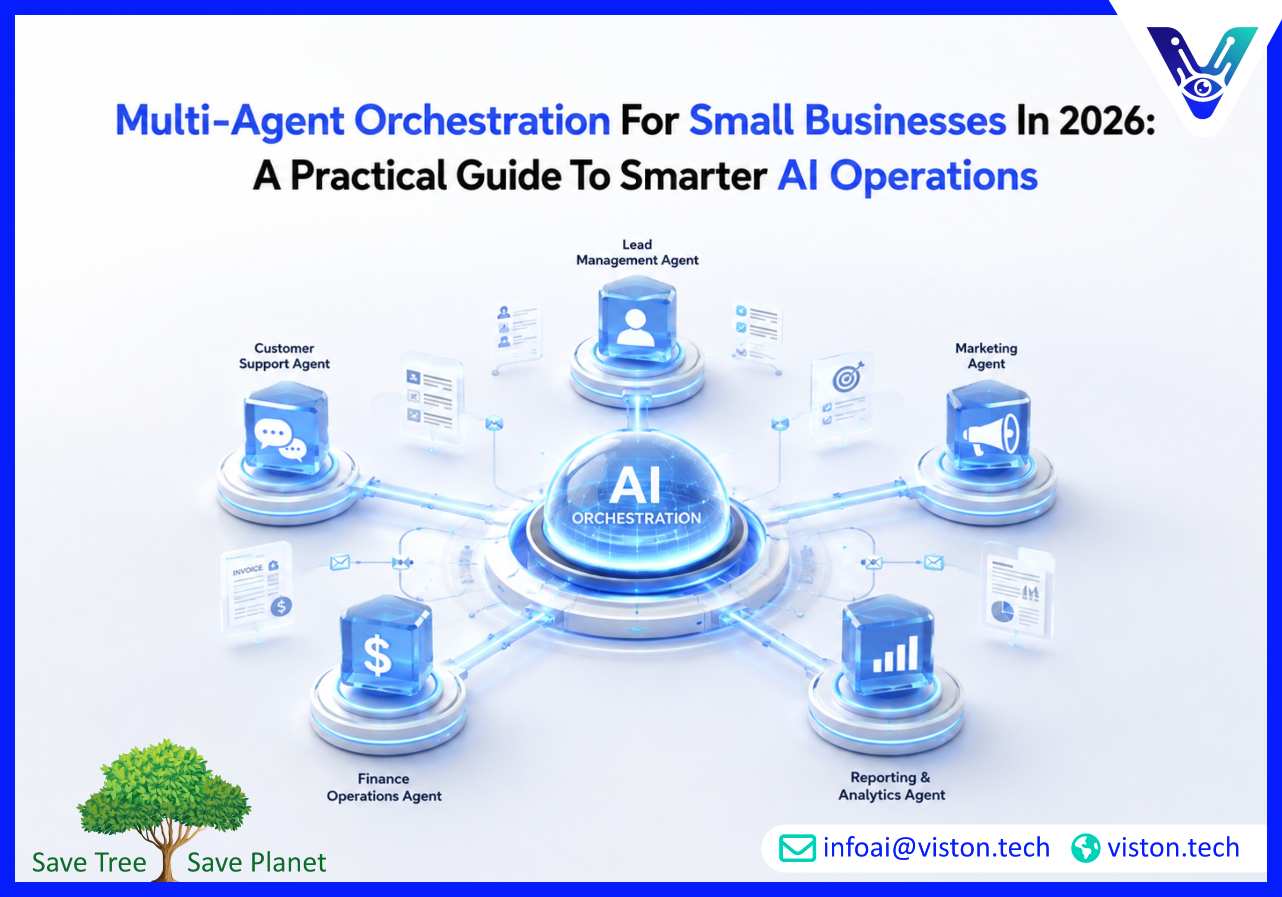
Small businesses are increasingly adopting AI to improve productivity, reduce manual work, and scale operations without significantly increasing headcount. Multi-agent orchestration is emerging as a practical approach that allows multiple AI agents to work together across workflows, helping smaller organizations automate complex processes with greater efficiency and control.
Multi-agent orchestration is the process of coordinating multiple AI agents that each perform specialized tasks within a business workflow. Rather than relying on a single AI assistant to handle everything, businesses deploy different agents with specific responsibilities and use an orchestration layer to manage communication, decision-making, task routing, and execution.
For small businesses, this means AI can support end-to-end processes that involve multiple steps, systems, and stakeholders. An orchestrated environment allows agents to collaborate, share context, access business tools, and complete workflows more effectively than isolated automation solutions.
For example, a small business managing inbound leads may use:
These agents work together under centralized orchestration, reducing manual coordination while maintaining process consistency.
Many small businesses operate with lean teams where employees handle multiple responsibilities. As customer expectations rise and competition increases, businesses need ways to improve operational efficiency without adding unnecessary complexity.
Multi-agent orchestration helps address several common challenges.
Small teams often spend significant time on repetitive administrative tasks. AI agents can handle routine activities, allowing employees to focus on strategic work, customer relationships, and business growth.
Information frequently moves between spreadsheets, CRM platforms, email systems, project management tools, and customer support applications. Orchestrated agents help connect these systems and reduce manual handoffs.
As businesses grow, operational complexity increases. Multi-agent systems provide a scalable framework that can support higher transaction volumes without requiring proportional staffing increases.
AI agents can collect information, perform analysis, and present recommendations more quickly than traditional manual workflows, helping businesses respond faster to opportunities and challenges.
In 2026, businesses that successfully combine human expertise with orchestrated AI workflows are often better positioned to improve efficiency, customer experience, and operational visibility.
Effective orchestration requires more than deploying multiple AI models. Businesses need a structured framework that ensures reliability, governance, and measurable outcomes.
Each agent should have clearly defined responsibilities. Common roles include:
Clear specialization improves performance and reduces workflow conflicts.
The orchestration layer controls how agents communicate, share information, transfer tasks, and manage exceptions. It ensures workflows follow defined business rules and operational requirements.
To create business value, agents must connect with existing platforms such as CRM systems, accounting software, customer support platforms, inventory systems, communication tools, and internal databases.
Agents need access to relevant information to perform tasks accurately. Shared context helps maintain consistency across workflows and reduces duplicate processing.
Not every decision should be fully automated. Human review remains important for financial approvals, customer escalations, compliance matters, and other high-impact decisions.
Businesses should track workflow performance, agent accuracy, completion rates, escalation patterns, and operational outcomes. Governance mechanisms help ensure AI systems remain reliable and aligned with business objectives.
Multi-agent orchestration can support a wide range of operational functions across different industries.
Multiple agents can collaborate to identify prospects, enrich contact information, score leads, update CRM records, draft communications, and generate sales reports.
Support workflows can use agents to classify tickets, retrieve knowledge base information, generate responses, escalate complex issues, and track resolution performance.
Agents can assist with appointment scheduling, document processing, internal approvals, invoice management, and routine business operations.
Marketing teams can orchestrate agents for market research, content planning, campaign monitoring, audience segmentation, and performance analysis.
Small businesses can automate invoice validation, payment tracking, expense categorization, reporting preparation, and anomaly detection.
The most successful implementations focus on workflows that deliver measurable business outcomes such as reduced processing time, improved accuracy, lower operational costs, and enhanced customer experiences.
Organizations should approach implementation strategically rather than attempting to automate every process simultaneously.
Identify processes that are repetitive, time-consuming, and operationally important. Early success creates momentum and helps justify further investment.
Document workflows, decision points, system interactions, and manual bottlenecks. Process clarity is essential before introducing AI agents.
Assign specific tasks to each agent rather than creating overly broad responsibilities. Specialized agents are easier to test, monitor, and optimize.
Determine which actions agents can perform independently and which require human approval.
Track metrics such as response times, workflow completion rates, cost savings, productivity improvements, and customer satisfaction.
Continuous optimization ensures that orchestrated workflows continue delivering value as business needs evolve.
For organizations exploring Multi-Agent Orchestration, Viston AI provides services that align directly with the design, implementation, and optimization of coordinated AI workflows. Rather than focusing solely on individual AI agents, Viston AI helps businesses build orchestrated systems where multiple specialized agents collaborate to achieve defined business objectives.
Small businesses often require solutions that balance automation capabilities with operational practicality. This includes workflow design, agent role definition, integration planning, governance frameworks, security considerations, monitoring strategies, and scalability planning. Effective orchestration ensures agents work together reliably while supporting real-world business processes.
Viston AI’s expertise in Multi-Agent Orchestration enables businesses to identify suitable automation opportunities, design structured workflows, connect existing systems, and implement AI-driven processes that remain manageable and measurable. This approach helps organizations avoid unnecessary complexity while creating automation frameworks capable of supporting future growth.
As small businesses increasingly adopt AI technologies in 2026, orchestration-focused implementation becomes an important factor in achieving sustainable operational improvements and long-term business value.
Multi-agent orchestration is the coordination of multiple specialized AI agents that work together to complete business workflows through managed communication, task routing, and decision-making processes.
Yes. Small businesses can benefit significantly because orchestrated AI systems help automate repetitive work, improve operational efficiency, and support growth without requiring large teams.
Common functions include sales operations, customer support, marketing workflows, administrative tasks, finance operations, data processing, and internal knowledge management.
Implementation complexity varies. Many organizations work with specialized providers to design, integrate, deploy, and maintain orchestrated AI workflows aligned with business objectives.
A chatbot typically performs conversational tasks, while orchestrated multi-agent systems coordinate multiple specialized agents across broader workflows involving data, tools, systems, approvals, and business processes.
Yes. Viston AI provides Multi-Agent Orchestration services that help businesses design coordinated AI workflows, integrate systems, establish governance controls, and deploy scalable automation solutions.
Multi-agent orchestration for small businesses is becoming an increasingly valuable strategy for improving operational efficiency, reducing manual workloads, and supporting sustainable growth in 2026. By coordinating specialized AI agents across business workflows, organizations can automate complex processes while maintaining oversight, reliability, and scalability. For businesses exploring Multi-Agent Orchestration, focusing on clear workflows, strong governance, and measurable outcomes is essential. With specialized expertise in Multi-Agent Orchestration, Viston AI helps organizations build practical AI systems that align with real business objectives and long-term operational success.
