
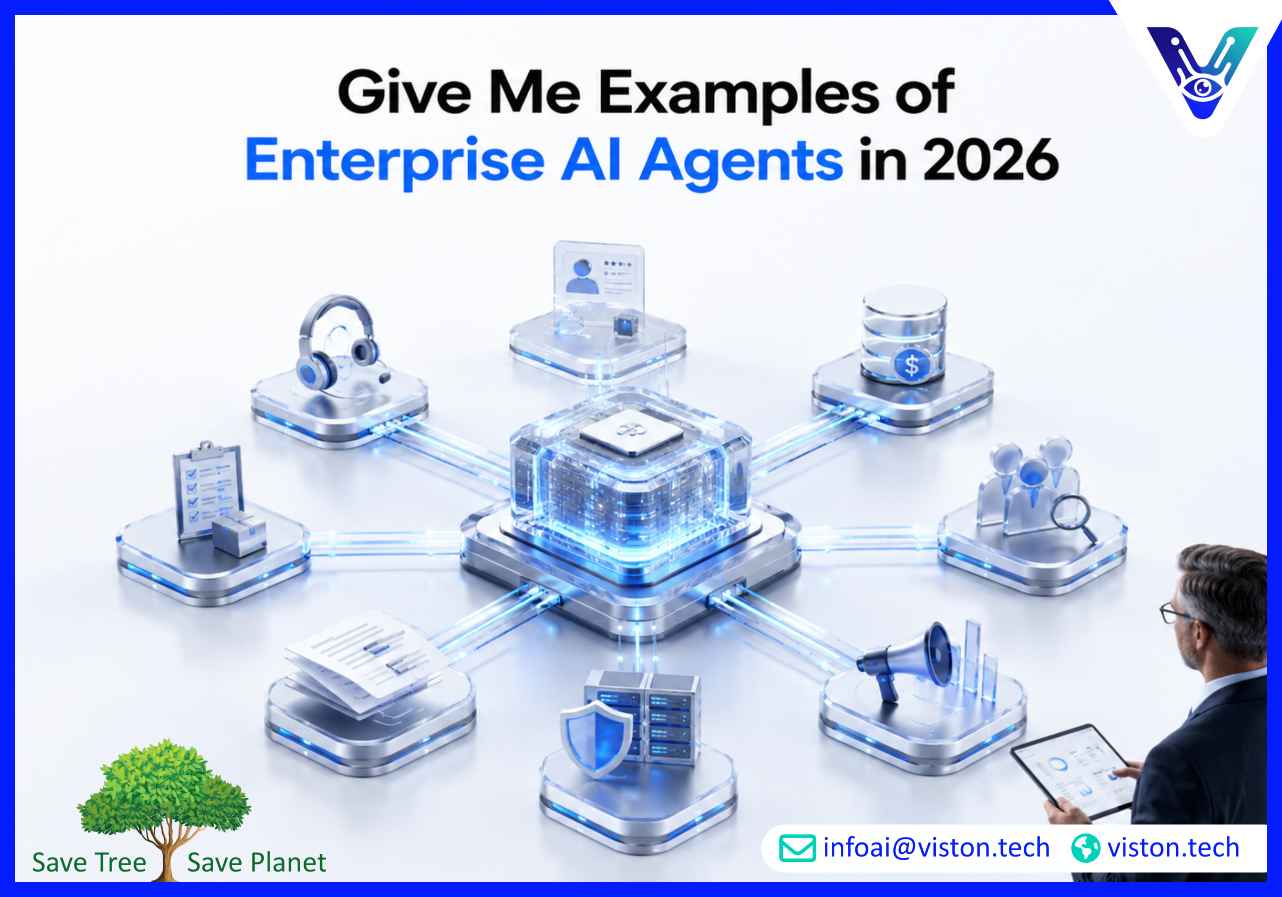
Enterprise AI agents are transforming how organizations operate by automating decision-making, streamlining workflows, and improving productivity across departments. As businesses increasingly adopt AI Agent Development & Deployment strategies in 2026, understanding practical enterprise AI agent examples can help leaders identify high-value opportunities for implementation.
Enterprise AI agents are intelligent software systems designed to perform business tasks autonomously or semi-autonomously. Unlike traditional automation tools that follow fixed rules, AI agents can analyze information, make contextual decisions, interact with multiple systems, and continuously improve performance through learning and feedback.
These agents are typically integrated with business platforms such as CRM systems, ERP software, databases, communication tools, document repositories, and customer service platforms. Their purpose is to reduce manual work, improve operational efficiency, and support faster business outcomes.
Modern enterprise AI agents can operate independently or as part of larger multi-agent ecosystems where several specialized agents collaborate to complete complex workflows.
Organizations are under increasing pressure to improve productivity without significantly increasing operational costs. Enterprise AI agents provide a scalable way to automate repetitive activities while supporting higher-value strategic work.
Several factors are driving enterprise adoption in 2026:
Rather than replacing employees, enterprise AI agents are increasingly being used to augment teams by handling routine tasks, gathering information, and supporting decision-making.
Customer support agents are among the most widely adopted enterprise AI solutions. These agents can answer common questions, retrieve information from knowledge bases, classify support tickets, and escalate complex issues to human representatives.
Common responsibilities include:
This reduces response times and improves service consistency while allowing support teams to focus on higher-priority cases.
Sales teams often spend significant time researching prospects and qualifying leads. AI agents can automate much of this process by gathering information, evaluating lead quality, updating CRM records, and preparing recommendations for sales representatives.
Typical functions include:
These capabilities help sales teams focus on opportunities with the highest likelihood of conversion.
Human resources departments increasingly use AI agents to streamline recruitment and employee onboarding processes.
Examples include:
HR agents can improve hiring efficiency while creating a smoother experience for both candidates and employees.
Finance departments benefit from AI agents that manage repetitive administrative activities while improving accuracy and compliance.
Common applications include:
These agents help reduce manual workloads and minimize errors in financial operations.
Procurement teams use AI agents to manage vendor communications, compare supplier information, monitor purchasing activities, and identify cost-saving opportunities.
Capabilities often include:
This allows procurement departments to operate more efficiently while maintaining governance and control.
Many organizations struggle with information scattered across multiple systems. Knowledge management agents help employees locate accurate information quickly.
These agents can:
By improving knowledge accessibility, organizations can reduce time spent searching for information and improve decision-making.
IT teams increasingly deploy AI agents to support infrastructure management and operational monitoring.
Examples include:
These agents help IT departments identify issues faster and maintain system reliability.
Marketing teams use AI agents to improve campaign execution, audience analysis, and content operations.
Common functions include:
Marketing agents help teams make data-driven decisions while improving operational efficiency.
Successful AI agent deployment requires more than selecting a technology platform. Organizations should evaluate operational readiness, data quality, security requirements, governance frameworks, and integration needs.
AI agents should be implemented to solve specific business problems rather than simply adopting new technology.
The effectiveness of enterprise AI agents depends heavily on the quality and accessibility of business data.
Organizations should define approval processes, monitoring systems, audit trails, and escalation procedures for agent activities.
Human-in-the-loop workflows remain important for financial decisions, legal matters, compliance requirements, and customer-sensitive interactions.
Enterprise AI initiatives should be designed with long-term growth, integration flexibility, and ongoing optimization in mind.
Organizations exploring enterprise AI agents often face challenges related to strategy, architecture design, system integration, governance, deployment, and ongoing optimization. This is where specialized expertise becomes critical.
Viston AI focuses on AI Agent Development & Deployment, helping businesses design and implement practical AI solutions aligned with real operational requirements. Rather than approaching AI as a standalone technology project, successful deployments require careful workflow analysis, role definition, integration planning, security controls, and performance monitoring.
Enterprise AI agents frequently need access to CRM platforms, internal knowledge systems, communication tools, business databases, analytics platforms, and workflow applications. Building reliable agent ecosystems requires thoughtful orchestration and governance to ensure accuracy, security, and scalability.
By focusing on business outcomes rather than experimentation alone, Viston AI helps organizations identify where AI agents can create measurable value, automate repetitive work, improve operational visibility, and support long-term digital transformation initiatives. As enterprise adoption accelerates in 2026, structured AI Agent Development & Deployment becomes increasingly important for organizations seeking sustainable results.
An enterprise AI agent is an intelligent software system that can perform business tasks, make decisions, interact with enterprise applications, and automate workflows using AI technologies.
Sales, customer support, marketing, finance, HR, procurement, operations, and IT departments can all benefit from enterprise AI agents.
Yes. While chatbots primarily handle conversations, enterprise AI agents can execute tasks, access systems, retrieve data, make recommendations, and participate in business workflows.
Common challenges include data quality, system integration, governance, security, compliance requirements, and change management.
Yes. Multiple specialized agents can collaborate through orchestration frameworks, creating multi-agent systems that handle complex workflows across departments.
Viston AI provides AI Agent Development & Deployment services that help organizations design, integrate, deploy, and optimize enterprise AI solutions aligned with business objectives.
Enterprise AI agents are becoming a core component of modern business operations in 2026. From customer support and sales to finance, HR, procurement, and IT, these intelligent systems help organizations automate workflows, improve efficiency, and make better use of business data. Understanding practical examples of enterprise AI agents is often the first step toward identifying opportunities for implementation. For businesses evaluating AI Agent Development & Deployment initiatives, a structured approach focused on governance, integration, scalability, and measurable outcomes is essential. Viston AI supports organizations seeking practical and sustainable enterprise AI adoption strategies.
