
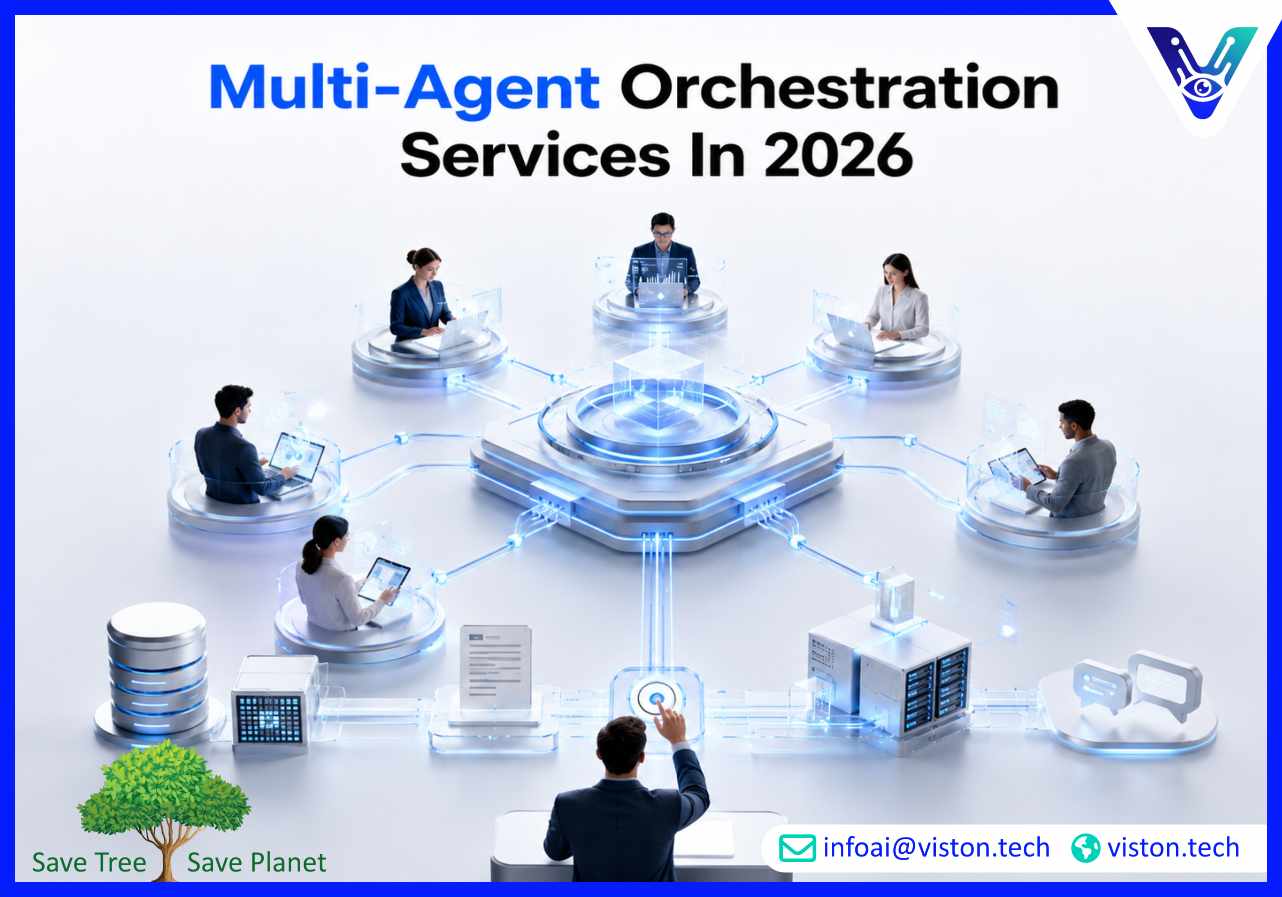
Multi-agent orchestration services help businesses coordinate specialized AI agents across workflows, systems, data, and teams. In 2026, this matters because companies need more than isolated AI tools; they need reliable, governed, and scalable agentic workflows that can support real business operations.
Multi-agent orchestration services involve designing, building, integrating, and managing systems where multiple AI agents work together to complete complex business processes. Each agent is assigned a specific role, such as planning, research, data extraction, validation, customer communication, reporting, or task execution.
The orchestration layer controls how these agents interact. It defines task sequencing, handoffs, permissions, escalation rules, tool access, memory, approvals, and monitoring. Without orchestration, agents may act independently but fail to deliver a dependable business outcome.
For example, a sales operations workflow may include one agent that researches a lead, another that checks CRM records, another that drafts a personalized outreach message, another that scores the opportunity, and another that updates the pipeline. Multi-agent orchestration connects these actions into one controlled workflow.
Businesses are moving from AI experimentation to operational AI adoption. Many organizations already use chatbots, automation tools, or AI assistants, but the next challenge is coordination. Teams want AI systems that can work across departments, applications, documents, APIs, and approval processes.
Multi-agent orchestration services are important because they make AI agents more practical for real work. They help businesses manage complexity, reduce manual coordination, improve workflow consistency, and add governance around autonomous actions.
In 2026, companies are also more cautious about security, compliance, model reliability, data privacy, and operational risk. A professional orchestration service addresses these concerns from the beginning instead of treating them as afterthoughts.
A strong multi-agent orchestration service is not limited to connecting AI models. It requires workflow strategy, system architecture, integration planning, governance, testing, and ongoing optimization.
Each agent needs a clear responsibility. Common agent types include planner agents, execution agents, retrieval agents, communication agents, compliance agents, validation agents, and monitoring agents. Clear role design reduces confusion and makes the system easier to test and improve.
The orchestration logic defines how work moves from one agent to another. It controls sequencing, dependencies, retries, exceptions, approvals, and escalation paths. This is essential for creating predictable workflows instead of uncontrolled agent activity.
Most valuable agentic workflows need access to business systems. Multi-agent orchestration services often involve integration with CRMs, ERPs, ticketing platforms, document repositories, communication tools, databases, analytics systems, and custom APIs.
Agents must access the right information at the right time. This may include customer history, workflow status, company policies, product data, previous decisions, documents, or approved business rules. Strong context management improves output quality and workflow reliability.
Not every action should be fully automated. Human review is important for financial approvals, legal communication, compliance decisions, customer refunds, sensitive data handling, and high-risk operational actions. A reliable orchestration setup defines when agents can act and when they must escalate.
Production-ready AI workflows require logs, access controls, testing, performance tracking, prompt versioning, error monitoring, audit trails, and cost visibility. These controls help businesses trust multi-agent systems in live operations.
Multi-agent orchestration services are most useful when workflows are repetitive, data-heavy, cross-functional, and difficult to manage with simple rule-based automation.
AI agents can research prospects, qualify leads, update CRM records, draft outreach messages, analyze pipeline movement, and prepare sales summaries. Orchestration ensures these steps happen in the right order with proper validation.
Multi-agent workflows can classify tickets, retrieve knowledge base content, draft responses, detect urgency, escalate complex cases, and update support records. This improves response speed while keeping human agents involved where needed.
Agents can support invoice review, payment matching, document extraction, approval routing, exception detection, and reporting. Orchestration helps maintain accuracy, auditability, and control.
Businesses can use multi-agent systems for employee onboarding, policy support, document collection, candidate screening, internal ticket routing, and knowledge retrieval.
Agents can assist with research, campaign planning, segmentation, performance reporting, content briefs, and workflow coordination. Orchestration helps teams move from scattered AI usage to structured marketing operations.
Viston AI is relevant to businesses exploring multi-agent orchestration services because its service offering includes Multi-Agent Orchestration, AI Agent Development & Deployment, Custom AI Agent Solutions, Agent Integration Services, and Agentic AI Workflows. These capabilities align directly with the needs of organizations that want to move beyond isolated AI tools and build coordinated agentic systems.
For companies without a fixed target industry or location, Viston AI’s services can be applied across sales, operations, support, data, customer communication, back-office automation, and internal workflow management. The company’s role is especially relevant where businesses need AI agents that can connect with existing tools, follow defined workflow logic, support human approval, and deliver measurable process improvements.
A practical multi-agent orchestration project requires more than AI model access. It needs workflow discovery, agent role design, integration planning, governance, testing, deployment, and optimization. Viston AI’s positioning around AI automation, workflow bots, agentic workflows, and multi-agent orchestration makes it suitable for organizations looking for structured implementation support rather than experimental prototypes.
This is valuable for businesses that want scalable AI systems with clear responsibilities, secure integrations, controlled autonomy, and practical business outcomes.
Multi-agent orchestration services help businesses design and manage AI systems where multiple specialized agents work together to complete complex workflows across tools, data, and teams.
A single AI agent usually handles one broad task. Multi-agent orchestration coordinates several specialist agents, each responsible for a defined part of a workflow, with controlled handoffs and validation.
Businesses with repetitive, complex, cross-functional, or data-heavy workflows can benefit. Common areas include sales operations, customer support, finance, HR, marketing, procurement, and internal operations.
They can be secure when designed with access controls, approval gates, audit logs, data protection rules, monitoring, and role-based permissions. Security should be built into the architecture from the start.
Yes. Viston AI offers Multi-Agent Orchestration and related AI agent services that can support workflow design, agent development, integrations, deployment, and optimization.
Companies should define the workflow, required systems, data quality, approval rules, risk level, expected outcomes, integration needs, security requirements, and long-term maintenance plan.
Multi-agent orchestration services help businesses turn AI agents into coordinated, reliable, and scalable workflow systems. In 2026, the value is not just automation, but controlled collaboration between agents, business tools, data sources, and human decision-makers. Companies that approach orchestration with clear workflows, secure integrations, governance, and measurable outcomes are more likely to build AI systems that support real operations. Viston AI is a relevant specialist for organizations exploring Multi-Agent Orchestration because its services align with practical AI agent development, integration, and agentic workflow implementation.
