
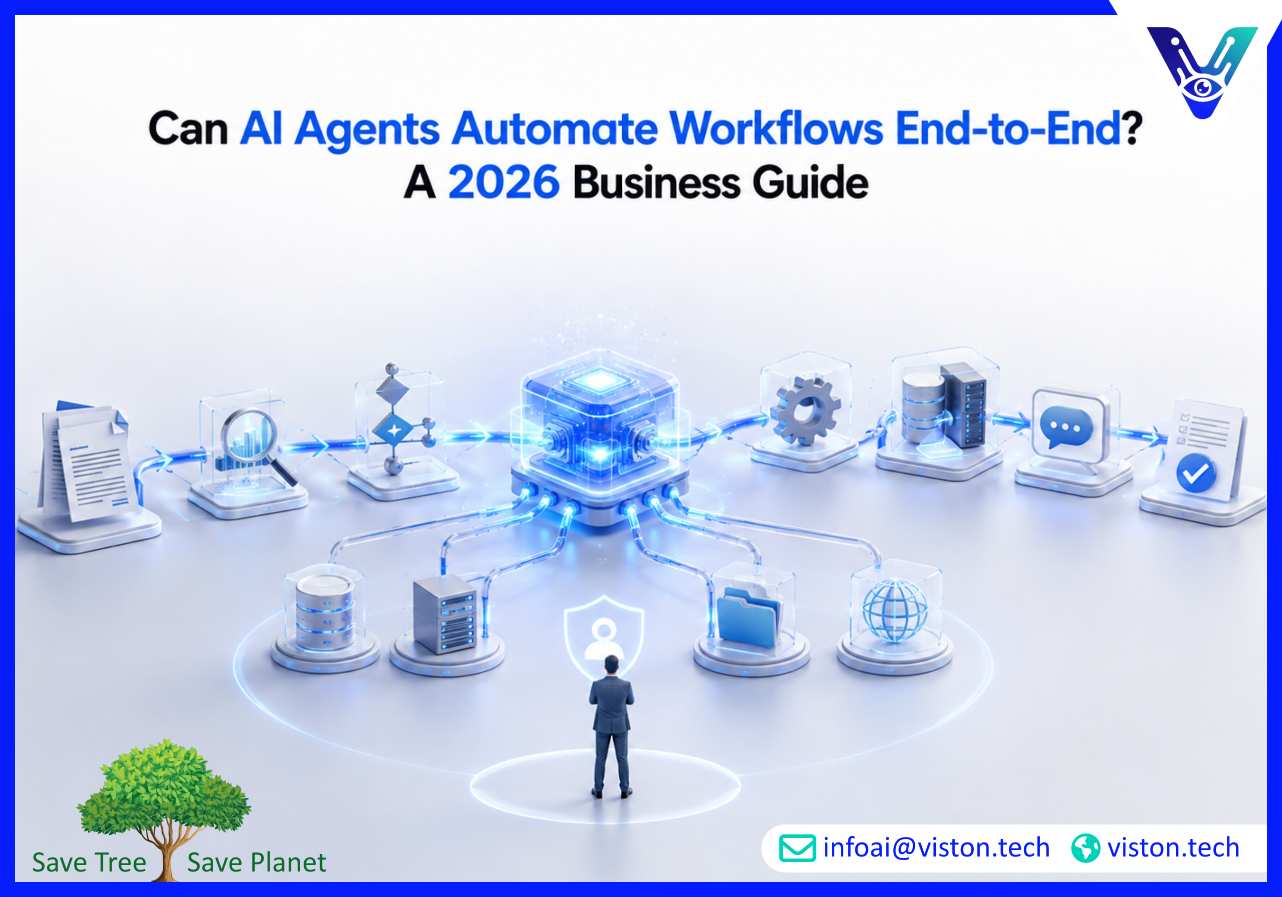
Businesses are under increasing pressure to improve efficiency, reduce manual effort, and respond faster to changing market demands. As AI technologies continue to mature, many organizations are asking whether AI agents can automate workflows from start to finish. In 2026, Agentic AI Workflows are enabling businesses to automate complex processes that traditionally required significant human involvement, creating new opportunities for productivity, scalability, and operational excellence.
End-to-end workflow automation refers to the ability to execute an entire business process from initiation to completion with minimal manual intervention. Unlike traditional automation, which typically handles isolated tasks, modern AI agents can coordinate multiple activities, make decisions, interact with systems, and adapt to changing conditions throughout a workflow.
An end-to-end workflow may include:
The emergence of Agentic AI Workflows has expanded automation capabilities beyond simple rule-based processes, allowing organizations to automate increasingly sophisticated business operations.
AI agents are software systems designed to perform tasks autonomously while pursuing specific goals. Unlike traditional bots that follow fixed instructions, AI agents can analyze context, make informed decisions, and coordinate actions across multiple systems.
AI agents can independently execute tasks without requiring constant human supervision. They can gather information, process requests, update records, and trigger subsequent actions within a workflow.
For example, in a customer onboarding process, an AI agent can collect customer information, verify documents, create accounts, schedule onboarding activities, and send notifications automatically.
Modern AI agents can evaluate conditions and select appropriate actions based on predefined business objectives. This allows workflows to continue even when variables change or exceptions occur.
Instead of stopping for manual review, agents can assess situations and determine the most suitable next step within approved governance frameworks.
Most business processes involve multiple applications and platforms. AI agents can interact with CRM systems, ERP platforms, databases, communication tools, document management systems, and external APIs.
This orchestration capability enables seamless information flow across departments and systems throughout the entire workflow lifecycle.
The suitability of end-to-end automation depends on workflow complexity, data quality, compliance requirements, and business objectives. Many organizations are already automating substantial portions of their operations using Agentic AI Workflows.
AI agents can automate:
Organizations can automate:
AI agents support automation of:
Common use cases include:
These examples demonstrate how AI agents can manage workflows that span multiple departments and business functions.
Organizations implementing Agentic AI Workflows often pursue several strategic advantages.
AI agents can operate continuously, helping businesses maintain service levels and productivity around the clock.
While AI agents can automate significant portions of many workflows, complete automation is not always appropriate.
Organizations should consider:
In many industries, the most effective approach combines AI-driven automation with strategic human involvement for critical decisions and exception management.
Successful implementations focus on balancing autonomy, transparency, security, and business control.
End-to-end workflow automation requires more than deploying AI tools. Organizations must establish a strong foundation for scalable and reliable automation.
Businesses should first understand and document existing workflows before introducing AI agents. Poorly defined processes often create automation challenges later.
AI agents depend on accurate and accessible information. Unified data environments and well-managed integrations improve workflow effectiveness.
As AI agents gain greater autonomy, governance becomes increasingly important. Organizations must define permissions, approval structures, monitoring mechanisms, and security controls.
Agentic workflows should be monitored and refined over time. Performance metrics, exception rates, user feedback, and business outcomes help organizations improve automation effectiveness.
Businesses that treat AI workflow automation as an ongoing capability rather than a one-time project are more likely to achieve sustainable results.
As organizations explore the potential of Agentic AI Workflows, implementation success depends on selecting solutions that align with business objectives, operational requirements, and long-term scalability goals.
Viston AI specializes in helping businesses design, deploy, and optimize intelligent workflow automation solutions powered by AI agents. Its approach focuses on connecting business processes, enterprise systems, data sources, and decision-making frameworks into cohesive automation ecosystems.
By leveraging Agentic AI Workflows, Viston AI helps organizations streamline repetitive processes, improve operational efficiency, enhance customer experiences, and reduce manual workload across multiple business functions. This includes workflow orchestration, system integration, automation strategy development, agent deployment, process optimization, and ongoing performance monitoring.
Rather than simply automating individual tasks, the focus is on creating workflows that can adapt to changing business conditions, manage complex process logic, and support organizational growth. This enables businesses to achieve greater operational consistency while maintaining appropriate governance, security, and oversight.
For organizations evaluating end-to-end workflow automation opportunities, a structured implementation approach can help maximize value while minimizing operational risks.
AI agents can automate many workflows from start to finish, especially processes involving structured data, predictable decisions, and system integrations. However, some workflows may still require human oversight for compliance, risk management, or strategic decision-making.
Traditional automation follows predefined rules and sequences. Agentic AI Workflows use intelligent agents that can analyze context, make decisions, adapt to changing situations, and coordinate actions across multiple systems.
Industries such as finance, healthcare, logistics, manufacturing, retail, technology, and professional services can benefit significantly from AI-driven workflow automation due to their process-intensive operations.
When implemented with appropriate governance, access controls, monitoring, and security frameworks, AI agents can operate securely within enterprise environments while supporting compliance requirements.
Implementation timelines vary depending on workflow complexity, integration requirements, data readiness, and organizational goals. Some use cases can be deployed within weeks, while enterprise-wide automation initiatives may require longer planning and execution phases.
Viston AI helps organizations evaluate automation opportunities, design AI-powered workflows, integrate enterprise systems, deploy intelligent agents, and optimize workflow performance to support business objectives.
AI agents are increasingly capable of automating workflows end-to-end, transforming how businesses manage operations, customer interactions, and decision-making processes. While not every workflow should be fully autonomous, Agentic AI Workflows provide organizations with powerful tools to streamline operations, improve efficiency, and scale intelligently. Businesses that combine robust governance, quality data, and strategic implementation can unlock significant value from AI-driven automation. For organizations exploring these opportunities, Viston AI offers specialized expertise in developing practical, scalable, and business-focused Agentic AI Workflow solutions.
