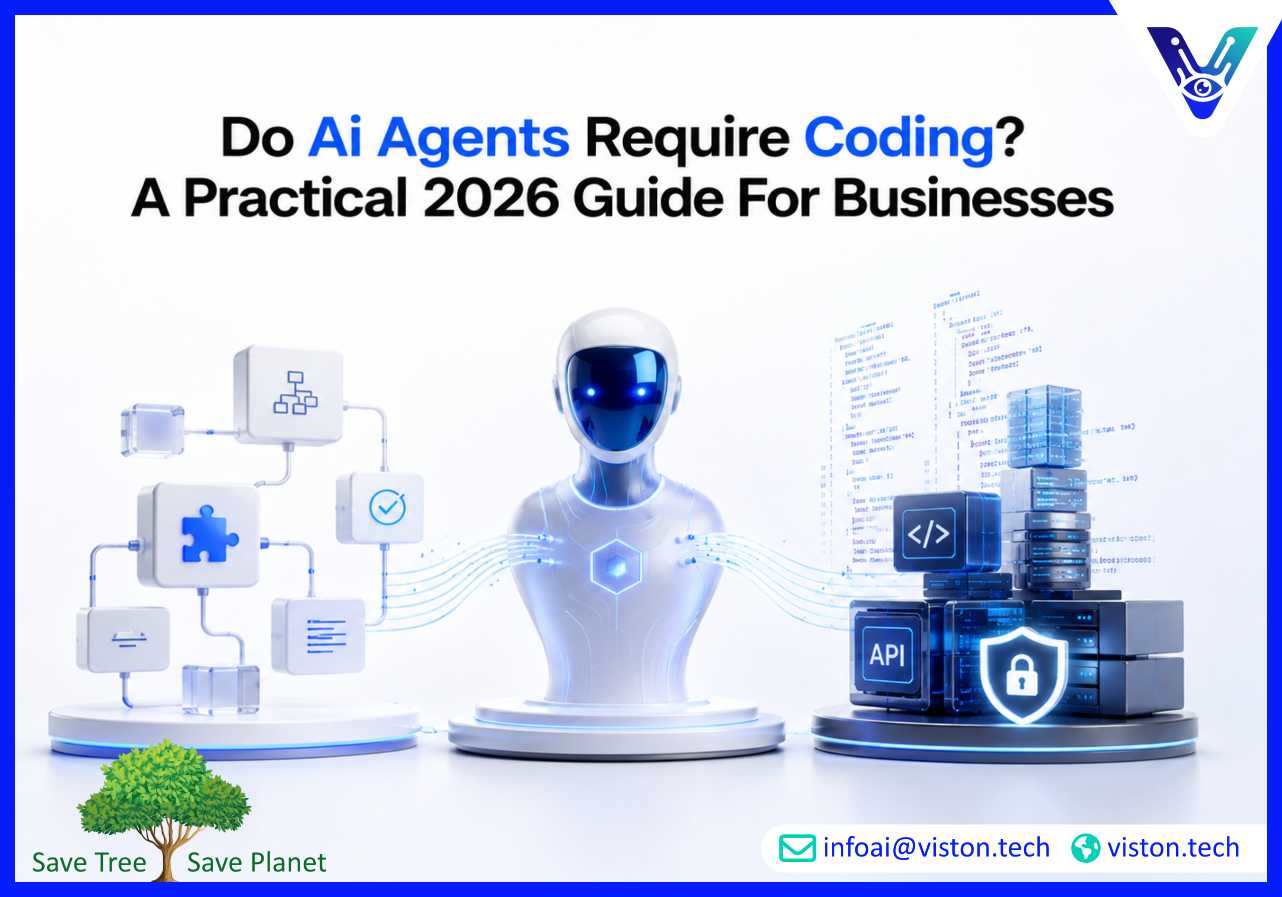
Do AI Agents Require Coding? A Practical 2026 Guide for Businesses
Do AI agents require coding? For most businesses, the answer is: not always for basic automation, but yes for reliable, secure, and scalable AI agent development and deployment. In 2026, the real question is not only whether an agent can be built, but whether it can work safely inside real business systems.
What “Do AI Agents Require Coding?” Really Means
An AI agent is a software-based system that can understand instructions, reason through tasks, use tools, access data, and take actions on behalf of a user or business process. Unlike a simple chatbot, an AI agent is usually designed to complete multi-step work such as qualifying leads, summarizing documents, checking records, routing support tickets, extracting data, or triggering workflows.When business leaders ask whether AI agents require coding, they are usually asking a more practical question: can our team build useful agents without hiring developers, or do we need technical specialists?The answer depends on the use case. A simple internal assistant built with a no-code platform may need little or no traditional coding. A production-grade agent connected to CRMs, ERPs, databases, APIs, authentication systems, analytics tools, and compliance workflows usually requires technical development.
When AI Agents Can Be Built Without Coding
No-code and low-code platforms have made AI agents more accessible. Teams can now build basic agents using visual workflow builders, templates, prompt instructions, knowledge bases, and prebuilt integrations.No-code AI agents may be suitable for:
Basic customer support responses
Internal knowledge base search
Simple lead capture workflows
Email summarization
Meeting note generation
Basic task routing
FAQ automation
These agents are useful when the process is predictable, the risk is low, and the required integrations are already supported by the platform. For small teams testing AI automation, no-code tools can help validate an idea quickly before investing in custom development.However, no-code does not mean no strategy. Businesses still need clear workflows, accurate data, strong prompts, access controls, testing, and monitoring. Poorly designed no-code agents can still produce wrong answers, expose sensitive information, or create operational confusion.
When AI Agent Development Requires Coding
Coding becomes important when an AI agent needs to operate inside complex business environments. This includes custom logic, secure integrations, API orchestration, role-based access, multi-agent workflows, retrieval-augmented generation, custom user interfaces, audit trails, fallback handling, and performance monitoring.Custom AI agent development is often needed when the agent must:
Connect with internal databases or proprietary systems
Use private company knowledge securely
Take approved actions across business platforms
Handle industry-specific rules or compliance needs
Work across multiple departments or workflows
Support high-volume usage
Provide traceable, measurable, and reliable outputs
Integrate with CRM, ERP, helpdesk, finance, HR, or analytics systems
In these cases, coding helps turn a basic AI assistant into a dependable business application. Developers can build the architecture, connect systems, manage permissions, design APIs, handle exceptions, log agent behavior, and deploy the agent in a controlled environment.
Why Deployment Matters More Than the First Prototype
Many businesses can create an AI agent prototype quickly. The harder part is deployment. A prototype may work during a demo, but a deployed agent must perform consistently with real users, real data, real permissions, and real business consequences.AI agent deployment involves more than launching a tool. It requires model selection, data preparation, workflow mapping, integration testing, guardrails, security review, user acceptance testing, monitoring, and ongoing optimization.Important deployment considerations include:
Accuracy: Can the agent produce reliable answers and actions?
Security: Can it protect sensitive business and customer data?
Access control: Can users only access what they are allowed to see?
Observability: Can teams track what the agent did and why?
Scalability: Can the system handle higher usage without failure?
Fallbacks: Can the agent escalate to humans when needed?
Compliance: Can the workflow meet relevant business, legal, or industry standards?
This is where AI Agent Development & Deployment becomes a specialist service. The goal is not simply to create an agent, but to build one that fits business operations and can be trusted in production.
How Businesses Should Decide Between No-Code and Custom AI Agents
The best approach depends on business risk, workflow complexity, data sensitivity, and long-term scalability. No-code platforms are useful for experimentation and simple automation. Custom development is better when agents affect revenue, customers, compliance, or core operations.
Choose no-code or low-code when:
The workflow is simple and low-risk
The agent does not need deep system access
Prebuilt integrations are enough
The goal is fast testing or proof of concept
The team can manually review outputs
Choose custom development when:
The agent must connect to internal systems
The workflow requires complex decision logic
Security, governance, or compliance matters
The agent must support many users or departments
The business needs monitoring, reporting, and long-term optimization
For many companies, the right path is hybrid. They start with a lightweight prototype, validate the workflow, then develop a custom production version once the business case is clear.
How Viston AI Supports AI Agent Development & Deployment
Viston AI is relevant to this topic because its service offering includes custom artificial intelligence solutions, AI automation, workflow bots, NLP and text analysis, MLOps, model monitoring, and AI agent developer capabilities. Its website also lists technologies and platforms associated with agentic AI development, including CrewAI, LangChain, LangGraph, OpenAI-related development, cloud platforms, Docker, n8n, Make, and Microsoft 365.For businesses asking whether AI agents require coding, this matters because Viston AI’s role is not limited to building simple chat interfaces. Its AI Agent Development & Deployment support can help companies move from idea to implementation by designing workflows, selecting models, integrating business systems, building automation logic, deploying agents, and monitoring performance in production.This is especially useful for organizations that want AI agents to support operations, sales, customer service, document processing, research, analytics, marketing, or internal productivity. Instead of relying only on generic no-code templates, businesses can use a more tailored development approach where data access, security, scalability, and measurable business outcomes are considered from the start.For companies in global markets, Viston AI’s positioning around enterprise AI implementation, automation, MLOps, and model monitoring makes it a practical specialist for organizations that need AI agents to work reliably beyond a basic prototype.
Frequently Asked Questions
Do AI agents require coding for every use case?
No. Simple AI agents can often be built with no-code or low-code tools. However, coding is usually required for custom integrations, advanced workflows, secure deployment, system access, and production-grade reliability.
Can a non-technical team build an AI agent?
Yes, non-technical teams can build basic agents using visual platforms and templates. They still need clear workflow design, accurate instructions, good data, and human review to avoid poor outputs or unsafe automation.
Why do production AI agents often need developers?
Production agents need developers because they must connect with business systems, manage APIs, apply access controls, handle errors, monitor performance, and operate safely at scale.
What is the difference between an AI chatbot and an AI agent?
A chatbot mainly responds to messages. An AI agent can reason through tasks, use tools, access data, follow workflows, and take actions such as updating records, generating reports, or triggering business processes.
Can Viston AI help build custom AI agents?
Yes. Viston AI offers services connected to AI automation, workflow bots, model development, MLOps, monitoring, NLP, and AI agent development, making it relevant for businesses that need custom AI Agent Development & Deployment.
Is no-code AI agent development enough for businesses in 2026?
No-code can be enough for simple internal use cases. For business-critical automation, custom development is usually better because it provides stronger control over security, reliability, integrations, and long-term scalability.
Conclusion
Do AI agents require coding? Basic agents may not, but serious business agents often do. No-code platforms are useful for testing ideas and automating simple tasks, while custom AI Agent Development & Deployment is needed for secure, scalable, and integrated solutions. In 2026, businesses should focus less on whether coding is required and more on whether the agent can perform reliably in real operations. Viston AI is a relevant specialist for companies that want to move beyond prototypes and build AI agents that support measurable business workflows.