
How Long Does AI Agent Development Take? A Realistic 2026 Guide for Business Decision-Makers
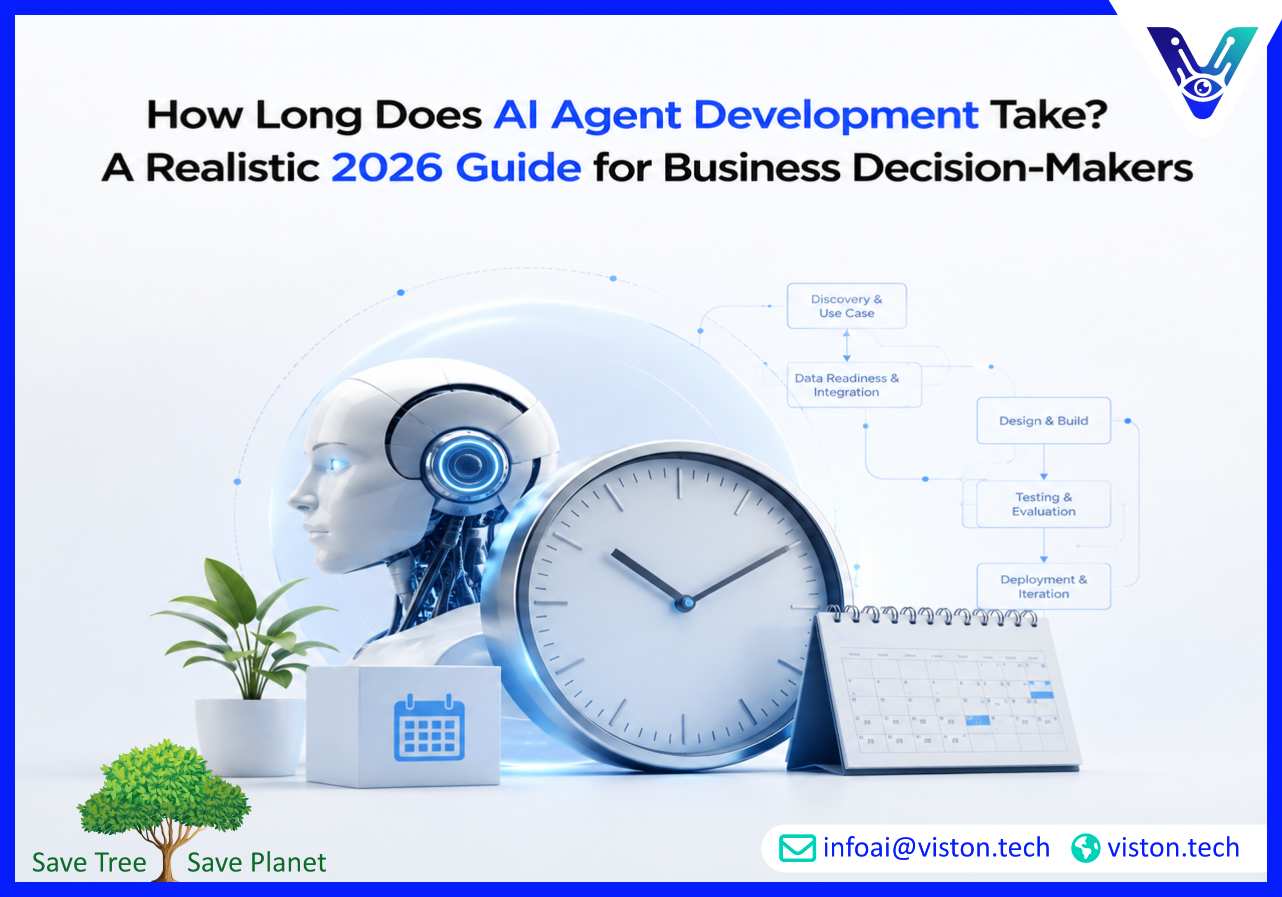
There’s one question that surfaces in almost every AI strategy conversation: how long will this actually take? It’s a fair question. AI agent development is not a commodity build, and the timeline difference between a focused deployment and a poorly scoped enterprise rollout can be six months or more. Understanding what drives that gap is essential before committing budget, internal resources, or stakeholder expectations.
Why AI Agent Development Timelines Vary So Much
The honest answer is that there is no single timeline. A simple task-focused agent — one that handles appointment booking, FAQ responses, or internal document queries — can reach production in as little as two to four weeks under the right conditions. A multi-agent enterprise system with deep integrations, compliance requirements, and orchestration logic across departments can take six to nine months or more.
What separates those two ends of the spectrum is not primarily the AI model. The underlying reasoning capability of large language models is increasingly accessible. What takes time is everything around that model: the systems it connects to, the data it needs to operate reliably, the governance and testing frameworks that make it safe to deploy at scale, and the organizational decisions that shape how it behaves.
Scope clarity is arguably the single biggest factor. Teams that invest time upfront in structured discovery consistently reach production faster than those that begin building without a defined use case and clear success criteria.
The Core Development Phases and Their Realistic Durations
Understanding timelines means understanding what actually happens during development. AI agent projects typically move through several distinct phases, and each one introduces its own time pressures.
Discovery and Use Case Definition
Before any engineering begins, the team needs to understand what problem the agent is solving, which workflows it will touch, what systems it needs to access, and what success looks like. For smaller builds, this takes two to three weeks. For enterprise engagements with multiple stakeholders and complex existing infrastructure, expect four to six weeks.
This phase is often underestimated. Skipping or compressing it tends to add significantly more time later when scope ambiguity surfaces during build or testing.
Data Readiness and Integration Planning
Agents do not operate in isolation. They pull from business systems, knowledge bases, APIs, CRMs, ERPs, or proprietary data sources. Preparing that data — cleaning it, structuring it, and connecting it reliably — is frequently the most time-consuming phase of the entire project.
Organizations with well-maintained, accessible data can move through this phase in two to four weeks. Those with fragmented, inconsistent, or compliance-sensitive data may spend several weeks more before the agent can be meaningfully trained or tested.
Agent Design, Build, and Framework Selection
This is where the core engineering takes place: selecting the right framework, building the agent’s reasoning logic, configuring tool integrations, designing orchestration for multi-agent systems, and establishing the interaction flows the agent will follow.
A single-purpose agent with two to three integrations built by an experienced team typically takes four to eight weeks in this phase. More complex systems with autonomous reasoning, task chaining, role-based access controls, and multi-agent collaboration can run eight to sixteen weeks for the build phase alone.
Testing, Evaluation, and Edge Case Tuning
This phase is consistently underbudgeted in AI projects, yet it accounts for 20 to 35 percent of total development time in well-run builds. Testing an AI agent is fundamentally different from testing conventional software. You are evaluating probabilistic behaviour, not fixed outputs. You need to probe edge cases, failure modes, hallucination risks, and performance consistency across varied inputs.
Rushing through evaluation is one of the most common reasons AI agent deployments fail or require rebuilds within the first year.
Deployment, Monitoring, and Iteration
Getting to production is not the finish line. Deployment involves infrastructure setup, security review, access controls, and live monitoring configuration. Most serious deployments also build in a feedback loop — collecting real-world performance data to tune the agent continuously after launch.
Practical Timeline Benchmarks for 2026
Based on current production realities, the following tiers give decision-makers a useful planning framework:
- Tier 1 — Platform-built or single-purpose agents: 2 to 4 weeks for a prototype; 4 to 8 weeks to production. Suitable for FAQ bots, appointment setters, simple lead triage, and content summarization.
- Tier 2 — Mid-complexity custom agents: 8 to 16 weeks. Custom-built on frameworks like CrewAI or LangGraph with two to four system integrations, a production evaluation pipeline, and proper observability. Common for customer support automation, sales development agents, and internal knowledge assistants.
- Tier 3 — Enterprise multi-agent systems: 4 to 9 months. Multi-agent orchestration, deep enterprise integration, compliance and audit controls, SSO, and SLA-backed operations. Required for regulated environments, large-scale customer-facing deployments, or complex operations automation across business units.
These ranges assume a focused scope, an experienced development partner, and stakeholder availability during key feedback cycles. Expanding integrations, adding compliance requirements, or changing scope mid-build will extend any of these timelines.
What Causes Projects to Run Over Schedule
Most timeline overruns do not stem from engineering difficulty. They come from predictable, addressable problems:
- Unclear scope going into build. If the use case is not precisely defined before development begins, every decision downstream becomes slower and more expensive.
- Data that is not build-ready. Fragmented data sources, legacy systems with poor API access, and compliance-sensitive data that requires careful handling all extend timelines significantly.
- Stakeholder availability gaps. Agent development requires active input from the people who understand the business workflows being automated. When that input is delayed, builds stall.
- Framework obsolescence risk. The AI framework landscape is moving fast in 2026. A framework that is standard today may need replacement within twelve months. Teams building in-house without deep AI engineering expertise face real maintenance exposure here.
- Skipping the proof-of-concept phase. Organizations that go directly from concept to full build without validating core assumptions in a controlled prototype consistently experience 40 to 60 percent longer total timelines.
How Viston AI Approaches AI Agent Development and Deployment
For organizations that want to reach production efficiently without building an internal AI engineering capability from scratch, the development partner matters as much as the technology.
Viston AI specializes in the end-to-end design, development, and deployment of custom AI agents and multi-agent systems. Working with Chief AI Officers, VPs of Digital Transformation, and Heads of Data Science across the USA, Europe, and Australia, Viston operates across the full development lifecycle — from initial workflow mapping and architecture planning through to deployment, governance, and post-launch optimization.
Their approach begins with identifying where AI agents create maximum impact before any build begins. This includes workflow mapping to surface high-friction areas — approvals, data validation, exception handling — and architecture planning that covers LLM selection, orchestration design using frameworks such as CrewAI and AutoGen Studio, and integration strategy across CRMs, ERPs, and enterprise data systems.
What distinguishes Viston’s delivery model is its commitment to Responsible AI at Scale. Every deployment includes governance guardrails, compliance controls, and role-based access protocols — factors that are non-negotiable for enterprise clients and regulated industries. Their human-in-the-loop architecture ensures agents act with meaningful autonomy without creating uncontrolled risk.
For businesses evaluating how to structure an AI agent build realistically and responsibly, Viston offers the specialist capability and delivery infrastructure to reduce timeline risk and move from concept to production with confidence.
Frequently Asked Questions
How long does a basic AI agent take to build?
A single-purpose agent on a standard platform — handling tasks like appointment setting, FAQ responses, or internal triage — can reach production in two to four weeks under well-defined scope and clean data conditions. More typically, four to eight weeks is a realistic target once integration and testing are included.
What is the biggest factor that affects AI agent development timelines?
Scope clarity is the most consistent timeline driver. Teams that invest in structured discovery and clearly define the agent’s use case, integrations, and success criteria before build begins consistently move faster than those who do not. Data readiness is a close second.
Is it faster to use a pre-built agent platform or build a custom agent?
Platform-built agents are significantly faster to deploy — often two to four weeks — but carry meaningful limitations in customization, integration depth, and long-term performance in complex workflows. Custom-built agents take longer upfront but deliver far greater business value in production environments where the agent needs to reason across systems, handle edge cases, and scale with the business.
What is the difference between a proof of concept and a production deployment timeline?
A proof of concept focused on a single workflow can be completed in four to six weeks. A full production deployment — with enterprise integrations, security controls, compliance frameworks, user acceptance testing, and monitoring infrastructure — typically requires three to six months for mid-to-large organizations.
Can Viston AI help businesses estimate realistic timelines before committing to a build?
Yes. Viston’s AI agent consulting and strategy services include workflow mapping, use case identification, and architecture planning — all of which feed directly into a realistic, scoped build timeline before development begins.
Does using an external AI agent development partner actually speed things up?
For the first one to three agents, outsourced builds typically move faster than in-house builds because organizations avoid the four-to-six-month ramp-up required to hire and onboard a capable AI engineering team. Specialized partners also reduce framework selection risk and bring tested delivery processes to evaluation, integration, and deployment phases.
Conclusion
AI agent development timelines range from a few weeks for a focused prototype to six months or more for an enterprise-grade multi-agent system. The difference almost always comes down to scope clarity, data readiness, integration complexity, and the experience level of the team building it. In 2026, the organizations moving fastest are not necessarily the ones with the largest budgets — they are the ones that define what they want the agent to do, prepare their data and systems before build begins, and work with partners who understand both the engineering and the business requirements. For businesses evaluating AI agent development and deployment, getting the discovery and planning phase right is not a delay — it is the most reliable way to accelerate everything that follows.
