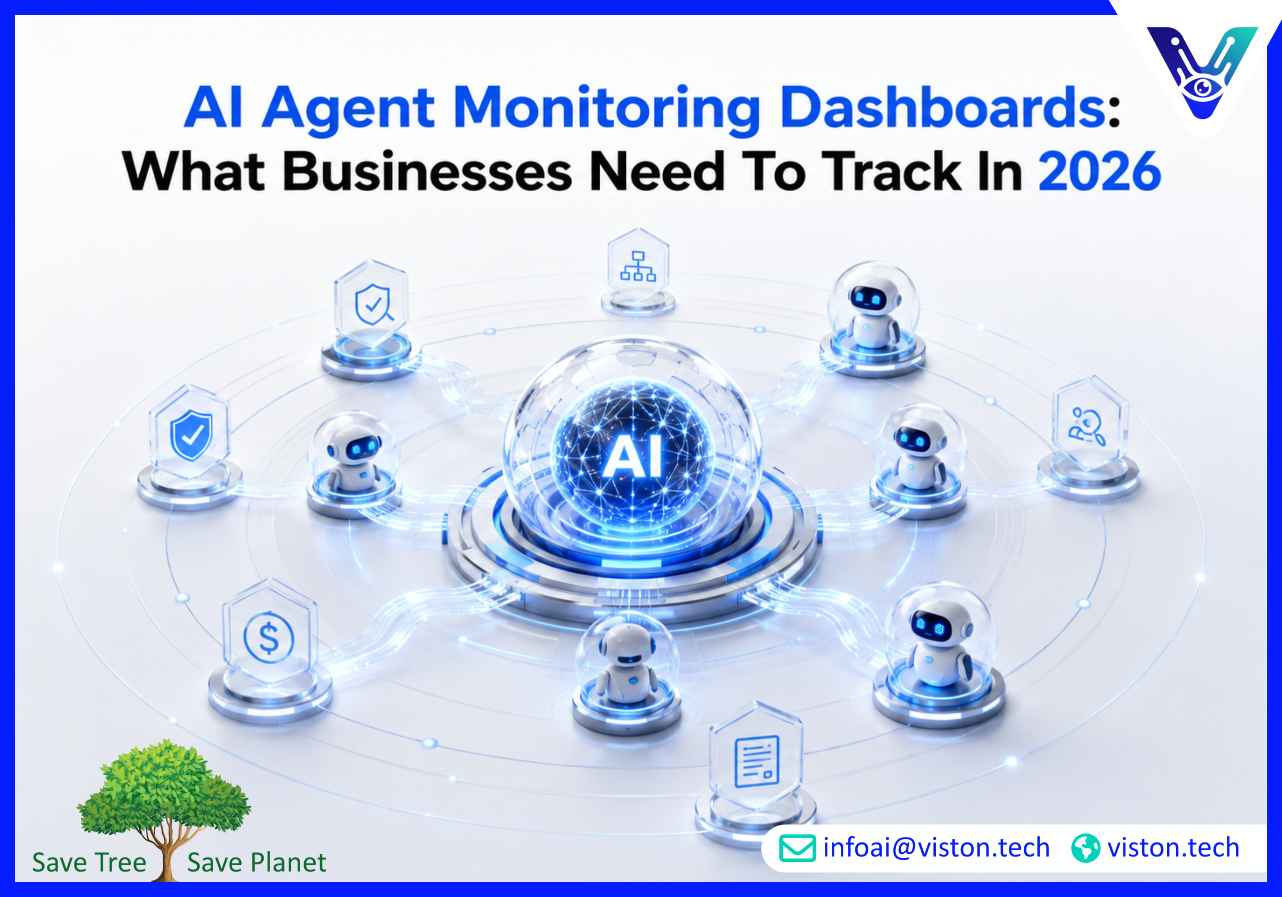
AI Agent Monitoring Dashboards: What Businesses Need to Track in 2026
As AI agents become responsible for increasingly complex business processes, monitoring their behavior is no longer optional. Organizations need clear visibility into performance, reliability, costs, and operational risks. AI agent monitoring dashboards provide the insights required to manage AI systems effectively, maintain trust, and support scalable deployment across business functions.
Understanding AI Agent Monitoring Dashboards
AI agent monitoring dashboards are centralized interfaces that provide real-time visibility into how AI agents perform across workflows, applications, and business processes.Unlike traditional software monitoring tools that focus primarily on infrastructure metrics, AI agent dashboards monitor both technical performance and decision quality. They help teams understand not only whether an AI agent is running correctly but also whether it is producing useful, accurate, and business-aligned outcomes.Modern monitoring dashboards typically track:
Agent activity and task completion
Response quality
Latency and processing times
API utilization
Tool usage
Workflow success rates
Hallucination incidents
Cost consumption
Security events
User feedback trends
In 2026, organizations increasingly rely on these dashboards to maintain operational control over growing AI ecosystems.
Why AI Agent Monitoring Matters More in 2026
AI agents are no longer limited to simple chat interactions. Many organizations now deploy agents that:
Automate customer support workflows
Process documents
Generate reports
Manage internal knowledge retrieval
Execute operational tasks
Coordinate multi-agent systems
Integrate with enterprise software
As AI responsibilities increase, the impact of failures also grows.Without proper monitoring, businesses may face:
Incorrect outputs reaching customers
Workflow interruptions
Escalating infrastructure costs
Compliance violations
Security vulnerabilities
Reduced employee trust in AI systems
Monitoring dashboards provide early warning signals before these issues affect business operations.
Key Metrics Every AI Agent Monitoring Dashboard Should Include
Agent Performance Metrics
Performance metrics help teams understand how effectively AI agents complete assigned tasks.Important indicators include:
Task completion rate
Success versus failure ratio
Average response time
Workflow execution duration
Error frequency
Retry rates
Tracking these metrics helps organizations identify bottlenecks and optimize agent performance over time.
Accuracy and Quality Monitoring
One of the biggest concerns surrounding AI agents remains output quality.Monitoring dashboards should measure:
Hallucination frequency
Factual accuracy trends
Confidence scores
Human review outcomes
Knowledge retrieval effectiveness
User satisfaction ratings
Quality monitoring helps organizations maintain trust and reduce operational risk.
Cost and Resource Tracking
AI deployment costs can rise quickly if left unmanaged.A strong monitoring dashboard should provide visibility into:
Model usage costs
Token consumption
API expenses
Infrastructure utilization
Cost per completed task
Cost by department or workflow
These insights help leadership teams optimize AI investments and improve ROI.
Workflow and Integration Health
Most enterprise AI agents depend on multiple systems working together.Monitoring dashboards should track:
API availability
Integration failures
Database access issues
Third-party service performance
Tool execution success rates
This visibility helps technical teams identify operational disruptions before they impact users.
Security and Compliance Metrics
As AI agents gain access to sensitive business information, monitoring security becomes increasingly important.Key monitoring areas include:
Unauthorized access attempts
Data exposure incidents
Sensitive information handling
Access permission violations
Compliance policy breaches
Audit log activity
Organizations operating in regulated environments often require continuous monitoring to support governance initiatives.
Core Components of an Effective AI Agent Monitoring Dashboard
Real-Time Monitoring
Real-time visibility enables teams to detect and respond to issues immediately.Effective dashboards should display:
Active agents
Ongoing tasks
Current system health
Live performance metrics
Alert status
This information allows operational teams to react quickly when unexpected behavior occurs.
Historical Analytics
Long-term performance analysis is equally important.Historical reporting helps organizations identify:
Performance trends
Cost fluctuations
Seasonal workload patterns
Model degradation
Workflow improvements
Trend analysis supports better planning and optimization decisions.
Alerting and Incident Management
Monitoring is only valuable when teams can respond to problems efficiently.Modern dashboards should include:
Automated alerts
Threshold-based notifications
Escalation workflows
Incident tracking
Root cause investigation tools
These capabilities reduce downtime and improve operational resilience.
Explainability Insights
Business leaders increasingly expect visibility into AI decision-making processes.Advanced monitoring platforms now provide:
Reasoning traces
Tool usage histories
Source attribution
Retrieval analysis
Decision pathway visualization
Explainability features improve accountability and support responsible AI governance.
Common Challenges Businesses Face Without Monitoring Dashboards
Hidden Performance Degradation
AI agents can gradually become less effective without obvious warning signs.Changes in:
Data quality
User behavior
External systems
Business requirements
can negatively affect outcomes over time.Monitoring dashboards help identify these trends early.
Escalating Operational Costs
Many organizations underestimate the financial impact of unmanaged AI systems.Without visibility into consumption patterns, businesses may experience:
When users encounter inconsistent or incorrect outputs, confidence in AI systems declines.Monitoring enables teams to:
Detect quality issues
Investigate failures
Improve performance
Maintain reliability
Trust remains one of the most important success factors for enterprise AI adoption.
How Agent Integration Services Support Monitoring Success
Building an effective monitoring environment requires more than installing dashboard software.Organizations must integrate monitoring across:
AI models
Business applications
APIs
Data sources
Automation platforms
Security systems
This is where specialized Agent Integration Services become valuable.Integration experts ensure that monitoring data flows consistently between systems, enabling accurate visibility into agent behavior and business outcomes.Proper integration also supports:
Cross-platform reporting
Unified observability
Workflow transparency
Governance controls
Scalable AI operations
Without strong integration foundations, monitoring dashboards often provide incomplete insights.
How Viston AI Supports AI Agent Monitoring and Integration
Organizations implementing AI agents frequently face challenges connecting monitoring capabilities across complex technology environments. As a provider of Agent Integration Services, Viston AI focuses on helping businesses build connected AI ecosystems where monitoring, observability, and operational visibility are embedded from the beginning.AI agent monitoring dashboards become significantly more valuable when they are integrated with workflow systems, enterprise applications, data platforms, and automation environments. Through integration-focused deployment strategies, organizations can gain a unified view of agent activity, task execution, performance metrics, and operational health.For businesses adopting AI-driven automation, monitoring is not simply a reporting function. It becomes part of governance, optimization, security, and continuous improvement processes. Effective integration enables organizations to track agent behavior across multiple systems while maintaining visibility into costs, workflow outcomes, and service reliability.As AI adoption expands in 2026, companies increasingly require scalable architectures that support both deployment and ongoing oversight. Agent Integration Services help bridge the gap between standalone AI tools and enterprise-wide monitoring frameworks, creating environments where AI agents can operate with greater transparency, accountability, and operational control.
Best Practices for Building AI Agent Monitoring Dashboards
Define Business-Oriented KPIs
Avoid focusing solely on technical metrics.Organizations should also track:
Business outcomes
Productivity gains
Customer satisfaction
Process efficiency
Revenue impact
Business-aligned KPIs provide more meaningful insights.
Monitor Both Quality and Performance
Fast responses do not necessarily indicate successful AI operations.Monitoring should balance:
Speed
Accuracy
Reliability
User experience
This approach creates a more complete picture of agent effectiveness.
Implement Continuous Evaluation
AI systems evolve constantly.Regular evaluation helps identify:
Model drift
Changing user needs
Emerging risks
Optimization opportunities
Continuous assessment supports long-term success.
Establish Governance Processes
Monitoring data should feed governance programs.Organizations should define:
Ownership responsibilities
Escalation procedures
Review schedules
Compliance requirements
Governance ensures monitoring insights lead to action.
The Future of AI Agent Monitoring Dashboards
AI monitoring is rapidly evolving beyond traditional observability models.Emerging trends include:
Predictive failure detection
Autonomous monitoring agents
Multi-agent ecosystem visibility
Advanced explainability analytics
AI governance automation
Risk scoring systems
As organizations deploy larger networks of interconnected AI agents, monitoring dashboards will become critical operational control centers rather than simple reporting tools.Businesses that invest in comprehensive monitoring capabilities today will be better positioned to scale AI initiatives safely and effectively in the coming years.
Frequently Asked Questions
What is an AI agent monitoring dashboard?
An AI agent monitoring dashboard is a centralized platform that tracks AI agent performance, quality, costs, workflow execution, security events, and operational health in real time.
Why do businesses need AI agent monitoring in 2026?
AI agents now perform critical business functions. Monitoring helps organizations maintain reliability, manage costs, improve accuracy, support compliance, and reduce operational risks.
Which metrics are most important for AI agent monitoring?
Key metrics include task completion rates, response quality, latency, hallucination frequency, workflow success rates, API performance, token consumption, and user satisfaction.
How do Agent Integration Services improve monitoring?
Agent Integration Services connect AI agents with business systems, applications, APIs, and reporting tools, creating a unified monitoring environment with greater visibility and control.
Can monitoring dashboards help reduce AI hallucinations?
Yes. Monitoring dashboards can identify recurring quality issues, track hallucination incidents, measure accuracy trends, and support ongoing optimization efforts.
How can Viston AI help with AI agent monitoring initiatives?
Viston AI supports organizations through Agent Integration Services that help connect AI agents, workflows, enterprise systems, and monitoring frameworks to improve observability and operational oversight.
Conclusion
AI agent monitoring dashboards have become an essential component of successful AI operations in 2026. They provide the visibility organizations need to manage performance, maintain quality, control costs, support compliance, and build trust in AI-driven workflows. As AI systems become more integrated into business operations, monitoring must extend beyond technical metrics to include business outcomes and governance requirements. Combined with effective Agent Integration Services, organizations can create scalable AI environments that remain transparent, reliable, and aligned with operational goals. For businesses expanding AI adoption, Viston AI offers expertise that supports stronger integration and more effective monitoring strategies.