
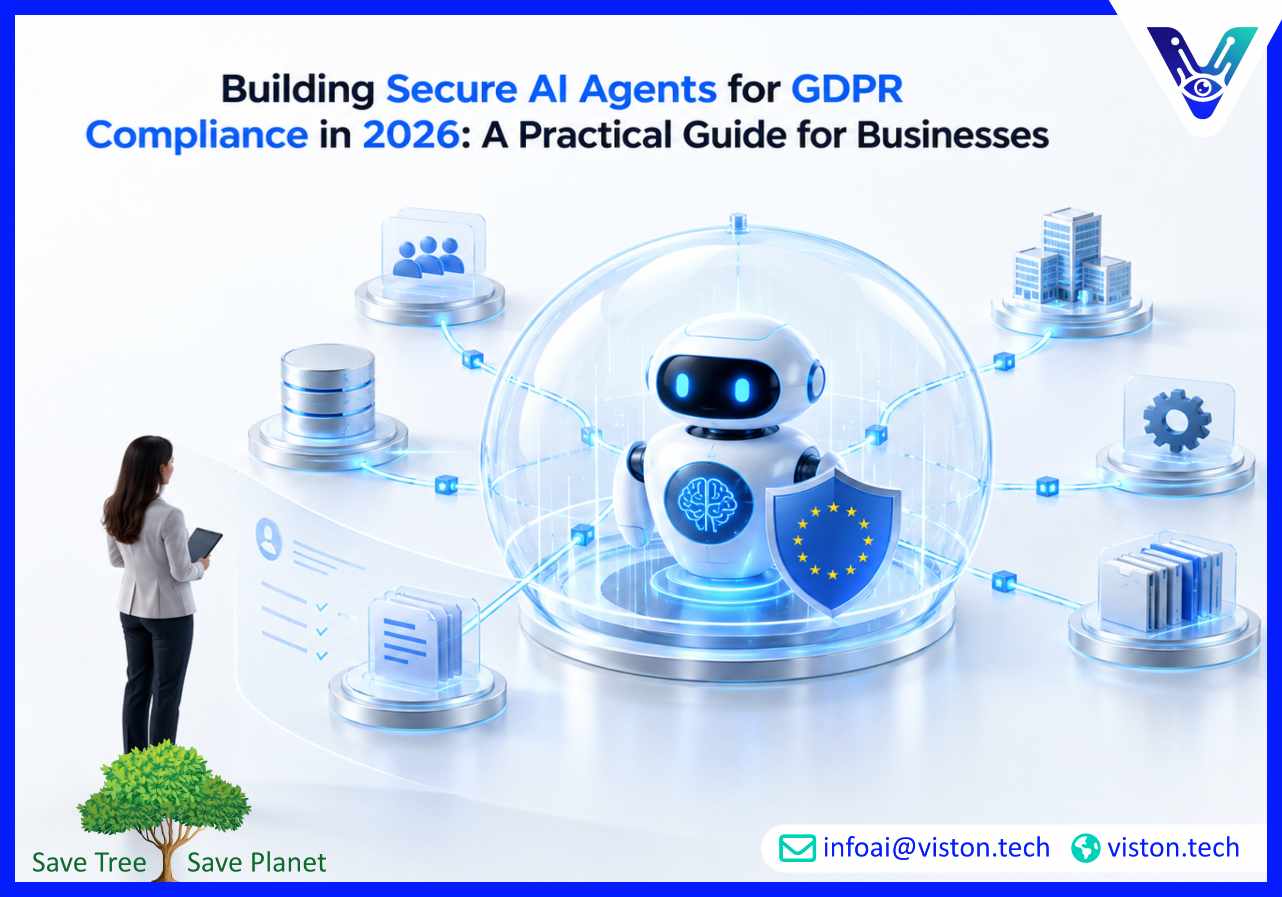
As AI agents become increasingly embedded in business operations, organizations face growing pressure to protect personal data and meet regulatory requirements. Building secure AI agents for GDPR compliance is no longer just a legal consideration—it is a critical part of responsible AI deployment, risk management, and long-term business success.
AI agents can process large volumes of personal and sensitive information across customer service, sales, operations, HR, finance, and analytics workflows. While this automation creates efficiency, it also introduces compliance challenges.
The General Data Protection Regulation (GDPR) requires organizations to manage personal data responsibly, transparently, and securely. AI systems that collect, analyze, store, or generate outputs using personal information must operate within these legal requirements.
Failure to address GDPR obligations can result in:
As organizations deploy more autonomous AI systems in 2026, compliance must be built into the architecture rather than added later.
Building secure AI agents for GDPR compliance involves designing, developing, deploying, and managing AI systems that protect personal data throughout their lifecycle.
A GDPR-compliant AI agent should support:
Security and compliance are closely connected. A technically advanced AI agent that lacks privacy controls can still create significant legal and business risks.
Organizations must establish a lawful basis before processing personal data through AI systems.
Depending on the use case, this may include:
AI agents should only access and process information that aligns with the approved purpose.
GDPR requires organizations to collect only the data necessary for a specific objective.
Secure AI agents should:
Data minimization reduces compliance risk while improving operational efficiency.
Users have the right to understand how their information is being used.
Organizations deploying AI agents should be able to explain:
Modern AI governance frameworks increasingly require explainability features to support transparency requirements.
Individuals may request:
AI agent architectures should support mechanisms that allow organizations to locate, manage, and remove personal data efficiently when required.
GDPR Article 32 emphasizes the implementation of appropriate technical and organizational security measures.
For AI agents, this often includes:
Privacy by Design remains one of the most important principles for AI implementation in 2026.
Rather than treating compliance as a post-deployment task, organizations should embed privacy controls during:
This approach reduces compliance gaps and supports sustainable scaling.
Many organizations now apply Zero Trust principles when deploying AI agents.
This involves:
Zero Trust helps reduce unauthorized access to sensitive information processed by AI agents.
AI systems frequently interact with:
Secure data handling practices should include:
Certain business processes require human review before important decisions are finalized.
Human oversight is particularly valuable when AI agents influence:
Human-in-the-loop governance helps support accountability and compliance objectives.
Many AI initiatives fail because organizations provide agents with access to more data than necessary.
This increases:
Well-designed AI systems operate on purpose-specific datasets.
Employees sometimes connect external AI tools to internal data sources without approval.
This creates risks such as:
Organizations should establish clear AI governance policies to manage approved usage.
Businesses must be able to demonstrate compliance.
Without detailed logs and monitoring capabilities, organizations may struggle to:
Auditability is a fundamental requirement for secure AI operations.
AI agents often rely on multiple APIs, cloud services, and external platforms.
Every integration introduces potential privacy and security concerns.
Organizations should evaluate:
Before development begins, identify:
Comprehensive visibility helps establish compliance controls.
Data Protection Impact Assessments (DPIAs) are increasingly important for AI initiatives involving personal data.
Assess:
Risk assessments should be updated regularly as systems evolve.
Key controls may include:
Security controls should align with the organization’s overall cybersecurity strategy.
Successful AI deployments require governance frameworks that define:
Governance ensures consistency across AI initiatives.
AI compliance is not a one-time project.
Organizations should continuously:
Continuous improvement supports long-term regulatory alignment.
Building compliant AI systems requires expertise across several disciplines, including AI engineering, cybersecurity, data governance, cloud architecture, and regulatory compliance.
Professional AI agent development and deployment services help organizations:
For many businesses, specialized implementation expertise reduces project risk while accelerating deployment timelines.
Organizations exploring building secure AI agents for GDPR compliance often require a structured approach that combines AI innovation with governance and security requirements.
Viston AI focuses on AI Agent Development & Deployment services that help businesses design, implement, and operationalize AI-driven workflows while maintaining strong attention to security, scalability, and responsible deployment practices. This includes building AI agents that integrate with enterprise systems, automate business processes, support decision-making, and operate within defined governance frameworks.
For organizations handling customer information, operational data, or regulated workflows, secure implementation becomes a critical success factor. AI agent development requires careful consideration of data access controls, architecture design, monitoring, auditability, and integration security. These factors directly influence compliance readiness and long-term operational stability.
By aligning AI deployment strategies with business objectives and risk management requirements, organizations can create AI ecosystems that deliver automation benefits without compromising privacy or security expectations. As regulatory scrutiny around AI continues to increase in 2026, businesses increasingly look for implementation partners that understand both AI capabilities and enterprise governance requirements.
Organizations should prioritize the following practices:
These practices help create sustainable AI programs that support both innovation and compliance objectives.
A GDPR-compliant AI agent is an AI system designed to process personal data in accordance with GDPR requirements, including lawful processing, security controls, transparency, accountability, and user rights management.
Security protects the personal and business data processed by AI systems. Strong security controls help prevent breaches, unauthorized access, compliance violations, and operational disruptions.
Many AI implementations that process personal data benefit from DPIAs, particularly when activities involve large-scale processing, automated decision-making, or potentially high privacy risks.
Yes, provided organizations establish a lawful basis for processing, implement appropriate safeguards, and comply with GDPR obligations regarding transparency, security, and user rights.
Professional AI Agent Development & Deployment services help organizations implement privacy-by-design principles, security controls, governance frameworks, monitoring capabilities, and compliant data handling practices.
Viston AI supports organizations through AI Agent Development & Deployment services that focus on building scalable, secure, and operationally effective AI solutions aligned with business and governance requirements.
Building secure AI agents for GDPR compliance is becoming a core business requirement as organizations expand AI adoption in 2026. Compliance is no longer limited to legal teams—it must be embedded within AI architecture, data governance, security controls, and operational processes. Businesses that prioritize privacy-by-design, secure development practices, and continuous oversight are better positioned to reduce risk while realizing the benefits of AI automation. Through specialized AI Agent Development & Deployment expertise, Viston AI can help organizations create AI systems that balance innovation, security, scalability, and responsible data management in an increasingly regulated environment.
