
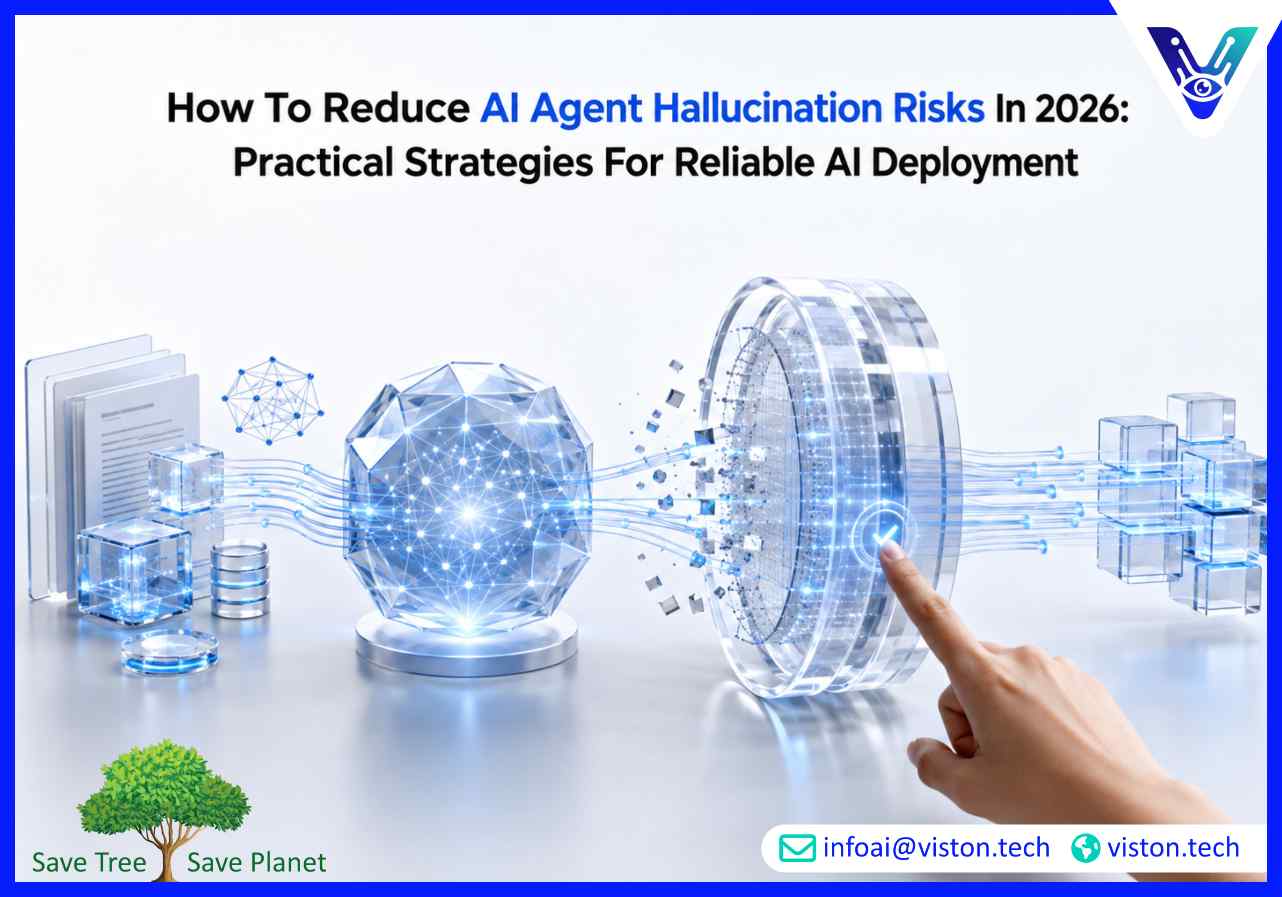
As AI agents become increasingly responsible for business workflows, customer interactions, decision support, and operational automation, hallucinations remain one of the most significant deployment risks. Organizations investing in AI agent development and deployment need practical strategies to improve reliability, reduce incorrect outputs, and build trustworthy systems that can operate safely at scale.
AI hallucinations occur when an AI agent generates information that appears credible but is inaccurate, misleading, incomplete, or entirely fabricated.
Unlike traditional software systems that operate using predefined logic, AI agents rely on large language models and probabilistic reasoning. This flexibility enables sophisticated problem-solving capabilities but also introduces uncertainty when agents encounter ambiguous instructions, incomplete context, outdated information, or complex business scenarios.
In enterprise environments, hallucinations can lead to:
As AI adoption expands across departments, minimizing hallucination risks has become a critical requirement for successful AI agent deployment.
The role of AI agents has evolved significantly. Modern agents are no longer limited to answering questions. Many organizations now use them for:
The more authority an AI agent receives, the greater the potential impact of incorrect outputs.
Businesses in 2026 increasingly expect AI systems to provide:
Reducing hallucinations is therefore not simply a technical challenge—it is a business risk management priority.
Before reducing hallucination risks, organizations must understand why they occur.
AI agents often generate inaccurate responses when they lack sufficient context about a task, process, customer, or business objective.
Without access to relevant information, the model attempts to fill knowledge gaps using probability-based predictions rather than verified facts.
Agents trained on outdated, incomplete, duplicated, or inconsistent information are more likely to produce unreliable outputs.
Data quality remains one of the most important factors influencing AI accuracy.
Unclear instructions can cause agents to make assumptions.
Poorly designed prompts often lead to:
Many AI models possess broad knowledge but lack awareness of company-specific processes, policies, products, or operational requirements.
When enterprise knowledge is unavailable, hallucinations become more likely.
AI agents performing lengthy workflows may accumulate errors throughout the process.
Small inaccuracies introduced early can create larger downstream problems.
Agents operating without verification systems have no way to confirm whether generated information is correct before delivering results.
Organizations can significantly improve AI reliability by implementing multiple safeguards throughout development and deployment.
Retrieval-Augmented Generation has become one of the most effective approaches for reducing hallucinations.
Instead of relying solely on model memory, RAG systems retrieve relevant information from approved knowledge sources before generating responses.
Benefits include:
Organizations commonly connect AI agents to:
This approach helps agents ground responses in verified business information.
AI agents are only as reliable as the information they access.
Businesses should establish structured processes for:
Well-maintained knowledge repositories provide a stronger foundation for trustworthy AI performance.
Clear system instructions help guide agent behavior.
Effective guardrails can:
Organizations should establish consistent prompt frameworks aligned with business objectives and risk tolerance.
When possible, AI agents should reference the sources used to generate responses.
Source attribution helps:
Users can verify information rather than relying solely on model-generated content.
Not every AI-generated decision should be fully automated.
For higher-risk workflows, organizations should implement human review checkpoints.
Human oversight is particularly important for:
Human-in-the-loop models allow businesses to benefit from automation while maintaining quality control.
General-purpose AI agents often struggle with industry-specific terminology, processes, and regulations.
Specialized agents trained or configured for specific business functions typically deliver more reliable outcomes.
Examples include:
Domain specialization reduces ambiguity and improves response quality.
AI agent deployment should not end after launch.
Ongoing monitoring helps identify:
Key metrics may include:
Measure how frequently outputs align with verified information.
Evaluate whether agents successfully complete intended workflows.
Monitor user satisfaction and reported issues.
Track how often human intervention becomes necessary.
Assess whether agents consistently reference approved knowledge resources.
Continuous evaluation supports long-term reliability improvements.
Modern enterprise AI deployments increasingly incorporate validation layers before outputs reach end users.
These systems may include:
Validation layers help detect inaccuracies before they impact business operations.
Persistent memory enables AI agents to maintain context across interactions.
However, poorly managed memory can introduce errors and outdated information.
Best practices include:
Effective memory management improves both accuracy and security.
AI governance has become increasingly important as organizations scale AI adoption.
Governance frameworks should address:
Agents should only access information necessary for their assigned tasks.
Organizations should maintain records of agent actions and outputs.
Businesses must ensure AI systems align with applicable regulations and internal policies.
AI models should undergo controlled testing before production deployment.
Governance practices help reduce both hallucination risks and operational exposure.
Reducing hallucination risks requires more than selecting a capable language model. Successful implementation depends on architecture design, knowledge integration, governance controls, testing methodologies, monitoring frameworks, and ongoing optimization.
As a specialist in AI agent development and deployment, Viston AI helps organizations build AI systems that prioritize reliability, business alignment, and operational performance. Rather than deploying generic AI solutions, the focus is on creating agents that operate within defined business rules, leverage approved data sources, and support measurable business objectives.
A structured deployment approach typically includes knowledge-base integration, workflow orchestration, retrieval-augmented generation frameworks, validation mechanisms, prompt engineering, and performance monitoring. These components work together to reduce hallucination risks while improving consistency and usability.
Organizations implementing AI agents often face challenges related to data quality, scalability, governance, and adoption. Through carefully designed deployment strategies, businesses can create AI systems that support operational efficiency while maintaining appropriate levels of accuracy and oversight.
As AI agents become increasingly embedded within business operations, a disciplined development and deployment methodology remains essential for long-term success. Reliable AI requires continuous improvement, monitoring, and alignment with evolving business requirements rather than a one-time implementation effort.
Organizations seeking long-term AI success should adopt several foundational practices.
Avoid deploying agents without specific business objectives.
Clearly defined use cases improve development focus and evaluation criteria.
Reliable outputs depend on reliable information.
Data governance should be established before deployment.
Pilot programs allow businesses to identify issues before large-scale implementation.
Critical workflows should include review and approval processes where appropriate.
AI systems require ongoing improvement as business needs evolve.
AI agents typically hallucinate due to insufficient context, poor-quality data, weak prompts, lack of verification mechanisms, or attempts to answer questions beyond their available knowledge.
No. While hallucinations can be significantly reduced through proper development and deployment practices, no AI system can currently guarantee perfect accuracy in every situation.
Yes. RAG helps AI agents access verified information from trusted knowledge sources, reducing reliance on model assumptions and improving factual accuracy.
Monitoring helps identify emerging accuracy issues, workflow failures, performance degradation, and user concerns, enabling organizations to continuously improve agent reliability.
Organizations commonly measure response accuracy, task completion success, escalation rates, user feedback, compliance adherence, and validation performance.
Viston AI supports AI agent development and deployment through structured implementation approaches that incorporate knowledge integration, validation systems, governance controls, monitoring frameworks, and optimization practices designed to improve reliability and business outcomes.
Understanding how to reduce AI agent hallucination risks is essential for organizations investing in AI-driven automation and decision support. Reliable AI agents require more than powerful models—they depend on quality data, effective knowledge retrieval, governance controls, validation mechanisms, and continuous monitoring. Businesses that prioritize these foundations are better positioned to achieve accurate, scalable, and trustworthy AI outcomes. Through specialized AI agent development and deployment practices, Viston AI helps organizations build AI systems that support operational goals while minimizing risks associated with inaccurate or unsupported outputs.
