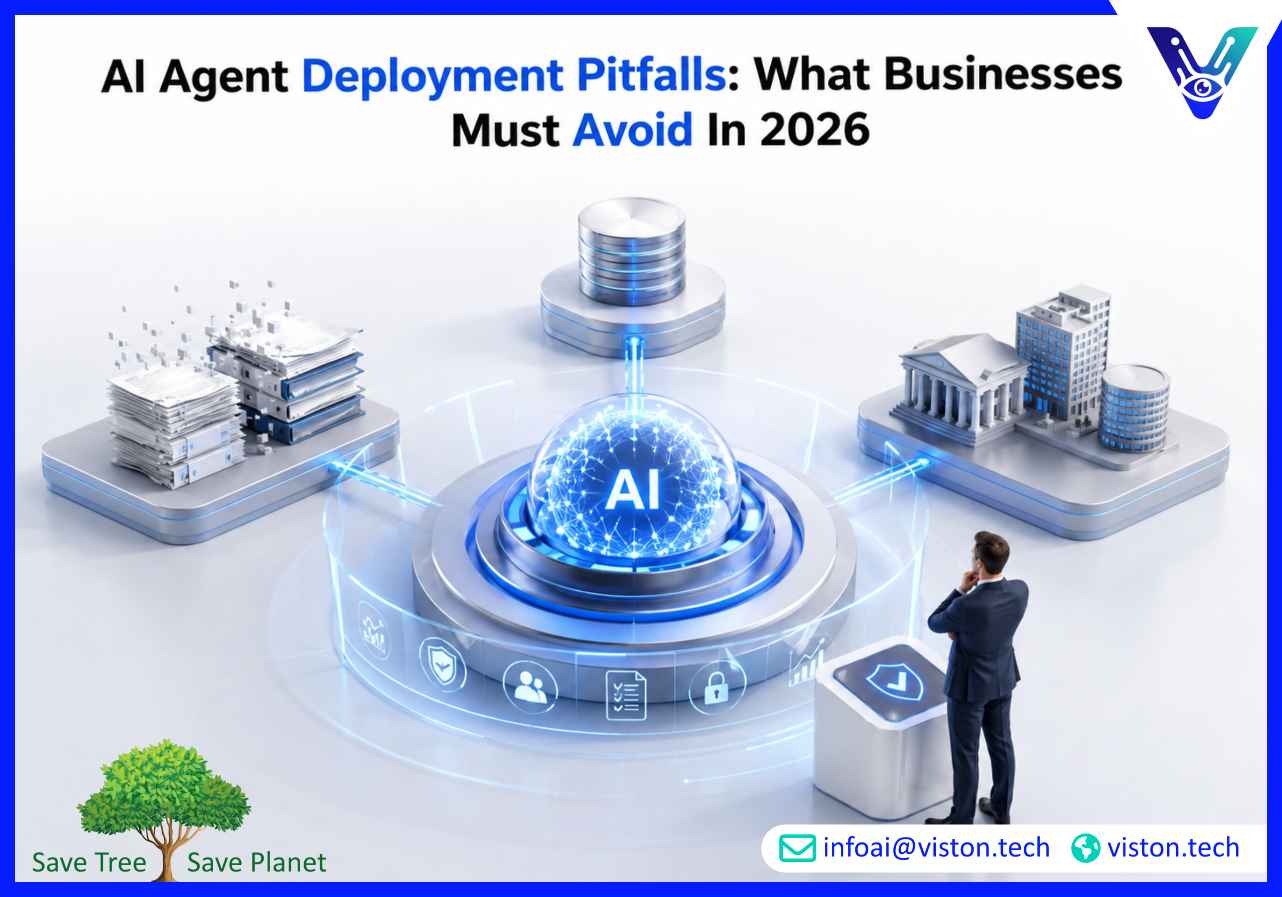
AI Agent Deployment Pitfalls: What Businesses Must Avoid in 2026
Introduction
AI agents are rapidly transforming how businesses automate workflows, improve decision-making, and enhance operational efficiency. However, deploying AI agents successfully requires more than selecting the right model. Many organizations encounter deployment challenges that affect performance, reliability, security, and business outcomes. Understanding common AI agent deployment pitfalls is essential for achieving long-term success in 2026.
Understanding AI Agent Deployment
AI agent deployment refers to the process of integrating autonomous or semi-autonomous AI systems into business environments where they can perform tasks, interact with systems, process information, and support decision-making.Modern AI agents often interact with multiple data sources, APIs, enterprise applications, knowledge bases, and human users. As deployment complexity increases, so do the risks associated with implementation.Organizations frequently focus on model capabilities while overlooking operational, governance, security, and scalability requirements that determine real-world success.
Why AI Agent Deployment Challenges Matter in 2026
Businesses are increasingly moving beyond experimentation and deploying AI agents into production environments. These systems are now responsible for handling customer interactions, workflow automation, research assistance, internal support, and business operations.A deployment failure can result in:
Operational disruptions
Inaccurate outputs
Compliance issues
Security vulnerabilities
Poor user adoption
Increased operational costs
Reduced trust in AI initiatives
Avoiding deployment mistakes helps organizations maximize return on investment while maintaining reliability and governance standards.
Common AI Agent Deployment Pitfalls
Deploying Without Clear Business Objectives
One of the most frequent mistakes is implementing AI agents without defining measurable business goals.Organizations often deploy AI because of market pressure or technology trends rather than identifying specific operational challenges that AI can solve.Successful deployments begin with questions such as:
What business process will be improved?
Which metrics will define success?
What level of automation is appropriate?
How will human oversight be maintained?
Without clear objectives, even technically successful deployments may fail to deliver meaningful business value.
Poor Data Quality and Knowledge Management
AI agents are only as effective as the information they can access.Common issues include:
Outdated documentation
Incomplete knowledge bases
Duplicate records
Inconsistent data formats
Missing governance policies
When agents rely on poor-quality information, they can generate inaccurate recommendations, inconsistent responses, or unreliable outputs.Businesses should establish data governance frameworks before deployment and continuously maintain knowledge sources used by AI systems.
Ignoring Hallucination Risks
AI hallucinations remain a significant challenge in enterprise environments.Even advanced models can occasionally generate:
Incorrect information
Unsupported conclusions
Fabricated references
Misinterpreted business data
Organizations that deploy AI agents without validation mechanisms risk exposing users to inaccurate outputs.Effective mitigation strategies include:
Retrieval-Augmented Generation (RAG)
Knowledge-grounded responses
Confidence scoring
Human approval workflows
Output validation systems
Continuous monitoring
Reducing hallucination risk should be considered a core deployment requirement rather than a post-launch improvement.
Weak Integration Planning
Many AI projects fail because organizations underestimate integration complexity.AI agents often need access to:
CRM platforms
ERP systems
Ticketing software
Internal databases
Document repositories
Collaboration tools
Poorly planned integrations can create data silos, workflow interruptions, and inconsistent user experiences.Deployment teams should assess integration requirements early and ensure agents can securely access relevant systems without disrupting operations.
Insufficient Security Controls
As AI agents gain access to sensitive information and business systems, security becomes a critical deployment consideration.Common security oversights include:
Excessive permissions
Weak authentication controls
Unsecured API connections
Inadequate access monitoring
Poor data encryption practices
Organizations should apply least-privilege access principles and conduct regular security assessments throughout the deployment lifecycle.
Lack of Governance and Accountability
AI agents can influence decisions, automate actions, and interact with customers. Without governance structures, businesses may struggle to manage risk and maintain accountability.Important governance considerations include:
Role-based access controls
Audit logging
Decision transparency
Escalation procedures
Compliance monitoring
Human oversight requirements
Strong governance frameworks help organizations maintain trust while ensuring responsible AI usage.
Scalability Challenges Businesses Often Overlook
Underestimating Infrastructure Requirements
A pilot deployment may perform well with a limited user base, but production environments introduce significantly greater demands.Organizations frequently underestimate:
Processing requirements
Concurrent user volumes
API usage costs
Storage requirements
Response time expectations
Scalable architecture planning should be incorporated from the beginning rather than added later.
Failing to Monitor Agent Performance
Many businesses launch AI agents and assume they will continue performing effectively without ongoing oversight.In reality, AI systems require continuous monitoring to evaluate:
Accuracy rates
Response quality
User satisfaction
Error frequency
System availability
Cost efficiency
Observability has become a critical component of AI agent deployment in 2026.
User Adoption Pitfalls
Ignoring Employee Training
Even well-designed AI agents can fail if users do not understand how to interact with them effectively.Organizations should provide:
User onboarding programs
Clear usage guidelines
Escalation processes
AI literacy training
Feedback mechanisms
Successful adoption requires both technical implementation and organizational readiness.
Over-Automating Critical Processes
Not every business process should be fully autonomous.Organizations sometimes attempt to eliminate human involvement entirely, creating unnecessary risks in areas such as:
Financial approvals
Legal reviews
Compliance decisions
Customer dispute resolution
Strategic planning
A balanced human-in-the-loop approach often produces better outcomes while reducing operational risk.
Compliance and Regulatory Challenges
As AI adoption expands globally, regulatory expectations continue to evolve.Businesses deploying AI agents must evaluate:
Data privacy requirements
Industry-specific regulations
Data retention policies
Auditability standards
Consent management requirements
Cross-border data considerations
Compliance should be integrated into deployment planning rather than treated as a separate initiative.Organizations operating across multiple jurisdictions may face additional governance obligations that influence architecture and deployment decisions.
Best Practices for Successful AI Agent Deployment
Start with Controlled Use Cases
Begin with clearly defined processes where success metrics are measurable and business impact is visible.Suitable starting points often include:
Internal knowledge assistance
IT support automation
Customer service augmentation
Document retrieval
Workflow orchestration
This approach allows teams to build expertise while minimizing risk.
Build Monitoring Into the Architecture
Monitoring should be embedded throughout the deployment lifecycle.Key metrics include:
Accuracy
Latency
Reliability
User engagement
Cost per interaction
Escalation rates
Continuous measurement enables proactive optimization and faster issue resolution.
Maintain Human Oversight
Human review remains essential for high-impact decisions.Organizations should establish clear escalation pathways and define situations where human intervention is required.Combining automation with expert oversight often delivers the best balance between efficiency and reliability.
How Viston AI Supports Successful AI Agent Deployment
Organizations looking to avoid AI agent deployment pitfalls often benefit from working with specialists experienced in both AI implementation and operational integration.Viston AI provides AI Agent Development & Deployment services designed to help businesses move from experimentation to production-ready AI solutions. This includes planning agent architecture, integrating enterprise systems, implementing governance controls, establishing monitoring frameworks, and creating scalable deployment strategies.Successful AI deployment requires more than model selection. It involves understanding workflows, security requirements, compliance expectations, data quality standards, and long-term operational management. By aligning AI agents with business objectives and deployment best practices, organizations can reduce implementation risks while improving adoption and measurable business outcomes.For businesses pursuing automation initiatives, a structured deployment approach helps ensure AI agents remain reliable, secure, and effective as organizational needs evolve.
Frequently Asked Questions
What is the biggest AI agent deployment pitfall?
The most common pitfall is deploying AI agents without clear business objectives and measurable success criteria. Without defined goals, organizations often struggle to demonstrate value or optimize performance.
How can businesses reduce AI hallucination risks during deployment?
Organizations can reduce hallucinations through retrieval-based architectures, trusted knowledge sources, validation workflows, human review processes, and continuous performance monitoring.
Why is monitoring important after AI agent deployment?
Monitoring helps identify accuracy issues, system failures, user experience problems, security concerns, and performance degradation before they significantly impact business operations.
Should AI agents fully replace human employees?
In most cases, AI agents are most effective when augmenting human teams rather than completely replacing them. Human oversight remains important for complex, sensitive, or high-risk decisions.
What security measures are important for AI agents?
Key measures include access controls, authentication protocols, encryption, audit logging, permission management, API security, and continuous security monitoring.
How can Viston AI help with AI agent deployment?
Viston AI supports organizations through AI Agent Development & Deployment services that focus on architecture design, integration planning, governance, monitoring, scalability, and long-term operational success.
Conclusion
Understanding AI agent deployment pitfalls is essential for organizations seeking successful AI adoption in 2026. Challenges such as poor data quality, weak governance, inadequate security, integration complexity, and insufficient monitoring can undermine otherwise promising initiatives. A structured AI Agent Development & Deployment strategy helps businesses address these risks while improving scalability, reliability, and user adoption. For organizations looking to deploy AI agents effectively, Viston AI provides specialized expertise that supports practical, secure, and business-focused implementation outcomes.