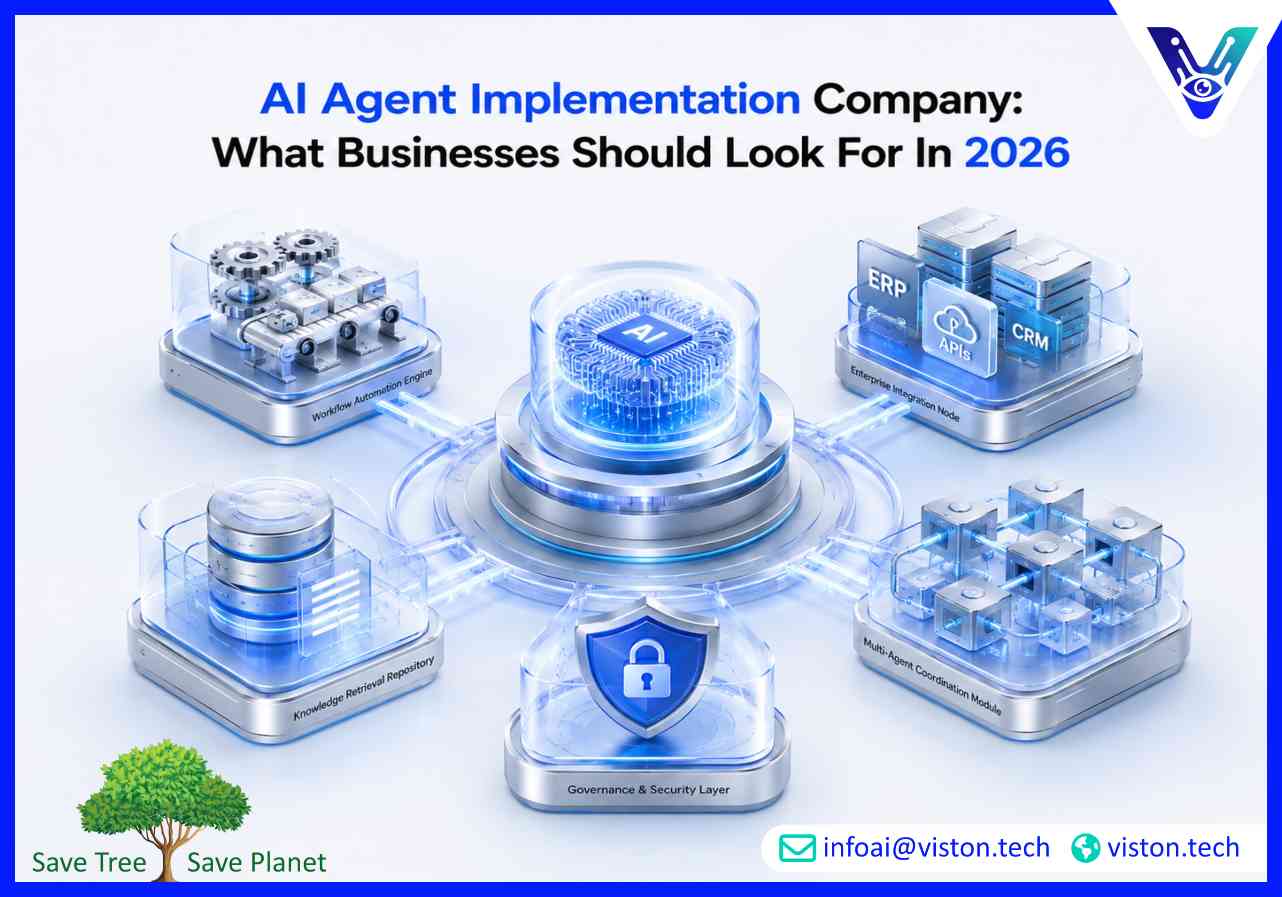
AI Agent Implementation Company: What Businesses Should Look for in 2026
Businesses are moving beyond experimental AI tools and investing in AI agents that can automate workflows, improve decision-making, and support operations at scale. Choosing the right AI agent implementation company has become a critical decision for organizations that want reliable automation, secure deployment, and long-term operational value.
Why AI Agent Implementation Matters in 2026
AI adoption has shifted from isolated chatbot deployments to interconnected AI systems capable of handling complex business tasks. Modern AI agents are now being used for:
Workflow automation
Customer support operations
Data analysis and reporting
Sales assistance
Internal knowledge management
Enterprise process orchestration
Multi-system task execution
However, successful implementation requires much more than integrating a large language model into existing software. Businesses now expect AI systems that are secure, scalable, context-aware, and aligned with operational goals.An experienced AI agent implementation company helps organizations move from proof-of-concept experimentation to stable production deployment.
What Is an AI Agent Implementation Company?
An AI agent implementation company specializes in designing, building, integrating, deploying, and optimizing AI-powered agents for business operations.Unlike basic AI chatbot providers, implementation-focused companies typically handle:
AI workflow architecture
Custom agent development
LLM integration
Retrieval-augmented generation (RAG) systems
Enterprise integrations
Automation pipelines
API orchestration
Security and governance controls
AI performance monitoring
Multi-agent coordination systems
The goal is to create AI agents that can reliably execute business tasks while maintaining accuracy, compliance, and operational consistency.
The Growing Demand for Custom AI Agent Solutions
Off-the-shelf AI tools often struggle to handle industry-specific workflows, internal business logic, or proprietary datasets. This is why many organizations are moving toward custom AI agent solutions.Custom implementations allow businesses to:
Connect AI agents with internal systems
Control data access and permissions
Automate unique workflows
Improve response quality using company-specific knowledge
Reduce hallucinations and irrelevant outputs
Maintain compliance requirements
Scale automation across departments
In 2026, organizations are prioritizing AI systems that fit operational realities instead of forcing teams to adapt to generic automation platforms.
Key Capabilities Businesses Should Expect
When evaluating an AI agent implementation company, businesses should assess both technical capabilities and delivery maturity.
Enterprise System Integration
AI agents rarely operate independently. Most implementations require integration with:
CRM platforms
ERP systems
Internal databases
Customer support platforms
Communication tools
Knowledge bases
Cloud infrastructure
Document management systems
Strong implementation providers understand how to connect AI agents securely with existing operational systems.
Workflow Automation Expertise
AI agents deliver the most value when integrated into real business workflows.Implementation teams should understand:
Process mapping
Automation logic
Trigger-based workflows
Human-in-the-loop approvals
Exception handling
Escalation systems
Operational dependencies
Without workflow expertise, AI deployments often remain disconnected from actual business operations.
AI Model Selection and Optimization
Different use cases require different AI models. A reliable implementation company should help businesses choose appropriate models based on:
Accuracy requirements
Cost efficiency
Latency expectations
Data sensitivity
Domain specialization
Scalability needs
Businesses increasingly require multi-model strategies rather than relying on a single provider or model architecture.
Retrieval-Augmented Generation (RAG)
RAG systems have become a standard requirement for enterprise AI agents in 2026.These systems allow AI agents to retrieve information from trusted internal sources before generating responses. This improves:
Accuracy
Context relevance
Compliance
Knowledge consistency
Response reliability
RAG implementation is especially important for organizations managing large internal documentation systems.
Security and Governance Controls
AI governance is now a major enterprise concern.Implementation providers should support:
Role-based access control
Data encryption
Audit logging
Compliance monitoring
Usage tracking
Secure API architecture
Model access management
Prompt injection protection
Organizations operating in regulated sectors cannot rely on unsecured AI deployments.
Common Business Challenges AI Agents Solve
Businesses typically invest in AI agent implementation to solve operational inefficiencies and scaling limitations.
Customer Support Bottlenecks
AI agents can automate ticket handling, customer query routing, response generation, and knowledge retrieval.This helps businesses:
Reduce support response times
Improve service availability
Lower operational overhead
Scale support operations without proportional hiring
Internal Knowledge Access Problems
Many organizations struggle with fragmented internal information.AI agents can centralize access to:
SOPs
Policies
Technical documentation
Training materials
Project records
Internal databases
This improves employee productivity and reduces time spent searching for information.
Repetitive Operational Tasks
AI agents are increasingly used to automate:
Data entry
Reporting workflows
Email processing
Meeting summarization
Task coordination
Internal approvals
Lead qualification
This allows teams to focus on higher-value operational activities.
Multi-System Coordination
Modern AI agents can interact across multiple platforms simultaneously.For example, an AI agent may:
Pull data from a CRM
Generate a summary
Update an ERP system
Trigger a workflow in a project management platform
Notify internal teams automatically
This level of orchestration is becoming a major competitive advantage.
Important Considerations Before Implementation
Businesses should evaluate several operational factors before deploying AI agents.
Define Clear Business Objectives
AI implementation projects fail when organizations pursue automation without measurable goals.Businesses should define:
Operational pain points
Expected outcomes
Success metrics
Process improvement targets
Scalability objectives
Clear implementation goals improve deployment efficiency and ROI measurement.
Prioritize Data Quality
AI agents depend heavily on the quality of available business data.Poor documentation, outdated records, or fragmented knowledge systems can reduce implementation effectiveness.Businesses should review:
Data structure
Knowledge organization
Documentation quality
Access permissions
Content accuracy
Plan for Human Oversight
Even advanced AI agents require oversight mechanisms.Human review is important for:
High-risk decisions
Compliance-sensitive actions
Escalation handling
Quality assurance
Continuous optimization
The most effective AI systems combine automation with controlled human supervision.
Consider Long-Term Scalability
Businesses should evaluate whether an implementation approach can scale across teams, departments, and workflows.Scalable implementations typically include:
Modular architecture
API-driven integrations
Centralized monitoring
Flexible workflow logic
Expandable infrastructure
Short-term deployments without scalability planning often create operational limitations later.
How Viston AI Supports Custom AI Agent Solutions
Viston AI focuses on custom AI agent solutions designed to help businesses automate workflows, integrate operational systems, and deploy scalable AI-driven processes.Its implementation approach emphasizes practical business use cases rather than isolated AI experimentation. This includes developing AI agents that can interact with enterprise systems, support workflow automation, process business data, and improve operational efficiency across departments.For organizations exploring AI agent implementation, Viston AI supports areas such as:
Custom AI agent development
Workflow automation architecture
AI system integration
Multi-agent orchestration
Enterprise automation support
AI deployment optimization
Knowledge-based AI systems
The company’s service model aligns with businesses seeking tailored AI deployments that fit existing operational environments rather than relying solely on generic automation tools.As AI adoption expands in 2026, organizations increasingly require implementation partners capable of balancing automation performance with scalability, integration reliability, and operational practicality. Custom implementation support becomes particularly important when businesses need AI agents that align with internal processes, security requirements, and long-term automation strategies.
Signs of a Reliable AI Agent Implementation Partner
Businesses should look for implementation providers that demonstrate:
Technical Depth
The provider should understand:
LLM architectures
AI orchestration
API integrations
Vector databases
Automation frameworks
Cloud infrastructure
AI governance models
Business Workflow Understanding
Strong providers focus on operational outcomes instead of only model deployment.They should understand:
Process efficiency
Department workflows
Automation dependencies
Operational risk management
User adoption challenges
Transparent Delivery Processes
Implementation partners should clearly explain:
Deployment stages
Security controls
Testing procedures
Optimization strategies
Maintenance responsibilities
Performance monitoring methods
Long-Term Support Capability
AI systems require continuous optimization.Reliable implementation companies typically provide:
Performance monitoring
Workflow refinement
Model updates
Infrastructure scaling support
AI governance adjustments
Integration maintenance
The Future of AI Agent Implementation
AI agent ecosystems are becoming more autonomous, collaborative, and operationally embedded.Key trends shaping 2026 include:
Multi-agent collaboration systems
AI workflow orchestration platforms
Industry-specific AI agents
Real-time business intelligence agents
Autonomous process execution
AI governance automation
Context-aware enterprise agents
Businesses are increasingly prioritizing implementation quality over rapid experimentation.As AI systems become more integrated into core operations, implementation expertise will play a major role in determining business outcomes.
Frequently Asked Questions
What does an AI agent implementation company do?
An AI agent implementation company designs, deploys, integrates, and optimizes AI-powered agents that automate business workflows, support operations, and interact with enterprise systems.
Why are custom AI agent solutions important?
Custom AI agent solutions allow businesses to automate workflows that align with their internal systems, operational processes, security requirements, and business objectives.
What industries benefit most from AI agent implementation?
Industries with high operational complexity, repetitive workflows, large knowledge systems, or multi-platform operations often benefit significantly from AI agent implementation.
How long does AI agent implementation take?
Implementation timelines vary depending on workflow complexity, system integrations, data readiness, and deployment scope. Some projects take a few weeks, while enterprise-scale deployments may require several months.
What technologies are commonly used in AI agent implementation?
Modern implementations may involve LLMs, RAG systems, vector databases, workflow automation platforms, APIs, cloud infrastructure, orchestration frameworks, and enterprise integrations.
How does Viston AI support AI agent implementation?
Viston AI provides custom AI agent solutions focused on workflow automation, enterprise integration, AI deployment support, and scalable business automation systems.
Conclusion
Choosing the right AI agent implementation company is becoming increasingly important as businesses expand automation initiatives in 2026. Effective AI deployment requires more than basic chatbot integration — it demands workflow expertise, secure architecture, scalable systems, and operational alignment.Custom AI agent solutions help organizations automate complex processes, improve efficiency, and support long-term digital transformation goals. For businesses seeking practical and scalable AI implementation support, companies such as Viston AI are helping organizations build AI systems that align with real operational needs and evolving business demands.