
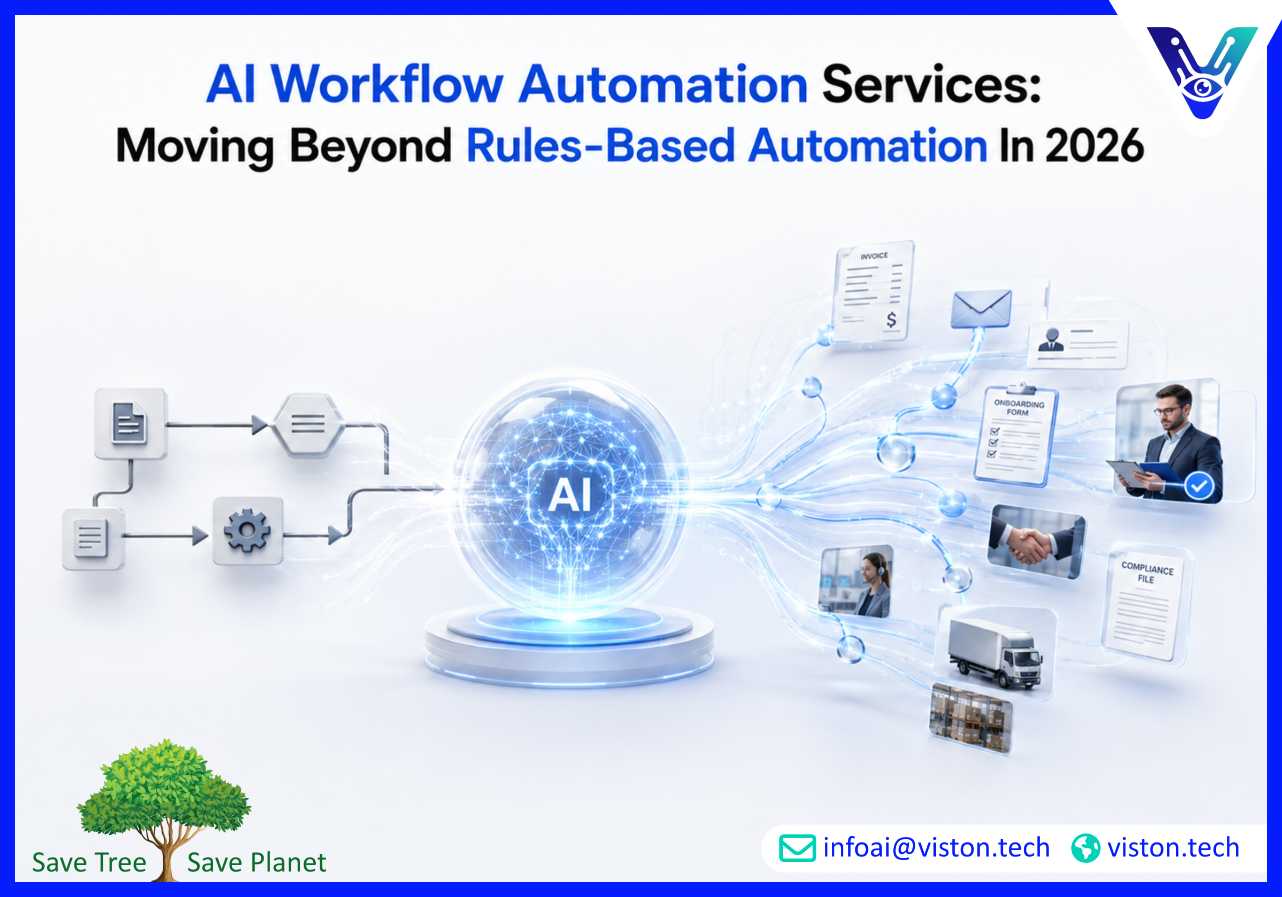
Businesses have automated simple, rules-based tasks for years. But what happens when a process involves unstructured data, ambiguous inputs, or decisions that require real judgment? That is where traditional automation falls short—and where AI workflow automation services enter the picture.
Traditional automation—think basic if-then rules or simple trigger-action sequences—works well for predictable, structured tasks. File uploads to a designated folder. Auto-responses to specific keywords. Data copying between two cleanly formatted spreadsheets.
Real business operations are rarely that tidy.
AI workflow automation incorporates large language models and intelligent agents that can interpret context, handle variance, and make reasoned decisions. Instead of breaking when an email arrives with unexpected phrasing or missing information, an AI-driven workflow can assess what is present, infer what is missing, and determine the appropriate next step.
This distinction matters because most business processes begin with messy inputs: emails, PDFs, scanned documents, free-form text fields, or customer messages written in natural language. Rules-based systems struggle here. AI-native workflows are built for exactly this environment.
Operational inefficiency rarely comes from a single, obvious bottleneck. It accumulates across dozens of small, repetitive tasks that individually seem insignificant but collectively consume hours of skilled employee time each week.
Consider common scenarios across business functions:
AI workflow automation services address these patterns by building systems that read, interpret, and act across connected tools—with human oversight reserved for decisions that genuinely require judgment.
Not every process benefits equally from AI-driven automation. The strongest candidates share specific characteristics.
Real-world deployments show significant operational leverage. Deel, a global payroll and compliance platform, reported automating more than 100,000 cases per month across finance, tax, treasury, benefits, and HR using AI workflow automation.
The value of workflow automation depends almost entirely on how well it connects to existing systems. CRMs, ERPs, communication platforms, document repositories, and industry-specific tools must all be part of the automated flow.
Fully autonomous AI that never requires human review sounds appealing but is rarely appropriate for business operations. The right model combines AI execution for routine, low-risk actions with human oversight for exceptions, approvals, and sensitive decisions.
As workflows become more autonomous, governance requirements increase. Organizations need visibility into what automated decisions are being made, why, and whether they comply with internal policies and external regulations.
The cost calculation for AI workflow automation differs from traditional software licensing. Beyond platform fees, organizations must account for implementation, integration, training, ongoing monitoring, and iterative refinement.
Finance and banking lead in AI workflow automation adoption, driven by document processing, compliance monitoring, and customer onboarding requirements.
Healthcare organizations apply similar capabilities to patient administration, prior authorization, medical billing, and claims processing.
Logistics and supply chain operations manage exception-heavy, time-sensitive workflows spanning multiple systems and trading partners.
Human resources departments use workflow automation for recruitment coordination, onboarding, benefits administration, and internal employee requests.
Viston AI builds enterprise AI automation solutions that move beyond simple rules-based logic. The company specializes in AI workflow automation that handles real business complexity—messy data, exception paths, multi-step processes, and the need for human oversight where it matters.
Based in Ahmedabad, India, and serving global clients across finance, healthcare, retail, manufacturing, and logistics, Viston AI combines AI strategy consulting with practical implementation.
What distinguishes Viston AI is its focus on production-ready automation rather than demos that break under real-world conditions. The company emphasizes security, governance, and compliance—recognizing that enterprise buyers need automated systems that are both effective and auditable.
Robotic process automation follows fixed rules to perform repetitive tasks within structured systems. AI workflow automation uses large language models and intelligent agents to interpret unstructured data, handle exceptions, and make context-aware decisions.
Implementation timelines vary based on process complexity, system integration requirements, and organizational readiness. Simple single-system workflows may deploy in four to eight weeks. Complex cross-functional processes involving multiple systems and custom integration work typically require eight to sixteen weeks from discovery to production.
The strongest candidates combine high volume, repetitive tasks, unstructured or variable inputs, and clear decision logic. Invoice processing, customer support ticket routing, document data extraction, employee onboarding coordination, and approval workflows with routine and exception paths all perform well.
No. Mature AI workflow automation platforms integrate with existing systems rather than requiring replacement.
Effective AI workflow automation combines model confidence scoring with human-in-the-loop design. Routine, high-confidence actions are handled automatically, while sensitive or uncertain decisions are escalated for human review.
AI workflow automation services have moved from experimental to essential for organizations seeking operational leverage in 2026. The technology now reliably handles the messy, variable, exception-heavy processes that traditional automation could never touch.
For business decision-makers, the path forward involves identifying high-volume, judgment-light processes that consume disproportionate staff time, then evaluating automation partners based on integration capabilities, security posture, and real-world deployment experience.
Companies like Viston AI represent the next generation of automation specialists—focused not on simple rules engines but on intelligent systems that understand context, connect across tools, and deliver measurable operational impact without compromising governance or control.
The question is no longer whether AI workflow automation will affect your operations. It is how quickly you can deploy it where it matters most.
