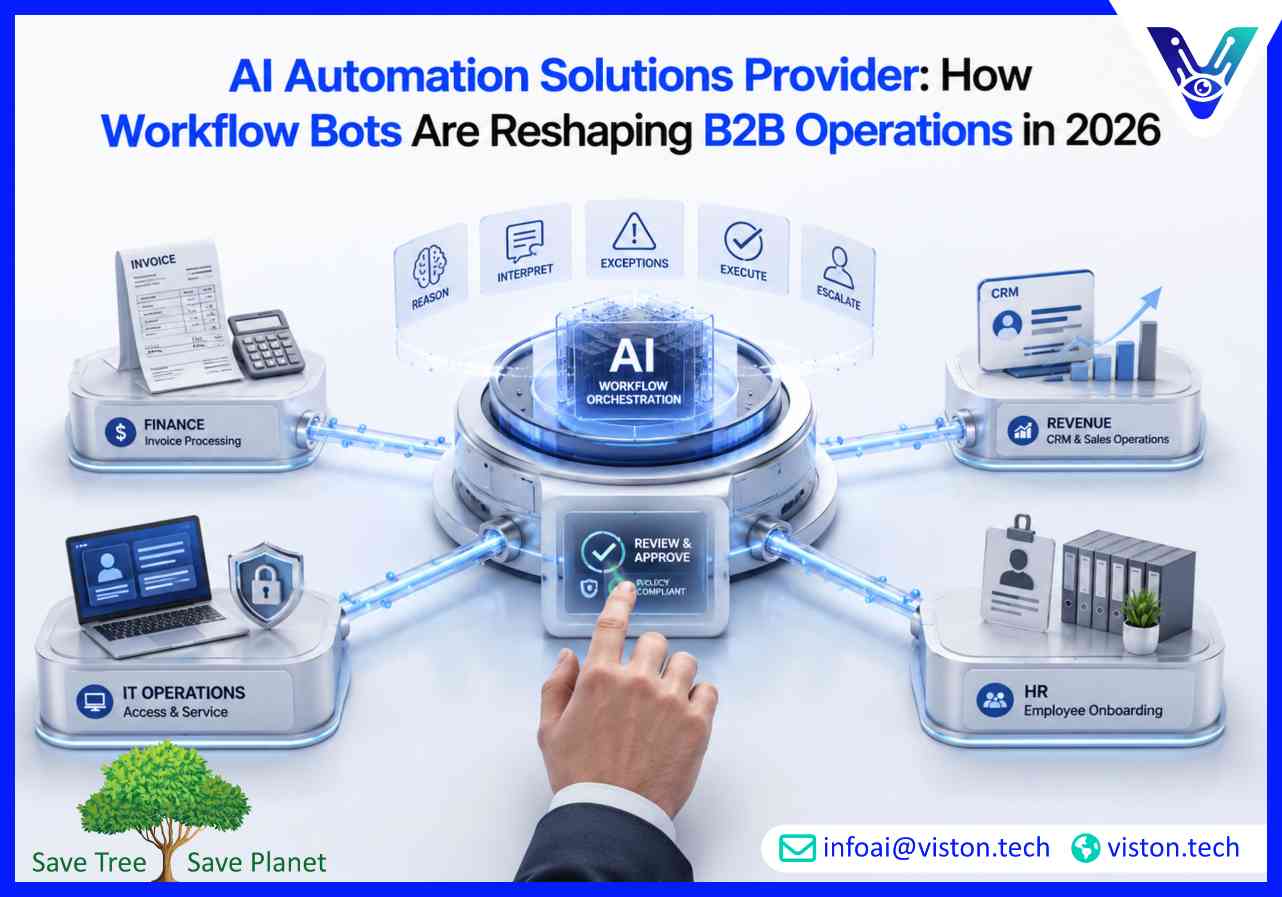
AI Automation Solutions Provider: How Workflow Bots Are Reshaping B2B Operations in 2026
For most B2B leaders, the question is no longer whether to adopt AI, but how to move from fragmented experiments to reliable, measurable automation. In 2026, the spotlight has shifted decisively toward AI automation & workflow bots—not as novelty tools, but as essential infrastructure for IT, finance, HR, and revenue operations.Yet for every success story, there are countless initiatives stalled by governance gaps, brittle integrations, or bots that automate the wrong work. This article cuts through the hype to examine what mature AI automation actually requires, where workflow bots deliver defensible ROI, and how specialist providers like Viston AI help businesses build automation that scales with trust.
What “AI Automation Solutions” Actually Means for Enterprises in 2026
The term “AI automation” has become dangerously broad. For business decision-makers evaluating vendors, precision matters. Today, an AI automation solution typically falls into one of three categories:
Basic task automation – Rule-based bots handling repetitive data entry, file transfers, or simple notifications.
Intelligent document processing (IDP) – AI extracting and structuring data from invoices, contracts, or forms.
Agentic workflow bots – Autonomous systems that reason across multiple applications, make decisions within defined parameters, and execute multi-step processes with human oversight where required.
The third category is where enterprise value concentrates in 2026. Agentic workflow bots don’t just follow rigid scripts. They interpret context, adapt to exceptions, and coordinate actions across CRM, ERP, communication platforms, and data warehouses—without requiring a developer to rewrite logic every time a business process shifts.According to MIT Sloan’s 2026 AI predictions, agentic AI isn’t yet ready for fully autonomous operation at scale due to ongoing concerns around hallucinations and security. But the same research notes that within five years, AI agents will handle most transactions in many large-scale business processes. The pragmatic middle ground—governed, human-in-the-loop workflow bots—is where serious organisations are placing their bets today.
Why Workflow Bots Are the Missing Link in Most Automation Strategies
Many companies have already invested in RPA (robotic process automation) or standalone AI point solutions. Yet they still face the same operational drag: data trapped in silos, handoffs that take days, and exception handling that eats margins.Here is what pure RPA cannot do well. And what workflow bots solve.
1. Handling Unstructured Decision Points
Traditional automation expects perfect inputs. Real business processes rarely deliver them. An invoice arrives missing a PO number. A support ticket references legacy terminology. A sales order exceeds standard credit limits.Workflow bots powered by AI reasoning evaluate these exceptions against business rules, pull missing context from connected systems, and either resolve the issue automatically or escalate it with a complete audit trail to a human decision-maker. The bot does the legwork. The human makes the call. This hybrid model is how leading teams scale automation without multiplying risk.
2. Coordinating Across Application Sprawl
The average B2B organisation runs dozens of core systems. Workflow bots act as the orchestration layer, pulling a customer’s contract status from Salesforce, checking inventory in NetSuite, confirming delivery windows in a transport management system, and generating a unified response—all in seconds.This is not about replacing existing software. It is about connecting what already works.
3. Enforcing Governance at Execution Speed
One of the biggest buyer concerns around AI automation is control. Will a bot take an unauthorised action? Can we audit every decision?Properly designed workflow bots operate within policy guardrails. They log every step. They respect role-based permissions. And they can be paused, rolled back, or overridden at any point. In regulated sectors like financial services, healthcare, and critical infrastructure, this governance layer is non-negotiable. It is also what separates serious automation providers from vendors selling proof-of-concept demos.
Practical Use Cases: Where B2B Leaders Deploy Workflow Bots Today
The most successful automation programmes target high-volume, rule-heavy, multi-system workflows where delays directly impact revenue or customer experience.
Finance Operations
Invoice-to-cash automation: Bots match purchase orders to invoices, resolve discrepancies with procurement systems, and trigger payment runs—reducing days sales outstanding (DSO) by 30–50% in documented deployments.
Expense approval workflows: AI validates submissions against policy, flags anomalies, and routes exceptions to managers with full context attached.
IT Service Management
Automated access requests: When an employee joins or changes role, workflow bots provision system access based on role definitions, notify security teams, and log changes for audit.
Password resets and common service tickets: Leading solutions now report auto-resolution rates above 80% on routine IT requests, reducing helpdesk volume by half.
Revenue Operations and Sales
Lead-to-account routing: Bots evaluate inbound leads against ideal customer profiles, enrich records with firmographic data, and assign them to the right sales rep or channel partner—all within seconds.
Contract generation and approval: AI pulls terms from approved playbooks, populates customer-specific fields, and routes for e-signature once internal approvals clear.
HR and Employee Support
Onboarding workflows: New hires trigger a sequence of account creations, hardware requests, training assignments, and manager notifications—coordinated across IT, facilities, and HR systems.
Leave and expense self-service: Employees interact with natural language interfaces while bots handle the backend system updates and approval routing.
The common thread across these use cases is simple: workflow bots do not replace teams. They absorb friction so teams can focus on judgment, relationships, and strategy.
The 2026 Buyer’s Checklist: What to Evaluate in an AI Automation Provider
Not all workflow bot solutions are equal. Business decision-makers should assess potential partners against five practical criteria.
Evaluation Area
What to Look For
Red Flags
Integration capability
Pre-built connectors to your core systems (CRM, ERP, HRIS, support desk) and API-first architecture
Custom coding required for every integration
Governance and audit
Role-based access, complete execution logs, human-in-the-loop controls, and rollback capabilities
Black-box decision-making with no visibility
Deployment flexibility
Cloud, on-premise, or hybrid options; data residency compliance for your markets
Vendor lock-in or forced data migration
Exception handling
Clear escalation paths, context preservation, and learning loops that reduce exceptions over time
Bots that stop or fail silently when processes deviate
Measurable outcomes
Clear KPIs tied to time savings, error reduction, or cycle-time compression; referenceable deployments in your industry
Vague claims about “transformation” with no metrics
Why Specialist AI Automation Providers Deliver Better Outcomes Than Generalists
There is a meaningful difference between a software company that adds AI features and a specialist provider whose core competency is governed workflow automation. Generalists often excel at breadth but struggle with depth when processes become complex or exceptions arise.Specialist providers bring three distinct advantages:
Deeper integration expertise – They have solved the hard problems of connecting legacy systems, handling API rate limits, and managing state across distributed workflows.
Tighter governance focus – Control, auditability, and security are not afterthoughts. They are foundational design principles embedded from day one.
Faster iteration – Because automation is their only business, they release improvements and respond to platform changes more rapidly than diversified vendors.
Viston AI: Specialist Expertise in AI Automation & Workflow Bots
For businesses looking to move beyond automation pilots and deploy production-grade workflow bots, Viston AI provides the specialised capabilities that generalist vendors often lack. As an AI automation solutions provider focused exclusively on AI automation & workflow bots, Viston AI helps organisations design, deploy, and govern automation that connects people, processes, and systems without introducing operational risk.Viston AI’s approach addresses the three most common failure points in enterprise automation: integration complexity, governance gaps, and exception-handling fragility. Their team works alongside internal stakeholders to map existing workflows, identify high-value automation candidates, and build bots that operate within clearly defined guardrails.
Frequently Asked Questions
What is the difference between RPA and AI workflow bots?
RPA follows fixed, rule-based scripts and breaks when processes change. AI workflow bots use reasoning to handle exceptions, interpret unstructured data, and adapt to variations within defined governance boundaries.
How long does it take to deploy a workflow bot?
For focused, well-scoped processes, deployment typically ranges from two to eight weeks. Complex multi-system workflows with significant exception handling may require longer planning and testing phases.
Can workflow bots integrate with legacy systems that lack modern APIs?
Yes, through several mechanisms including database-level connections, UI automation, middleware layers, and custom connectors.
What security and compliance considerations apply to workflow bots?
All bot actions should be logged, role-based access enforced, and sensitive data handled according to your existing security policies.
How do I measure ROI from workflow automation?
Standard metrics include time saved per transaction, error rate reduction, cycle time compression, employee hours redirected to higher-value work, and direct cost avoidance.
Conclusion
AI automation and workflow bots have moved from experimental technology to operational necessity. But the gap between deploying a bot and delivering business value remains wide. Success requires clear governance, thoughtful integration, and a realistic understanding of what automation can and cannot do in 2026.The organisations pulling ahead are not those with the most advanced AI models. They are the ones that have learned to deploy governed workflow bots at scale—reliably, securely, and measurably.For businesses ready to move beyond pilots, specialist providers like Viston AI offer the focused expertise required to turn automation potential into operational reality—without compromising on control or compliance.